Credits and licences
- #1 — vueltaalhuerto illustration
- #2 — vueltaalhuerto illustration
- #3 — vueltaalhuerto illustration
- #4 — vueltaalhuerto illustration
- #5 — vueltaalhuerto illustration
- #6 — vueltaalhuerto illustration
- #7 — vueltaalhuerto illustration
- #8 — vueltaalhuerto illustration
- #9 — vueltaalhuerto illustration
- #10 — vueltaalhuerto illustration
- #11 — vueltaalhuerto illustration
- #12 — vueltaalhuerto illustration
- #13 — Peter Forster · CC BY-SA 2.0 see on Wikimedia
- #14 — Krish Dulal · CC BY-SA 3.0 see on Wikimedia
- #15 — Алексей Тараканов · CC BY-SA 2.0 see on Wikimedia
- #16 — Rasbak · CC BY-SA 3.0 see on Wikimedia
Spinach
Spinach is sown directly outdoors from February to March and from September to October. It is harvested from April to May and from November to December (about 45 days to the first harvest). Grow it in sun or partial shade, 15 cm apart, with moderate watering. Dates are for a mild temperate climate in the northern hemisphere; the calendar below adjusts them to your zone.
What else to sow in February, March, September and October
Leaf spinach, quick-growing in cool weather; in heat and long days it bolts straight away. Sow it in autumn or late winter, water consistently and harvest leaf by leaf or the whole plant.
Family and origin: Goosefoot family (Amaranthaceae) · native to Persia (ancient Iran) · More plants from Fertile Crescent
01In your area
How will it do in your garden?
Year calendar
| Task | J | F | M | A | M | J | J | A | S | O | N | D |
|---|---|---|---|---|---|---|---|---|---|---|---|---|
| Direct sowingFeb–Mar, Sep–Oct | no | yes | yes | no | no | no | no | no | yes | yes | no | no |
| HarvestApr–May, Nov–Dec | no | no | no | yes | yes | no | no | no | no | no | yes | yes |
Its life cycle at a glance
Swipe and tap a stage to see its details.
02Step by step
From seed to harvest, stage by stage
What the plant needs at each point in its life, from the seed to the harvest and on to the next seed. The figures are only a guide: your climate, your soil and the variety will shift them.
Approximate months for a temperate Spanish climate. Choose your zone in the calendar to adjust them.
Stage 1Direct sowing and germinationDirect sowing and germination: Feb–Mar, Sep–OctGerminates in 5–12 daysSpinach is a cool-weather plant that is sown directly in the garden, because it does not like being transplanted. Its seed comes up well in cool, moist soil but is reluctant to germinate when the ground is warm.
Spinach is a cool-weather plant that is sown directly in the garden, because it does not like being transplanted. Its seed comes up well in cool, moist soil but is reluctant to germinate when the ground is warm.
With the soil between 10 and 20 °C it comes up in a week; in intense cold it can take two.
Temperature
min. 2°Cideal 7°C–24°Cmax. 29°CAbove 25 °C germination is sparse and patchy; in summer it is best to wait or to sow in the shade.
Moisture and watering
Water the sowing row with a watering can with a fine rose and keep the soil moist and cool until the seedlings come up; if a crust forms, the seedling cannot break through.
How often: Every one or two days if it does not rain.
Light · Not important
Light makes no difference to germination; what matters is that the soil does not warm up or dry out.
Container · Straight into the ground
Sow thinly in drills 1-2 cm deep and 25-30 cm apart, or in a trough at least 15-20 cm deep.
Potting mix or soil
pH 6.5–7.5
It prefers loose, cool soil rich in organic matter that does not become waterlogged. It does not cope well with acid soils.
Nutrients
Mainly needs: no fertiliser
It needs no fertiliser to germinate; it is enough to have dug in well-rotted compost before sowing.
Protection
- If you sow in late summer when it is hot, cover the drill with a board or shade netting until the seedlings start to come up, and remove it straight away.
- A thin layer of sieved compost over the drill prevents a crust forming after rain or watering.
Common problems
- Damping off. The seedlings keel over at the base in cold, waterlogged soils.
Warning signs
Very few plants have come up from a late-summer sowing.
Likely cause: The soil was too warm and the seed has not germinated.
What to do: Sow again when the weather cools or in a shady corner of the garden.
Reference photos
When it moves on to the next stageMove on to the growing stage when the two long, narrow seed leaves have come up and the first true leaf, more rounded, is showing.
Stage 2Thinning and rosette growthThinning and rosette growth: Mar–Apr, Oct–NovLasts about 25–45 daysSpinach forms a low rosette of leaves that grows quickly in cool weather. This is the time to thin out so that each plant has its own space and to keep the soil slightly moist at all times.
Spinach forms a low rosette of leaves that grows quickly in cool weather. This is the time to thin out so that each plant has its own space and to keep the soil slightly moist at all times.
Four to six weeks from emergence to the first usable leaves; longer in winter.
Temperature
min. -6°Cideal 10°C–20°Cmax. 26°CIt withstands moderate frosts without damage, although a hard frost scorches the outer leaves. Above 24-26 °C and with long days it bolts.
Moisture and watering
Water regularly so that the soil does not dry out: lack of water toughens the leaves and brings bolting forward. Avoid soaking the leaves in the evening.
How often: Once or twice a week in winter; every two or three days in spring.
How much: As a guide, 3 to 5 L per square metre each time you water.
Light · Partial shade
4–8 h of light
In winter it appreciates all the sun it can get; in spring, partial shade delays bolting. With four or five hours of direct sun it grows well.
Container · Straight into the ground
1–3 L
Thin in two stages until there are about 10-15 cm between plants. In a trough, one plant every 15 cm along its length is enough.
Potting mix or soil
Keep the soil crumbly and weeded; a thin mulch holds moisture and keeps mud off the leaves.
Nutrients
Mainly needs: nitrogen (N)
It needs plenty of nitrogen, but in moderation: good compost before sowing is usually enough. Too much nitrogen fertiliser builds up nitrates in the leaves and makes them soft.
How often: Only if the leaves turn pale, a light feed halfway through the cycle.
What with: well-rotted compost, worm compost, diluted nettle feed
Protection
- In areas with hard frosts, a tunnel or horticultural fleece keeps spinach producing in midwinter.
- In spring, shade netting in the middle of the day delays bolting.
Jobs for this stage
- Thin when the seedlings have two or three true leaves; the ones you remove can be eaten in salads.
- Weed carefully by hand so as not to damage the taproot.
- Sow another batch every two or three weeks in spring and autumn for a continuous supply of leaves.
Common problems
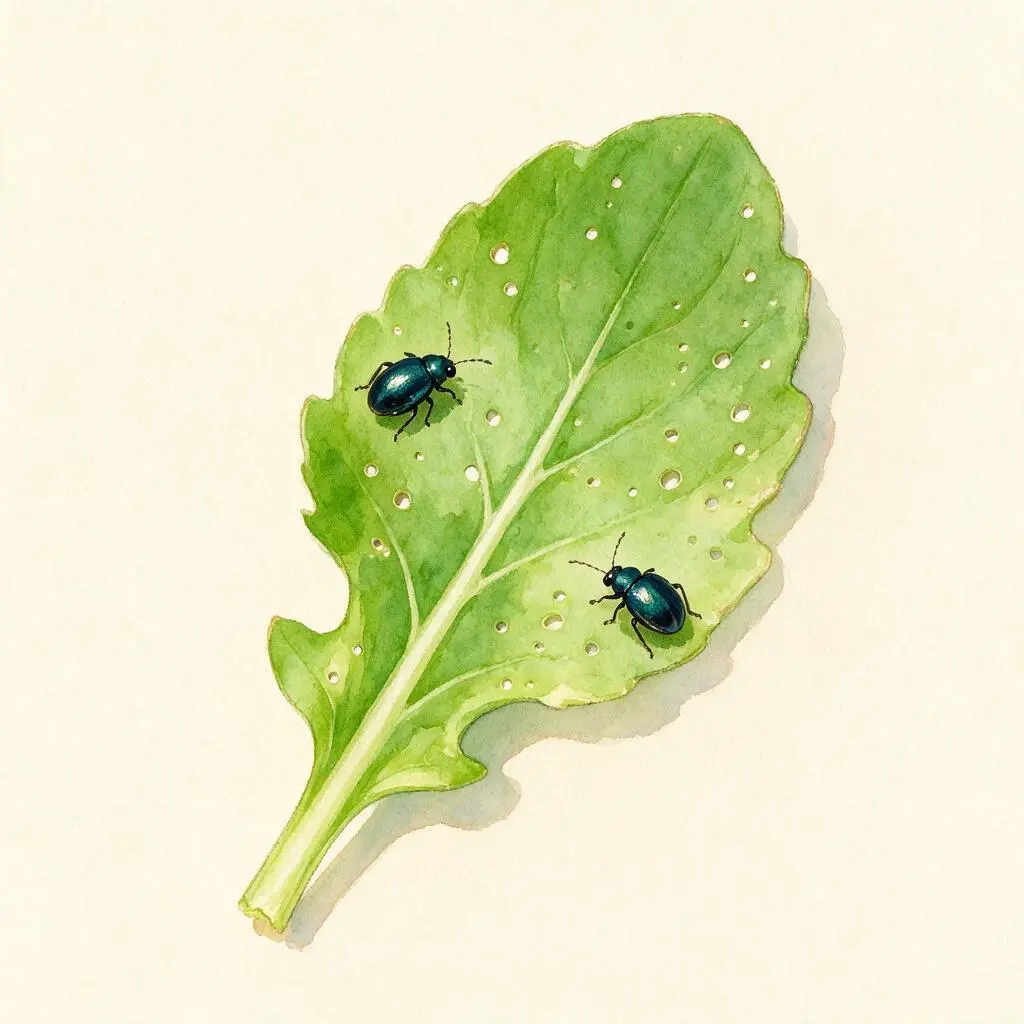
- Flea beetle. Small round holes in the young leaves, especially in spring in dry weather.
- Spinach downy mildew. Yellow patches on the upper side of the leaves and greyish or purplish fuzz underneath, in cool, damp weather.
- Leaf miner. Pale, blistered patches inside the leaf, where the larva lives; it affects the outer leaves.
- Aphids. Colonies on the undersides of the leaves and in the heart of the rosette.
- Slugs and snails. They nibble the tender leaves at night, especially after rain.
Warning signs
The leaves turn evenly yellow and the plant grows little.
Likely cause: Lack of nitrogen or soil that is too acid.
What to do: Add compost and, if the soil is acid, correct it with lime before the next sowing.
The plant starts to lengthen from the centre after only a few weeks.
Likely cause: Heat, long days or lack of water.
What to do: Harvest the usable leaves now and, for spring, choose slow-bolting varieties.
Reference photos
When it moves on to the next stageIt is ready to start harvesting when the rosette has five or six well-formed leaves.
Stage 3HarvestHarvest: Apr–May, Nov–DecLasts about 14–45 daysSpinach is harvested leaf by leaf or all at once, by cutting the whole plant. The young leaves are the most tender, and in winter the plant can give several pickings over a number of weeks.
Spinach is harvested leaf by leaf or all at once, by cutting the whole plant. The young leaves are the most tender, and in winter the plant can give several pickings over a number of weeks.
In spring, two or three weeks before it bolts; in autumn and winter, several weeks of pickings.
For this varietyThe Spinach profile gives about 45 days to the first harvest; treat it as a rough guide.
Temperature
min. -6°Cideal 8°C–20°Cmax. 26°CDo not cut it while the leaves are frozen: wait until they have thawed.
Moisture and watering
Keep watering regularly; the leaves of a plant that goes thirsty are tougher and less tasty.
How often: Once or twice a week in winter; every two or three days in spring.
Light · Partial shade
At least 4 h of light
Sun in winter and partial shade in spring, as in the previous stage.
Nutrients
Mainly needs: nitrogen (N)
If you are taking several pickings, a little compost or worm compost between cuts helps it regrow.
What with: worm compost
Jobs for this stage
- Always pick the outer, largest leaves and leave those in the centre to keep growing.
- When you see the plant starting to bolt, harvest everything that is left in one go.
Harvesting
When it is ready: You can start picking when the rosette has five or six leaves and the outer ones are about 7-8 cm long. It is at its best as a well-developed rosette with large, dark leaves, before the flower stem appears.
How to pick: Pinch or cut the outer leaves at the base of the stalk so that the central ones keep growing, or cut the whole plant with a knife at ground level or just below.
Time of day: Harvest in the morning, when the leaves are cool, or in mid-morning in winter, once they have thawed.
Yield: As a guide, 1 to 2 kg per square metre over all the pickings, depending on the time of year.
How to store: Store it unwashed in a bag or a closed container in the fridge, where it keeps for three to six days. Wash it well before eating, because the leaves hold on to soil.
Common problems
- Downy mildew. Picking when the leaves are wet spreads it; harvest when the plant is dry and remove spotted leaves.
- Leaf miner. Discard leaves with tunnels when harvesting so that the cycle does not continue.
Warning signs
The new leaves come through small and narrow, on a rising stem.
Likely cause: The plant has started to bolt.
What to do: Harvest everything straight away, because the quality drops within a few days.
Reference photos
When it moves on to the next stageThe harvest ends when a flower stem rises from the centre and the new leaves are small and narrow.
Stage 4BoltingBolting: Apr–JunLasts about 10–25 daysWhen the days lengthen and the temperature rises, spinach sends up a central stem with small leaves and forms its greenish, inconspicuous flowers. Spinach has separate male and female plants: the males release their pollen and die soon after, and the females are the ones that set seed.
When the days lengthen and the temperature rises, spinach sends up a central stem with small leaves and forms its greenish, inconspicuous flowers. Spinach has separate male and female plants: the males release their pollen and die soon after, and the females are the ones that set seed.
In spring it can bolt within a few weeks of sowing.
Temperature
min. 2°Cideal 12°C–24°Cmax. 30°CMoisture and watering
If you are going to save seed, water moderately until the seeds have formed and then let the plant dry out.
How often: Once or twice a week, depending on the heat.
Light · Full sun
At least 6 h of light
For the seed to ripen, full sun is best.
Jobs for this stage
- If you are not going to save seed, pull up the bolted plants to make room.
- If you are saving seed, leave a group of at least ten plants so that there are enough males and females.
Common problems
- Aphids. They build up on the flower stems and the tender shoots.
Warning signs
Spring spinach bolts before producing leaves.
Likely cause: Late sowing, when the days are already long and the heat is on its way.
What to do: Sow earlier, in late winter, and choose slow-bolting varieties for spring.
Reference photos
When it moves on to the next stageMove on to the seed stage when clusters of green seeds can be seen attached to the stems of the female plants.
Stage 5End of the cycleEnd of the cycle: Apr–May, Nov–DecLasts about 1–7 daysSpinach frees up the bed quickly and improves the soil with its roots. After the spring harvest it leaves a good gap for a summer crop, and after the winter harvest, for spring sowings.
Spinach frees up the bed quickly and improves the soil with its roots. After the spring harvest it leaves a good gap for a summer crop, and after the winter harvest, for spring sowings.
Jobs for this stage
- Pull up the bolted plants and put them on the compost heap if they are healthy.
- Plant a crop from another family in their place, such as tomatoes, beans or courgettes.
- Do not grow spinach, chard or beetroot in the same place in succession; they are related and share diseases.
Common problems
- Downy mildew. Badly affected plants are best removed from the garden rather than composted.
Warning signs
Downy mildew comes back every autumn in the same bed.
Likely cause: Infected remains and very dense plantings.
What to do: Rotate the crop, leave more space between plants and choose varieties resistant to downy mildew.
Stage 6Seeds and propagationSeeds and propagation: Jun–JulLasts about 30–50 daysSaving spinach seed is simple but needs space: you have to let a group of plants bolt and wait for the females to dry their seeds. As the pollen travels on the wind, it is hard to keep two varieties true at the same time. With late-winter sowings the seed is collected in early summer, in June and July in a temperate climate, and stored well it keeps for three to five years.
Saving spinach seed is simple but needs space: you have to let a group of plants bolt and wait for the females to dry their seeds. As the pollen travels on the wind, it is hard to keep two varieties true at the same time. With late-winter sowings the seed is collected in early summer, in June and July in a temperate climate, and stored well it keeps for three to five years.
Four to seven weeks from flower until the seeds on the female plants turn brown and dry.
Saving seed
When the seed is ripe: The seed is ripe when the female plants turn yellow, the stem dries and the seeds, attached in clusters along the stem, turn brown and hard.
How to extract it: Cut the stems when most of the seeds are brown and finish drying them hanging up or on a sheet. Then rub the stems between your hands, wearing gloves if the variety has prickly seed, and separate the chaff.
Drying: Leave the clean seed for another week in a thin layer somewhere dry and airy.
Storage: Store it in a paper envelope inside a tightly closed jar, labelled with the variety and the year, in a cool, dry, dark place.
The seed stays viable for about 3–5 years.
F1 hybrids: Many commercial spinach varieties are F1 hybrids, whose seed does not come true to the parent. Save seed only from open-pollinated varieties.
Cross-pollination: Spinach is wind-pollinated and two varieties cross easily even when they are far apart. If you want to keep it true, let only one variety bolt in your garden and the surrounding area; sources give distances of several hundred metres.
Reference photos
Sources and review
Reviewed on 4 November 2026. Approximate figures, written from these sources and the data in this profile.
- Royal Horticultural Society: Spinach, grow your own
- University of Illinois Extension: Spinach
- Clemson Home & Garden Information Center: Spinach
- Oregon State University Extension: soil temperature and vegetable seed germination
- Seed Savers Exchange: How to grow and save spinach seeds
- Maroto, J. V.: Horticultura herbácea especial (Mundi-Prensa), spinach chapter
- Vuelta al Huerto catalogue data (germination, calendar and Visual harvest guide)
03Planting
Where and how to plant it
Sow the seed 2.5 cm deep; leave 15 cm between plants and 20 cm between rows.
15 cm between plants · 20 cm between rows
Seed at a depth of 2.5 cm.
- In a square-foot bed
- 4 plants per square30 × 30 cm squares
- Direct sowing
- Feb–Mar, Sep–Oct
- Germination
- ~10 days
- TipSown in autumn, it gives leaves all winter in mild areas.
- TipSow in succession, a little every two or three weeks, so you get tender leaves without everything maturing at once.
- Common mistakeSowing in heat and long days: many bolt as soon as temperatures rise; better in the cool seasons.
04Care
Care through the year
Sun and aspectSun and shade · 5 h of sun · shade in summer
- Too little sun
- Ideal range
- Plenty of sun
East, or south with light shade during the middle of the day
Moderate sun: Copes with full sun, but give it some shade during heatwaves.
WateringMoist but never waterlogged · summer: every 2-3 days
- Summerevery 2-3 days2 L per plant/week
- Spring / Autumnevery 4-5 days1 L per plant/week
- Winterevery 2-3 weeks0.3 L per plant/week
Moist but never waterlogged: Water before the surface is completely dry. Never puddles. Mulch: straw or dry plant material cuts watering by 30-50 %.
When to water? Push your finger 3 cm into the soil next to the base of the plant:
- Damp: soil sticks to your finger. Do not water today. The moisture is fine.
- Cool but clean, no mud. Water early tomorrow if it stays like this, or this evening.
- Dry and dusty. Water now, and deeply. This is not where it likes to be.
Soil and feedingRich, airy loam
Rich, airy loam.
40 % topsoil · 40 % well-rotted compost · 20 % perlite or sand.
Medium: moist but never waterlogged.
This plant prefers a pH between 6.0 and 7.0 (slightly acidic to neutral).
- Well-rotted compost every season and well-decomposed manure in autumn.
- Mulch with straw or dry plant material to hold moisture and smother weeds.
- Rotate crops: do not grow the same family in the same spot two years running.
- Compacted soil or unbroken clay can halve the harvest.
- Watering with a hose from above compacts the soil: drip irrigation or watering at the base is better.
- Common mistakeLetting the soil dry out or watering in fits and starts toughens and embitters the leaves and brings on bolting (running to flower).
Common mistakes and tips
- TipIn inland Spain, where frosts are hard, a tunnel or a greenhouse keeps it productive.
05Harvest
Harvesting and storing
Harvest in Apr–May, Nov–Dec; the first, about 45 days after sowing.
- TipWater lightly and often, and harvest young or pick the outer leaves: it regrows and stays tender.
- Common mistakeLeaving the harvest too late: the leaves turn stringy or bitter.
06Uses and health
What it is used for, and with what care
Healthy for people; it contains oxalates, so large amounts can affect pets with kidney problems. If a large amount has been eaten, see a vet. Because of nitrates, AESAN (the Spanish Agency for Food Safety and Nutrition) advises not giving it to babies under one year old and limiting it between one and three years; also avoid it in children with a gut infection. People with oxalate kidney stones should moderate their intake.
- Properties
- Rich in iron, folate, vitamin K and antioxidants.
- Uses
- Leaves raw in salads or cooked.
For guidance only; this is not medical treatment and does not replace advice from a doctor or vet.
07Companions and related plants
What to plant it with

Group it in the same bedPlants with the same watering or the same sun
They are not essential companions, but you will not have to water or position them differently.
Same watering · Moderate watering
Compare with similar varieties
| Variety | Sowing | Harvest | Days | Spacing | Difficulty |
|---|---|---|---|---|---|
| Spinach | Feb–Mar, Sep–Oct | Apr–May, Nov–Dec | ~45 | 15 cm | Easy |
| New Zealand spinach | Mar–Jun | Jun–Oct | ~60 | 50 cm | Easy |
| Strawberry spinach | Mar–May, Sep–Oct | May–Oct | ~60 | 30 cm | Easy |
| Malabar spinach | Mar–Jun | Jun–Oct | ~60 | 30 cm | Easy |
08Pests and diseases
Critters and ailments to keep an eye on
The most common ones on this plant. Tap one to see how to recognise it and what to do.