
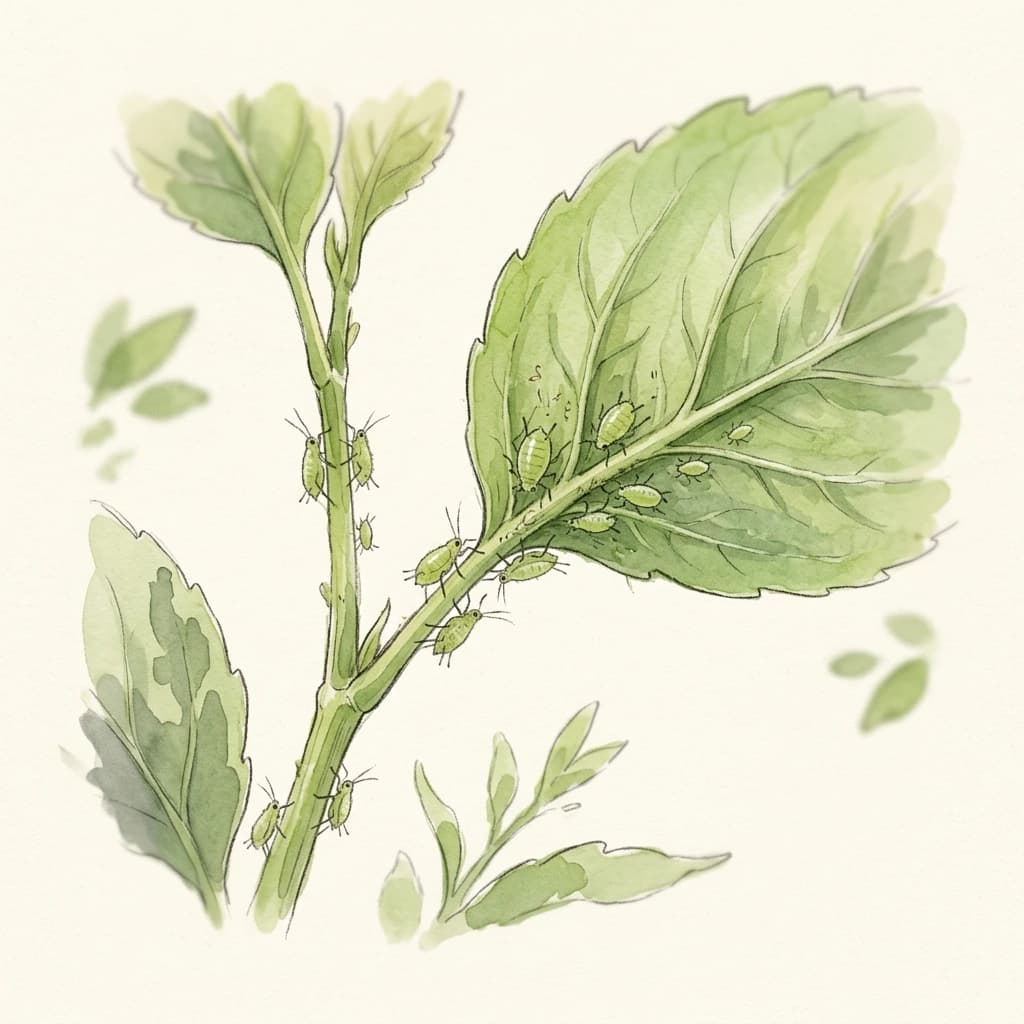
Aphids
Also known as: aphids, aphid, greenfly, blackfly, plant lice
Small, soft-bodied insects (green, black or yellow) that cluster on tender shoots and on the undersides of leaves, sucking the sap. They multiply very quickly and weaken the plant. The first step is to knock them off with a jet of water and check the shoots every few days.
Its best ally
Ladybird
A natural predator that helps to keep this pest under control. Tap to see how to attract it.

How to recognise it at every stage
Shares your gardenIt likes your tender shoots. It is the favourite food of ladybirds, hoverflies and lacewings.
Life cycle: Incomplete metamorphosis, with no pupa. In spring and summer nearly all aphids are females that give birth to live young without mating: a new generation every 7-10 days. In autumn some species lay eggs on trees and shrubs to get through the winter; in mild areas many simply carry on as females all year.
Tap a stage to see it full size. The photos are AI reference images checked against real photographs; stages without a reliable photo are shown as text only.
Life-stage calendar
| Jan | Feb | Mar | Apr | May | Jun | Jul | Aug | Sep | Oct | Nov | Dec | |
|---|---|---|---|---|---|---|---|---|---|---|---|---|
| Winter eggs | ||||||||||||
| Nymphs and colony | ||||||||||||
| Winged adult | ||||||||||||
| Curled leaves with ants |
Approximate months for mainland Spain; in cold areas they start later and in warm areas they last longer. Garden creatures this month
- 1Keep an eye on it
Winter eggs
· 0.5 mmTiny shiny black oval eggs.
- Where to find it
- On twigs of fruit trees and shrubs, next to the buds. Only some species.
- When: Nov–Mar
- What to do
- Leave them be: blue tits and great tits hunt for them in winter. Put up nest boxes near your fruit trees.
- 2Keep an eye on it
Nymphs and colony
· 0.5-2 mmTiny aphids of several sizes crowded together with the adults, with white moulted skins among them.
- Where to find it
- On tender shoots, leaf undersides and flowers, often with ants.
- When: Mar–Jun, Sep–Nov
- What to do
- Keep an eye on it for a few days: if there are already ladybirds, hoverfly larvae or mummies, let them work. If not, wash colonies off with a jet of water or pinch out the shoot.
- Often confused with
- Aphid mummies. Swollen, golden or black, stiff aphids: there is a tiny ally wasp inside. Do not remove them. See profile
- Whitefly nymphs or young mealybugs. They are flat and stay stuck to the leaf; aphids have long legs and antennae and two little tubes at the rear. See profile
- 3Keep an eye on it
Winged adult
· 1-3 mmSoft pear-shaped body, green, black or yellow, with two little tubes at the rear. Winged aphids (two pairs of clear wings) appear when the colony is crowded and fly off to other plants.
- Where to find it
- Wingless ones in the colony; winged ones on new leaves of other plants.
- When: Mar–Jun, Sep–Nov
- What to do
- Check shoots every few days in spring and autumn. Avoid too much nitrogen fertiliser, which they love.
Nests, egg clutches and shelters
- Protect your plants
Curled leaves with ants
Cupped or curled leaves, sticky with honeydew, with ants going up and down: there is a colony inside.
- Where to find it
- On peach, plum, apple, broad beans and roses.
- When: Mar–Jun
- What to do
- Put a band of sticky tape or cotton round the trunk so ants cannot climb up to 'farm' them: without ants, the allies move in.
Often confused with
- Aphid mummies. Swollen, golden or black, stiff aphids: there is a tiny ally wasp inside. Do not remove them. See profile
- Whitefly nymphs or young mealybugs. They are flat and stay stuck to the leaf; aphids have long legs and antennae and two little tubes at the rear. See profile
How to recognise it (symptoms)
- Colonies of tiny, motionless insects stuck to new shoots and the undersides of leaves
- Distorted, wrinkled or curled leaves and shoots
- Sticky, shiny honeydew on leaves and fruit
- Sooty mould (a black mould that grows on the honeydew)
- Lots of ants running up and down the stem, because they feed on the honeydew
Crops affected
 TomatoMarmande tomato, flattened and ribbed, a good size for salads.
 PepperCalifornia Wonder pepper, a blocky bell type with thick flesh, for stuffing or eating fresh.
 Broad beans'Muchamiel' broad bean, a traditional Mediterranean variety eaten both as shelled beans and in the pod.
 LettuceCos lettuce, with a long, crisp heart.
 Cabbages and other brassicasSavoy cabbage, with blistered, crinkled leaves, which grows sweeter with the cold; it does best in autumn…
What favours it
- Too much nitrogen fertiliser, which produces lots of soft new growth, the aphid's favourite food
- Mild springs and warm autumns, during which they breed non-stop
- A lack of beneficial insects (ladybirds, lacewings, hoverflies): without predators, colonies grow unchecked
- Ants, which protect aphids so they can keep the honeydew for themselves
Prevention
- Do not overdo nitrogen fertiliser: soft new growth attracts more aphids and the plant copes worse
- Encourage ladybirds and lacewings with hedges and flowers (calendula, fennel, dill): without shelter and nectar they will not stay in the garden
- Check tender shoots every few days: a colony can double in a few days in mild weather, and the sooner you act, the less you will have to do
- Plant nasturtiums near the crop: aphids prefer them, and you can remove the infestations without touching the main crop
Organic treatment
Always start here: these remedies are kind to the garden, the soil and pollinators.
- First: knock the colonies off with a firm jet of water (without breaking the shoots) and pick off the most heavily infested shoots by hand. If they are still spreading after a week, move on to potassium soap
- Potassium soap (10-20 g per litre of water): spray thoroughly, paying special attention to the undersides of the leaves. It works by contact, so the insects must be wetted, and you need to repeat every 5-7 days, 2 or 3 times
- Neem (azadirachtin): reduces the appetite and growth of the nymphs. Use only a product registered as an insecticide in Spain, at the rate on its label, and apply it at dusk to avoid harming bees. Cosmetic neem oil is not authorised for treating pests
- Diluted nettle tea: this is a tonic for the plant, not an insecticide, and its effect on aphids is modest
- Protect ladybirds and lacewings, which keep things in balance without chemicals: a single ladybird larva eats a lot of aphids a day
Chemical treatment (with caution)
Only if the infestation gets out of control, and always with a product registered for that crop. Choose a selective one, respect the safety interval on the label and do not spray while the plant is in flower, so as not to harm bees.
Don't confuse it with…
Honeydew and sooty mould are also caused by whitefly and scale insects; look closely at the actual insect on the underside of the leaf: aphids do not fly except in their winged form, and they cluster without moving.
In-depth guide — controlling aphids without poison
The techniques are listed in the order in which it makes sense to use them: prevention first, control when they appear, and recovery if the attack gets out of hand.
Stage 1 · Prevention
Aphids thrive in monocultures and on soft shoots with too much nitrogen. Diversify your garden and feed with well-rotted compost, not fresh manure.
- Aromatic herbs (basil, chives, rosemary) dotted among the vegetables.
- Nasturtiums as a trap crop.
- Flowers along the edges (fennel, coriander, dill, yarrow) to attract ladybirds, hoverflies, lacewings and parasitoid wasps.
- A shallow water dish with stones, so that beneficial insects have something to drink.
Method 1 · Hose jet
This is the simplest method and works well early on. Aim a firm jet, without breaking the shoots, at the colonies on the undersides of the leaves. Aphids that are knocked off hardly ever climb back up. Repeat every 2-3 days for a couple of weeks.
Method 2 · Potassium soap
Buy potassium soap intended for garden use and follow the label. As a guide, the usual rate is 1-2 % (10-20 g per litre of lukewarm water).
- Spray at dusk on the undersides of the leaves and on the affected shoots.
- Repeat every 5-7 days, for 2 or 3 applications.
- Avoid times of strong sun and temperatures above 30 °C, because it scorches the leaves.
Never spray open flowers or bees: it harms them.
Method 3 · Neem (registered product)
It slows the growth of the nymphs and reduces egg-laying. Use only a neem (azadirachtin) product registered as an insecticide and follow its label: rate, number of applications and the safety interval before harvesting. Spray at dusk. Neem oil sold for cosmetic use or in herbalists' shops is not authorised for treating pests.
Method 4 · Nettle tea
As a guide, 1 kg of fresh nettles in 10 litres of water, stirred daily for 7-10 days. Strain and dilute 1:10 for spraying. It works more as a plant tonic than as a treatment.
Method 5 · Natural allies
A garden rich in biodiversity largely regulates itself. Buying ladybirds or lacewings is only worthwhile in greenhouses or enclosed spaces, because outdoors they disperse; in that case, ask your biological control supplier for the right species for your crop (for example, the parasitoid Aphidius colemani).
If the attack gets out of hand
If the plant is covered in aphids, prune off the worst-affected part (up to a third of the plant, never more) and put the prunings in the rubbish bin, not on the compost heap. A few days later, repeat the water jet and potassium soap for two weeks. If the plant is vigorous, it will regrow healthy within a few weeks.
Common mistakes
- Using broad-spectrum insecticides: they kill the beneficial insects, and before long the pest comes back worse.
- Ignoring the ants: they protect the aphids. Put a band of tree glue or grease around the trunk to block their way.
- Acting too late: it is much easier to stop a small colony than one of hundreds of insects.
- Spraying in full sun or on open flowers.
When you do not need to treat
You do not always have to treat. A few aphids on a shoot will not ruin the harvest, and their presence attracts predators. Act when you see the colonies growing from one week to the next or the shoots becoming distorted.
Use plant protection products responsibly, even organic ones. Always read and follow the label, the doses and the harvest interval, and never treat plants in flower or while bees are flying, in order to protect pollinators. If in doubt, put prevention and organic methods first.

In the plant catalogue you'll see what to plant, how and when: a well-tended plant resists pests much better.