
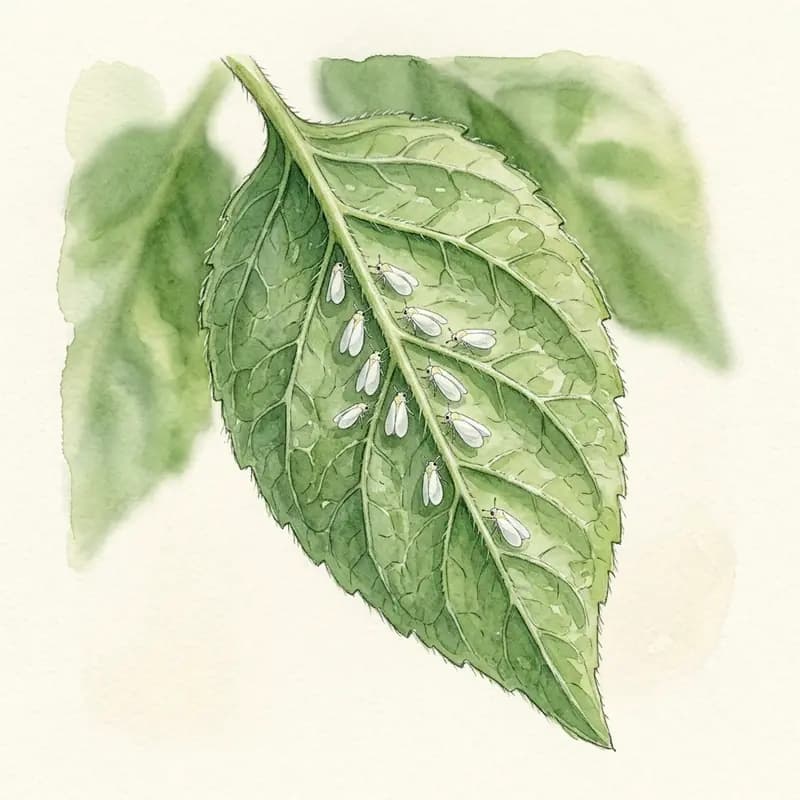
Whitefly
Also known as: whitefly, whiteflies, glasshouse whitefly, greenhouse whitefly, tobacco whitefly, Bemisia
Tiny white insects that fly up in a cloud when the plant is disturbed. They live on the undersides of leaves, sucking sap, and can transmit viruses. The first step is to hang yellow traps and check the undersides of the leaves to see how many there are.
Its best ally
Parasitic wasp
A natural predator that helps to keep this pest under control. Tap to see how to attract it.

How to recognise it at every stage
Shares your gardenIt likes your tomatoes, beans and courgettes, especially under cover.
Life cycle: Egg, four nymphal stages (the last one, which does not move, is called the 'pupa') and adult. At 20-25 °C it completes the cycle in 3-4 weeks, so it has many generations in summer and all year round in greenhouses.
Tap a stage to see it full size. The photos are AI reference images checked against real photographs; stages without a reliable photo are shown as text only.
Life-stage calendar
| Jan | Feb | Mar | Apr | May | Jun | Jul | Aug | Sep | Oct | Nov | Dec | |
|---|---|---|---|---|---|---|---|---|---|---|---|---|
| Eggs | ||||||||||||
| Nymphs | ||||||||||||
| 'Pupa' (fourth-stage nymph) | ||||||||||||
| Adult |
Approximate months for mainland Spain; in cold areas they start later and in warm areas they last longer. Garden creatures this month
- 1Keep an eye on it
Eggs
· 0.2 mmTiny elongated dots, pale yellow turning grey or black; sometimes in semicircles with white powder.
- Where to find it
- On the undersides of the youngest leaves, at the top of the plant.
- When: Apr–Nov
- What to do
- You need a hand lens. Check the undersides of the top leaves once a week in summer.
- 2Keep an eye on it
Nymphs
· 0.3-0.7 mmFlat, oval, translucent yellowish-green scales, stuck and motionless.
- Where to find it
- On the undersides of leaves in the middle of the plant.
- When: May–Nov
- What to do
- If there are many, a mild potassium soap on the undersides at dusk. The ones that turn black are parasitised: leave them.
- 3Protect your plants
'Pupa' (fourth-stage nymph)
· 0.7-0.8 mmAn opaque white oval box with raised sides and a fringe of wax; two little red eyes show through.
- Where to find it
- On the undersides of the low, older leaves.
- When: May–Nov
- What to do
- Remove heavily loaded lower leaves and put them in a closed compost bin: the simplest way to break the cycle.
- Often confused with
- Black nymphs (parasitised). 'Pupae' that turn black have an Encarsia wasp inside. They are allies: do not remove them. See profile
- 4Protect your plants
Adult
· 1-1.5 mmA tiny fly with floury white wings held flat over the body. A cloud flies up when you move the plant.
- Where to find it
- On the undersides of the top leaves.
- When: Apr–Nov
- What to do
- Yellow sticky traps, insect mesh in greenhouses and flowers for its predators (Macrolophus, lacewings, Encarsia).
- Often confused with
- Citrus mealybug. Bigger (3-4 mm), covered in cottony wax, and it does not fly when you move the plant. See profile
Often confused with
- Citrus mealybug. Bigger (3-4 mm), covered in cottony wax, and it does not fly when you move the plant. See profile
- Black nymphs (parasitised). 'Pupae' that turn black have an Encarsia wasp inside. They are allies: do not remove them. See profile
How to recognise it (symptoms)
- A cloud of small white insects that flies up when you shake the plant
- White specks (adults) and flat, oval scales (nymphs) on the undersides of the leaves
- Yellowing leaves and loss of vigour
- Sticky honeydew and sooty mould on the leaves, produced by the whitefly itself as it feeds
Crops affected
 TomatoMarmande tomato, flattened and ribbed, a good size for salads.
 PepperCalifornia Wonder pepper, a blocky bell type with thick flesh, for stuffing or eating fresh.
 AubergineAn aubergine with glossy black fruit, for warm climates.
 CucumberThe 'Marketmore' cucumber is a classic salad cucumber resistant to several diseases.
 CourgetteA cylindrical, very dark green courgette, productive and early, the classic bush type for continuous picking.
 Cabbages and other brassicasSavoy cabbage, with blistered, crinkled leaves, which grows sweeter with the cold; it does best in autumn…
 BeansA dwarf green bean that does not need a support and is easy to grow in a bed.
What favours it
- Heat and sheltered conditions: it multiplies very quickly at high temperatures
- Greenhouses and poorly ventilated corners
- Too much nitrogen: soft new growth attracts more pests
- Weeds around the garden, where it survives and from where it moves into the crop
Prevention
- Put up yellow sticky traps from the start of the crop: they warn you of its arrival before you see any damage
- Ventilate the greenhouse well and do not crowd the plants: stagnant air and heat favour the pest
- Clear weeds from the surrounding area: they act as a bridge for the pest to reach the crop
- Check the undersides of the leaves often, because that is where the nymphs and eggs hide, out of sight from above
Organic treatment
Always start here: these remedies are kind to the garden, the soil and pollinators.
- First: hang yellow traps (one for every 2-3 plants in a small greenhouse, or one every 10 m² for monitoring) and remove the most heavily infested lower leaves. This brings the population down and lets you see whether it is increasing
- If it keeps growing, spray potassium soap (10-20 g per litre) on the undersides of the leaves at dusk, 3 applications 5 days apart. It kills the nymphs by contact
- A registered neem product (at the rate on its label) stops the nymphs developing; repeat every 7 days
- In a greenhouse, introduce Encarsia formosa, a tiny wasp that parasitises the nymphs of the glasshouse whitefly. If the species is the tobacco whitefly (Bemisia), ask your supplier, because it is controlled by other parasitoids
Chemical treatment (with caution)
It is hard to eradicate with chemicals, because whitefly develops resistance quickly. If you do resort to them, use only products registered for the crop, alternate active ingredients and protect pollinators.
Don't confuse it with…
With aphids, because of the honeydew and sooty mould. Whitefly flies up in a cloud when disturbed and is white; aphids do not usually fly and cluster motionless in coloured colonies.
In-depth guide — whitefly in the Mediterranean vegetable garden
Whitefly thrives in heat and on stressed plants. Combine traps, biological control and leaf hygiene before thinking about chemicals.
Confirming the diagnosis
Gently shake the plant: if a cloud of white insects flies up, it is almost certainly whitefly. Then look at the undersides of the leaves, where you will see flat, oval nymphs like tiny scales.
- It can be told apart from aphids because aphids do not usually fly and form motionless colonies.
- Honeydew and sooty mould appear late: it is best to act before you see them.
Yellow sticky traps
Hang the cards at the height of the upper leaves, with the sticky side facing the crop. As a guide, one for every 2-3 plants in a small greenhouse or one every 10 m² for monitoring, with more if the pest is already present. Replace them when they are full or dirty.
They help detect and catch adults, but on their own they are not enough for a heavy infestation. They also trap pollinators, so do not put them next to flowers that are busy with visitors.
Biological control
- Encarsia formosa (and Eretmocerus for Bemisia) are tiny parasitoid wasps that attack the nymphs; they are sold by biological control suppliers.
- Lacewings (Chrysoperla) and predatory bugs (Orius) help in the greenhouse.
- Avoid broad-spectrum insecticides for several weeks before and after releasing them, because they kill the beneficial insects.
Cultural measures
- Remove heavily infested leaves and clear crop debris at the end of the season.
- Use drip irrigation early in the morning and do not wet the undersides of the leaves at dusk.
- Ventilate greenhouses so that heat does not build up.
Organic treatments
- Potassium soap at 1-2 % (10-20 g per litre) on the undersides of the leaves at dusk, three applications five days apart.
- A registered neem (azadirachtin) product, at the rate on its label and respecting the safety interval.
- Garlic infusion (50 g per litre) as a repellent on new shoots; its effect is modest.
Do not spray while the plant is in flower or when bees are about.
Frequent mistakes
- Ignoring the weeds along the edges: that is where the populations survive.
- Treating only the top leaves: the nymphs gather on the undersides of the middle and lower leaves.
- Growing tomatoes in the same soil and the same greenhouse all year round, with no break or rotation.
Use plant protection products responsibly, even organic ones. Always read and follow the label, the doses and the harvest interval, and never treat plants in flower or while bees are flying, in order to protect pollinators. If in doubt, put prevention and organic methods first.

In the plant catalogue you'll see what to plant, how and when: a well-tended plant resists pests much better.