
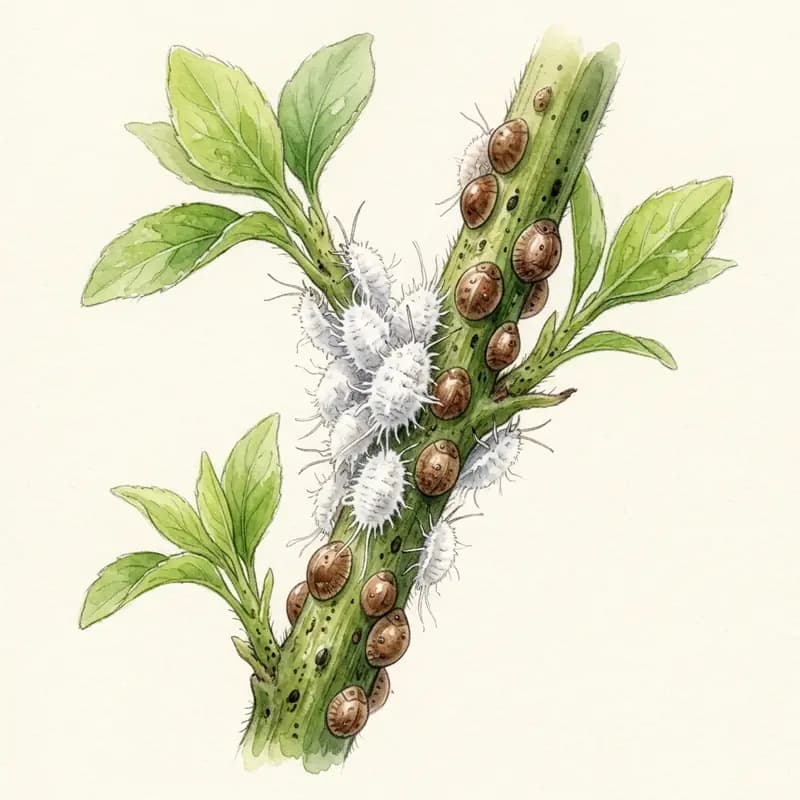
Scale insects and mealybugs
Also known as: scale insects, mealybugs, mealybug, soft scale, cottony cushion scale, scale
Sap-sucking insects protected by a waxy shield or by white cottony fluff. They stick to stems and the undersides of leaves, suck sap and produce honeydew and sooty mould. The first step is to remove them by hand with a cotton bud dipped in alcohol or with soapy water, and to control the ants.
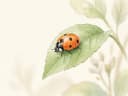
Its best ally
Ladybird
A natural predator that helps to keep this pest under control. Tap to see how to attract it.

How to recognise it at every stage
Shares your gardenIt likes your citrus trees, houseplants and succulents.
Life cycle: Egg, three nymphal stages and adult. Newly hatched nymphs move about for a few days, then settle and cover themselves in wax. Three to six generations a year, and all year round indoors. The males have wings and are hardly ever seen.
Tap a stage to see it full size. The photos are AI reference images checked against real photographs; stages without a reliable photo are shown as text only.
Life-stage calendar
| Jan | Feb | Mar | Apr | May | Jun | Jul | Aug | Sep | Oct | Nov | Dec | |
|---|---|---|---|---|---|---|---|---|---|---|---|---|
| Egg sac | ||||||||||||
| Crawling nymphs | ||||||||||||
| Adult female |
Approximate months for mainland Spain; in cold areas they start later and in warm areas they last longer. Garden creatures this month
- 1Protect your plants
Egg sac
· Egg sac 3-5 mmA little ball of white cotton with hundreds of tiny yellow or orange eggs inside.
- Where to find it
- In branch forks, on leaf undersides, under the calyx of fruits and in cracks.
- When: Mar–Oct
- What to do
- Wipe it off with a cotton bud dipped in alcohol or a gentle jet of water before the young hatch.
- 2Keep an eye on it
Crawling nymphs
· 0.3-0.5 mmTiny oval yellowish dots with six legs, walking over leaves and stems.
- Where to find it
- Coming out of the egg sacs towards leaves and shoots.
- When: Apr–Oct
- What to do
- The best moment for potassium soap or paraffin oil: they have no wax yet.
- 3Protect your plants
Adult female
· 3-4 mmOval and soft, covered in floury white wax, with short filaments around the edge.
- Where to find it
- In groups in forks, on leaf undersides, stems and fruits, with honeydew and sooty mould.
- When: all year
- What to do
- Remove it by hand or with a cotton bud and encourage its predators. Control ants, which protect it.
- Often confused with
- Cryptolaemus larva ('mealybug destroyer'). It looks like a big mealybug (up to 13 mm) with long curly wax filaments, but it walks quickly and eats mealybugs. It is an ally: protect it.
- Powdery mildew. Flat patches of white powder, with no insects underneath. See profile
- Whitefly. Adults fly when you move the plant; the nymphs are flat transparent scales. See profile
Often confused with
- Cryptolaemus larva ('mealybug destroyer'). It looks like a big mealybug (up to 13 mm) with long curly wax filaments, but it walks quickly and eats mealybugs. It is an ally: protect it.
- Powdery mildew. Flat patches of white powder, with no insects underneath. See profile
- Whitefly. Adults fly when you move the plant; the nymphs are flat transparent scales. See profile
How to recognise it (symptoms)
- Small brown bumps (shields) or white cottony masses on stems and leaves
- Sticky honeydew and sooty mould on the leaves
- Yellow leaves and a plant weakened by the constant loss of sap
- Ants climbing the trunk to collect the honeydew
Crops affected
 TomatoMarmande tomato, flattened and ribbed, a good size for salads.
 PepperCalifornia Wonder pepper, a blocky bell type with thick flesh, for stuffing or eating fresh.
What favours it
- Heat and sheltered, poorly ventilated spots
- Too much nitrogen, which produces soft shoots
- Ants, which protect them and help them spread over the plant
Prevention
- Check stems and the undersides of leaves to spot them early: colonies start there before they show on the upper surface
- Control the ants, which tend them and spread them
- Ventilate and avoid excessive nitrogen fertiliser
- Prune out and dispose of heavily infested parts
Organic treatment
Always start here: these remedies are kind to the garden, the soil and pollinators.
- First: for small outbreaks, dab each scale insect with a cotton bud soaked in 70 % alcohol (test on one leaf first) and go over the plant again every 5-7 days for 3 weeks. Prune out heavily infested branches and throw them away
- Potassium soap (10-20 g per litre) sprayed thoroughly over the young nymphs, repeating every 5-7 days, or a registered neem product (at the rate on its label)
- On leafless fruit trees and woody shrubs, horticultural paraffin oil in winter (1-2 %, once), on a frost-free day, and without mixing it with or applying it close to a sulphur treatment
- In a greenhouse or on citrus, the predator Cryptolaemus montrouzieri, a small ladybird-like beetle, controls mealybugs
Chemical treatment (with caution)
The shield protects scale from many insecticides, and oils control it better. If you treat, do so when young nymphs predominate and with products registered for the crop.
Don't confuse it with…
Mealybugs can be mistaken for downy or powdery mildew because of the white colour. With mealybugs, the white is a cottony mass with insects underneath.
In-depth guide — scale insects in the vegetable garden and on fruit trees
These are sap-sucking insects protected by a waxy shell or a cottony mass. Act when nymphs predominate and combine brushing, oils and ant control.
Identification
- White cottony masses (mealybugs, Planococcus and similar) or brown shields stuck to the stem (armoured and soft scales).
- Shiny honeydew with black sooty mould beneath.
- Ants climbing the trunk indicate active scale insects.
Mechanical removal
In winter, scrub the branches of fruit trees with a toothbrush and soapy water and remove heavily colonised branches. On potted plants, dab each colony with a cotton bud dipped in 70 % alcohol.
Paraffin oil or neem
Horticultural paraffin oil is applied in winter, when the tree is leafless, at 1-2 % and only once. In summer it is better to use neem or potassium soap on the mobile nymphs, at dusk, with two applications 7-15 days apart.
Do not mix the oil with sulphur or apply it within 3 weeks of a sulphur treatment. Do not apply it in strong sun or frost either.
Breaking the alliance with ants
A band of tree glue around the trunk stops ants climbing up and protecting the scale insects.
Use plant protection products responsibly, even organic ones. Always read and follow the label, the doses and the harvest interval, and never treat plants in flower or while bees are flying, in order to protect pollinators. If in doubt, put prevention and organic methods first.

In the plant catalogue you'll see what to plant, how and when: a well-tended plant resists pests much better.