
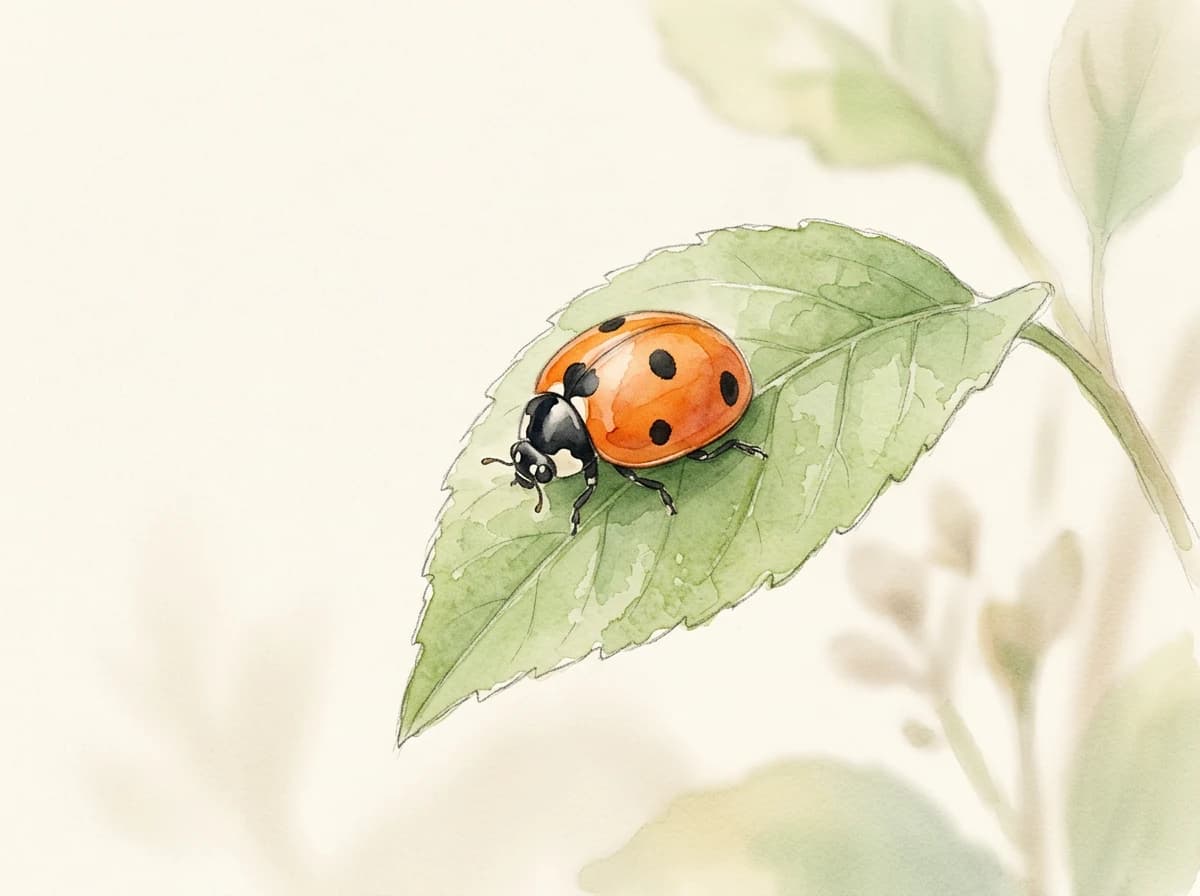
Ladybird
Coccinella septempunctata
Also called: ladybug, lady beetle, Coccinella, ladybird beetle
The queen of biological control. An adult ladybird eats about 50 aphids a day, and its larva several hundred before it becomes a pupa. If you see aphids and ladybirds together, do nothing: give them a week.

How to recognise it at every stage
Garden allyGarden ally: adults and larvae eat aphids.
Life cycle: Complete metamorphosis: egg (3-5 days), larva (2-4 weeks), pupa (about a week) and adult. It usually has one or two generations a year, and the adults overwinter in groups in shelters.
Tap a stage to see it full size. The photos are AI reference images checked against real photographs; stages without a reliable photo are shown as text only.
Life-stage calendar
| Jan | Feb | Mar | Apr | May | Jun | Jul | Aug | Sep | Oct | Nov | Dec | |
|---|---|---|---|---|---|---|---|---|---|---|---|---|
| Eggs | ||||||||||||
| Larva | ||||||||||||
| Pupa | ||||||||||||
| Adult | ||||||||||||
| Groups of overwintering ladybirds |
Approximate months for mainland Spain; in cold areas they start later and in warm areas they last longer. Garden creatures this month
- 1Protect it
Eggs
· 1-1.5 mmSmall clusters of 10 to 50 yellow or orange eggs, spindle-shaped, standing upright and tightly packed.
- Where to find it
- On the underside of leaves, almost always next to an aphid colony.
- When: Mar–Jun, Sep–Oct
- What to do
- Leave them be: in a few days larvae will hatch and eat the aphids around them. Do not wash those leaves.
- Often confused with
- Colorado potato beetle eggs. They are also yellow-orange and in clusters, but they are on potatoes, aubergines or tomato plants and not next to aphids; they are somewhat fatter and oval. See profile
- 2Protect it
Larva
· 3-12 mmElongated and slightly flattened, like a tiny crocodile: slate-grey or blackish, with small black warts and two pairs of orange spots. Six legs, all near the head.
- Where to find it
- Hurrying over shoots and leaves with aphids.
- When: Apr–Jul, Sep–Oct
- What to do
- Protect it: it eats the most aphids (several hundred before becoming a pupa). Do not mistake it for a pest or squash it.
- Often confused with
- Ladybird larva versus "a strange bug" or a pest. The ladybird larva is elongated, dark grey with orange spots and moves quickly among the aphids. Sap-sucking pests (aphids, scale insects) are small, soft and hardly move.
- 3Protect it
Pupa
· 5-7 mmA small, domed cupola, orange with black spots, stuck on by its tail; the wrinkled skin of the larva usually stays at the base.
- Where to find it
- On the upper side of leaves, on stems, canes, posts or sunny walls.
- When: May–Jul, Sep–Oct
- What to do
- Do not touch it or pull off that leaf: in a week an adult ladybird will come out.
- 4Protect it
Adult
· 5-8 mmA bright red dome with seven black spots (other species have two, fourteen or twenty-two spots, or are black with red spots). Black head with two small white marks.
- Where to find it
- On shoots with aphids, small flowers and tall grasses.
- When: all year
- What to do
- Protect it. If you see aphids and ladybirds together, do nothing for a week. No insecticides, not even broad-spectrum organic ones.
- Often confused with
- Harlequin ladybird (Harmonia axyridis). Bigger (6-8 mm), with very variable colours and often a black "M" or "W" on a white background behind the head. Its larva is black with an L-shaped orange stripe. It also eats aphids, but it displaces the native ones: do not buy it or release it.
- Melon ladybird (Chnootriba elaterii). Orange with 12 black spots, matt and slightly hairy. It eats the leaves of melon, watermelon and courgette (leaving window-like scrapings), not aphids.
Nests, egg clutches and shelters
- Protect it
Groups of overwintering ladybirds
Dozens of ladybirds sitting still and huddled together, like a bunch of little red beads.
- Where to find it
- In cracks in bark, under leaf litter, between stones, in window frames and in insect hotels.
- When: Nov–Mar
- What to do
- Do not disturb them: leave a corner untidied in autumn and put up a south-facing insect hotel.
Often confused with
- Ladybird larva versus "a strange bug" or a pest. The ladybird larva is elongated, dark grey with orange spots and moves quickly among the aphids. Sap-sucking pests (aphids, scale insects) are small, soft and hardly move.
- Colorado potato beetle eggs. They are also yellow-orange and in clusters, but they are on potatoes, aubergines or tomato plants and not next to aphids; they are somewhat fatter and oval. See profile
- Harlequin ladybird (Harmonia axyridis). Bigger (6-8 mm), with very variable colours and often a black "M" or "W" on a white background behind the head. Its larva is black with an L-shaped orange stripe. It also eats aphids, but it displaces the native ones: do not buy it or release it.
- Melon ladybird (Chnootriba elaterii). Orange with 12 black spots, matt and slightly hairy. It eats the leaves of melon, watermelon and courgette (leaving window-like scrapings), not aphids.
What it eats
- Aphids (their favourite dish)
- Young scale insects
- Some mites (the red spider mite specialists are tiny ladybirds, such as Stethorus)
- Eggs of other insects
How it helps in the garden
How to attract this ally to your garden
- Small flowers with easy-to-reach nectar: fennel, dill, marigold, tansy, coriander in flower.
- Leave a corner unmown: tall grasses where they can spend the winter.
- Put up an insect hotel with narrow chambers facing south: solitary bees, lacewings and ladybirds use it to breed and overwinter.
- Do not kill the larvae even if they look odd: a ladybird larva is elongated, dark with orange spots and has legs, and it eats aphids.
Plants in the catalogue that attract it
 Common fennelFennel grown for its leaves and aromatic seeds, hardier and wilder than bulb fennel.
 DillAn aromatic annual dill, grown for both its leaves and its seed.
 Pot marigold (calendula)An annual with almost continuous orange or yellow edible flowers that self-sows year after year with hardly…
 TansyA rhizomatous perennial 60 to 120 cm tall, with upright stems and very finely divided dark green leaves that…
 CorianderAn annual coriander, grown for its leaves and for its seed.
What to avoid so you do not harm it by accident
- Broad-spectrum insecticides (pyrethrins included): they kill the adults and even more the larvae.
- Buying Asian ladybirds (Harmonia axyridis): they are invasive and displace the native ones.
How to recognise it
Adult: 5-8 mm, bright red with black spots (or black with red spots). Larva: 6-10 mm, black or bluish-grey with orange spots, elongated body, visible legs.
Many allies are protected by Spanish law: do not capture or keep in captivity toads, hedgehogs, bats or native reptiles. Attract them, watch them and thank them from a distance. Rules in other countries differ: check your local regulations.

Allies do better if the garden is varied. Learn to identify each visitor and to prevent problems with good habits.