
Ladybirds: how to attract and rear them
The seven-spot ladybird and its relatives eat aphids from the day they hatch: a single larva eats hundreds during its development. The surest way to have many is to attract them, and if you want to help them grow, rear at home the larvae and pupae you find on your own aphid-infested plants.
- Difficulty: easy
- Temporary rearing box: 1–2 L tub, 3–5 larvae at most per container (they eat each other if food runs short)
- Profile: Ladybird
What it helps with
- Larvae and adults feed on aphids, and also on scale insects, mites and the eggs of other insects.
- With a couple of plants with a few aphids and flowers nearby, they stay on their own all year.
- It is one of the best ways to show children the cycle of a complete insect: egg, larva, pupa and adult.
Materials
- A clear container with a mesh or fine cloth lid (a 1–2 L food tub will do) for the temporary rearing box
- A leaf or branch with aphids, renewed every day
- A small jar with water and cotton wool so the branch does not dry out
- A fine paintbrush or a leaf to move the larvae without touching them
- For winter: hollow or dry plant stems (fennel, dill, thistle), loose bark, pine cones and dry leaf litter
- Optional: a wooden box with 5–8 mm slits filled with straw or pine cones, a “ladybird house”
Measurements
- Temporary rearing box
- 1–2 L tub, 3–5 larvae at most per container (they eat each other if food runs short)
- Eggs
- clusters of about 10–40 yellow or orange eggs, 1 mm, on the underside of leaves near aphids
- Approximate duration
- larva 2–4 weeks and pupa 5–10 days, depending on the warmth
- Winter shelter
- slits 5–8 mm wide and dry filling; at 0.5–1.5 m, facing south or south-east
Step by step
1. Learn to recognise them
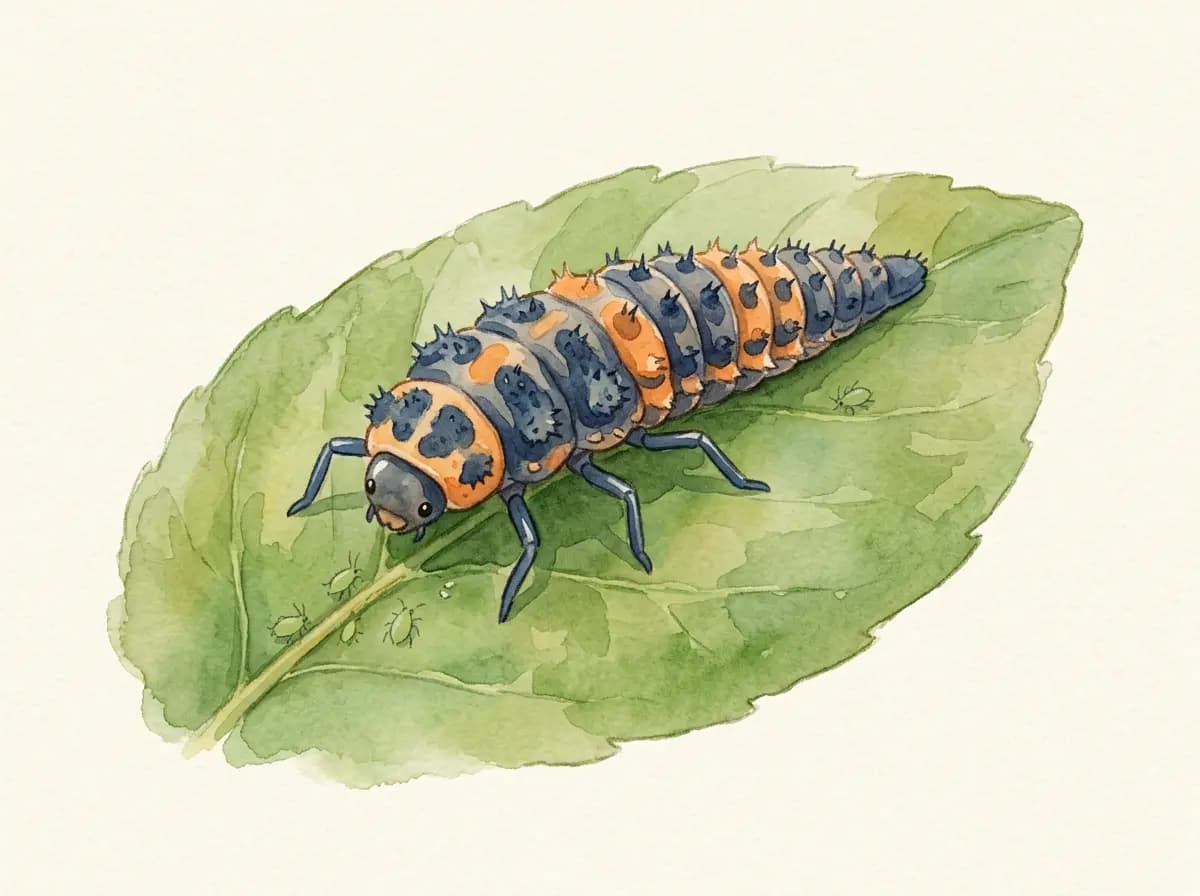
The larva looks like a small elongated alligator, dark grey with orange or yellow spots. The pupa is a little orange and black lump stuck to a leaf and motionless. The eggs are small, yellow and in clusters. Do not confuse them with the insects that eat your plants: they are allies.
2. Collect only from your own plants
If you find larvae or pupae on a plant with aphids, leave them there: they already have food. Only if a plant runs out of aphids (or you are going to prune it), use a paintbrush to move the larvae to another branch with aphids in your own garden. To rear them in a container, collect three to five at most.

3. Set up the simple rearing box
Put a leaf or branch with aphids in a small jar of water in the tub (plug the neck with cotton wool). Close it with mesh or fine cloth held on with a rubber band, so there is air. Keep it in the shade at room temperature, never in direct sun.

4. Feed every day
Replace the branch with a new one with aphids every day. A large larva can eat several dozen a day. If you do not have enough aphids, it is better to return the larvae to the plants that do. Remove the droppings with a paper towel.

5. Return them to the garden
When the larva sticks itself to a leaf and becomes a pupa, leave the leaf in the container. When the adult ladybird emerges (at first it is pale and spotless, and colours up in a day or two), open the container near a plant with aphids in your garden and let it go. Do not keep adults: flying is what they are for.

6. Prepare the winter shelter
At the end of summer leave the dry stems of fennel, dill, thistle or sunflower standing, and an area with leaf litter. Hang a “ladybird house” (a box with slits and straw or pine cones) in a sunny, sheltered corner. Adults huddle together through the cold and come out in spring.

How to recognise it at every stage
Garden allyGarden ally: adults and larvae eat aphids.
Life cycle: Complete metamorphosis: egg (3-5 days), larva (2-4 weeks), pupa (about a week) and adult. It usually has one or two generations a year, and the adults overwinter in groups in shelters.
Tap a stage to see it full size. The photos are AI reference images checked against real photographs; stages without a reliable photo are shown as text only.
Life-stage calendar
| Jan | Feb | Mar | Apr | May | Jun | Jul | Aug | Sep | Oct | Nov | Dec | |
|---|---|---|---|---|---|---|---|---|---|---|---|---|
| Eggs | ||||||||||||
| Larva | ||||||||||||
| Pupa | ||||||||||||
| Adult | ||||||||||||
| Groups of overwintering ladybirds |
Approximate months for mainland Spain; in cold areas they start later and in warm areas they last longer. Garden creatures this month
- 1Protect it
Eggs
· 1-1.5 mmSmall clusters of 10 to 50 yellow or orange eggs, spindle-shaped, standing upright and tightly packed.
- Where to find it
- On the underside of leaves, almost always next to an aphid colony.
- When: Mar–Jun, Sep–Oct
- What to do
- Leave them be: in a few days larvae will hatch and eat the aphids around them. Do not wash those leaves.
- Often confused with
- Colorado potato beetle eggs. They are also yellow-orange and in clusters, but they are on potatoes, aubergines or tomato plants and not next to aphids; they are somewhat fatter and oval. See profile
- 2Protect it
Larva
· 3-12 mmElongated and slightly flattened, like a tiny crocodile: slate-grey or blackish, with small black warts and two pairs of orange spots. Six legs, all near the head.
- Where to find it
- Hurrying over shoots and leaves with aphids.
- When: Apr–Jul, Sep–Oct
- What to do
- Protect it: it eats the most aphids (several hundred before becoming a pupa). Do not mistake it for a pest or squash it.
- Often confused with
- Ladybird larva versus "a strange bug" or a pest. The ladybird larva is elongated, dark grey with orange spots and moves quickly among the aphids. Sap-sucking pests (aphids, scale insects) are small, soft and hardly move.
- 3Protect it
Pupa
· 5-7 mmA small, domed cupola, orange with black spots, stuck on by its tail; the wrinkled skin of the larva usually stays at the base.
- Where to find it
- On the upper side of leaves, on stems, canes, posts or sunny walls.
- When: May–Jul, Sep–Oct
- What to do
- Do not touch it or pull off that leaf: in a week an adult ladybird will come out.
- 4Protect it
Adult
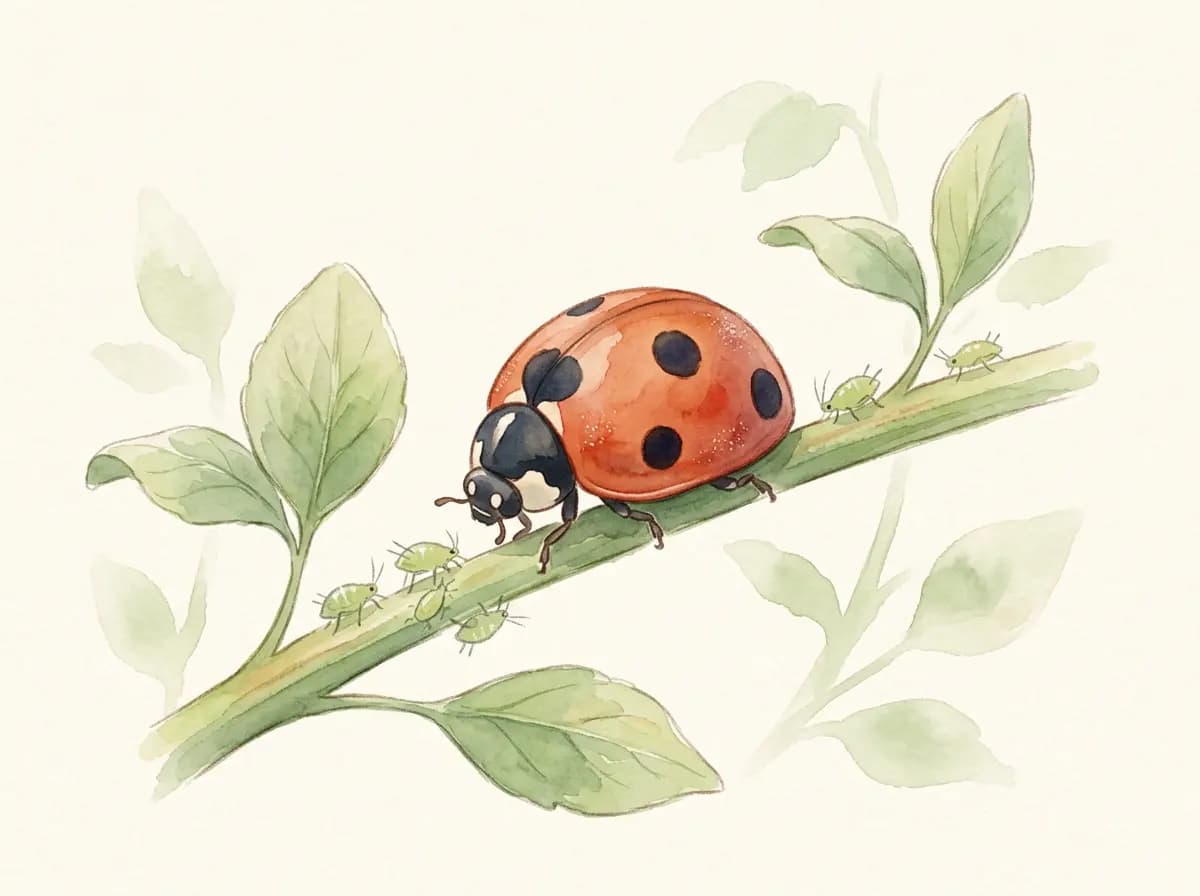
· 5-8 mmA bright red dome with seven black spots (other species have two, fourteen or twenty-two spots, or are black with red spots). Black head with two small white marks.
- Where to find it
- On shoots with aphids, small flowers and tall grasses.
- When: all year
- What to do
- Protect it. If you see aphids and ladybirds together, do nothing for a week. No insecticides, not even broad-spectrum organic ones.
- Often confused with
- Harlequin ladybird (Harmonia axyridis). Bigger (6-8 mm), with very variable colours and often a black "M" or "W" on a white background behind the head. Its larva is black with an L-shaped orange stripe. It also eats aphids, but it displaces the native ones: do not buy it or release it.
- Melon ladybird (Chnootriba elaterii). Orange with 12 black spots, matt and slightly hairy. It eats the leaves of melon, watermelon and courgette (leaving window-like scrapings), not aphids.
Nests, egg clutches and shelters
- Protect it
Groups of overwintering ladybirds
Dozens of ladybirds sitting still and huddled together, like a bunch of little red beads.
- Where to find it
- In cracks in bark, under leaf litter, between stones, in window frames and in insect hotels.
- When: Nov–Mar
- What to do
- Do not disturb them: leave a corner untidied in autumn and put up a south-facing insect hotel.
Often confused with
- Ladybird larva versus "a strange bug" or a pest. The ladybird larva is elongated, dark grey with orange spots and moves quickly among the aphids. Sap-sucking pests (aphids, scale insects) are small, soft and hardly move.
- Colorado potato beetle eggs. They are also yellow-orange and in clusters, but they are on potatoes, aubergines or tomato plants and not next to aphids; they are somewhat fatter and oval. See profile
- Harlequin ladybird (Harmonia axyridis). Bigger (6-8 mm), with very variable colours and often a black "M" or "W" on a white background behind the head. Its larva is black with an L-shaped orange stripe. It also eats aphids, but it displaces the native ones: do not buy it or release it.
- Melon ladybird (Chnootriba elaterii). Orange with 12 black spots, matt and slightly hairy. It eats the leaves of melon, watermelon and courgette (leaving window-like scrapings), not aphids.
Where and when to put it
- Spring and early summer: this is when there are aphids, eggs and larvae; it is the time for the rearing box.
- Late summer and autumn: winter shelters put up before the first frosts.
- Shelters: facing south or south-east, protected from wind and rain, near the crops.
- Plants to attract them: dill, fennel, calendula, yarrow, cornflower, chamomile and a nettle in a corner (it has its own aphids, which do not attack your crops).
Maintenance
- Put up with a few aphids: if you remove them all, ladybirds leave or do not breed. A few are their food.
- Do not use insecticides, not even broad-spectrum “organic” ones, when there are eggs, larvae or pupae.
- Leave the dry stems until the end of winter and prune afterwards.
- Check and top up the straw in the shelter at the end of summer; do not open it in winter.
- If ants are tending the aphids, put a sticky barrier on the trunk: that way the ladybirds can get to feed.
Common mistakes
What comes up most often, so you can avoid it from the start.
Buying and releasing the harlequin ladybird (Harmonia axyridis).
It is an invasive species: it is larger and hungrier than our native ones, it also eats their larvae and ends up displacing the local ladybirds.
Putting many larvae together with little food.
When they run short of aphids, the larvae eat one another. That is why it is best to rear three to five at most per container and give them fresh food every day.
Leaving the tub in the sun or without air.
Inside a closed container in the sun the heat rises enormously and the larvae die; without ventilation, moisture condenses and mould appears. Cover it with mesh and leave it in the shade.
Bringing in larvae from elsewhere or buying kits online without knowing the species or origin.
You may be releasing a foreign species (sometimes the harlequin ladybird) or insects with parasites and diseases. The ones already living in your garden are adapted to your area.
Spraying potassium soap or neem oil right where there are pupae.
The pupa is stuck to the leaf and cannot escape, so the product lands on it and may be fatal to it. If you have to treat, skip the leaves where you see them.
Plants that help
 DillAn aromatic annual dill, grown for both its leaves and its seed.
Its umbrella flowers are tiny and leave the nectar and pollen within reach of adult ladybirds, which have short mouthparts. It flowers in summer.
 FennelFennel grown for its leaves and aromatic seeds, hardier and wilder than bulb fennel.
It gives umbrella flowers, like dill, from summer to autumn. If you leave its dry stems standing, ladybirds shelter in them in winter.
 CalendulaAn annual with almost continuous orange or yellow edible flowers that self-sows year after year with hardly…
It flowers almost all year and gives pollen, which adult ladybirds eat when aphids are scarce.
 YarrowA wild plant with very finely cut, feathery leaves and white flowers in flat clusters.
Its flat clusters of little flowers, from spring to autumn, are easy for small insects such as ladybirds to visit.
 CornflowerA hardy annual with slender stems and narrow grey-green leaves that produces deep blue flower heads with…
Besides the flowers, its buds have glands that give off nectar, and ladybirds and other helpful insects drink that nectar.
 ChamomileCommon chamomile, grown for its flowers to make herbal tea.
Its open flowers, like little daisies, offer pollen with no effort in spring and summer.
 Stinging nettleOne of the most useful wild plants.
In spring it fills with an aphid of its own that does not move onto your vegetables; ladybirds breed there before the aphids reach your crops.
More information on the site
Sources
The measurements are a synthesis of these conservation guides; where each author gives different figures, they appear as a range.