
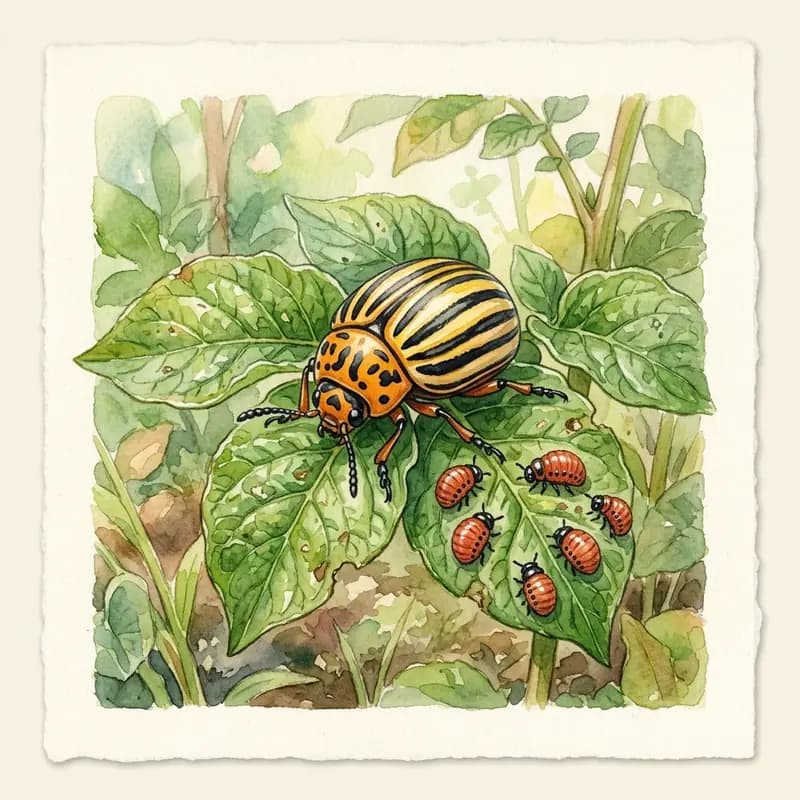
Colorado potato beetle
Also known as: Colorado potato beetle, Colorado beetle, potato beetle, potato bug, Leptinotarsa decemlineata
A yellow-and-black striped beetle whose voracious reddish larvae devour potato leaves. It can strip the plant bare. The first step is to pick it off by hand, along with the orange egg clusters on the undersides of the leaves.

Its best ally
Blue tit
A natural predator that helps to keep this pest under control. Tap to see how to attract it.

How to recognise it at every stage
Shares your gardenIt likes your potatoes and aubergines.
Life cycle: Complete metamorphosis: egg (4-10 days), larva (2-3 weeks), pupa in the soil (1-2 weeks) and adult. From egg to adult takes 4-6 weeks; two generations a year in most of Spain. Adults spend the winter buried.
Tap a stage to see it full size. The photos are AI reference images checked against real photographs; stages without a reliable photo are shown as text only.
Life-stage calendar
| Jan | Feb | Mar | Apr | May | Jun | Jul | Aug | Sep | Oct | Nov | Dec | |
|---|---|---|---|---|---|---|---|---|---|---|---|---|
| Eggs | ||||||||||||
| Larva | ||||||||||||
| Pupa | ||||||||||||
| Adult |
Approximate months for mainland Spain; in cold areas they start later and in warm areas they last longer. Garden creatures this month
- 1Protect your plants
Eggs
· 1.5 mmGroups of 10 to 40 oval, orange-yellow eggs standing on end.
- Where to find it
- On the undersides of potato, aubergine and tomato leaves.
- When: Apr–Aug
- What to do
- Check leaf undersides twice a week and remove the clutches with the leaf.
- Often confused with
- Ladybird eggs. Longer, in smaller groups and next to aphids. If they are on a potato or aubergine with no aphids, they are beetle eggs. See profile
- 2Protect your plants
Larva
· Up to 15 mmHump-backed and soft, orange-red, with a black head and two rows of black spots on each side.
- Where to find it
- Eating leaves at the top of the plant.
- When: May–Sep
- What to do
- Hand-pick them into a container in the morning. If there are many, Bacillus thuringiensis var. tenebrionis while they are small.
- 3Keep an eye on it
Pupa
· 1 cmOrange-yellow and soft, with legs and wings folded.
- Where to find it
- In a chamber 5-10 cm below ground.
- When: Jun–Sep
- What to do
- No need to dig: ground beetles and hens find many of them.
- 4Protect your plants
Adult
· 1 cmDomed, cream-yellow with ten black stripes on the wing cases and an orange shield with black spots.
- Where to find it
- On potato leaves; it comes out of the soil in April and May.
- When: Apr–Sep
- What to do
- Hand-pick them as soon as they appear, mulch with straw and rotate the crop every year.
- Often confused with
- Colourful leaf beetles (Chrysolina). Similar metallic beetles that live on mint, rosemary or lavender, not on potatoes.
Often confused with
- Ladybird eggs. Longer, in smaller groups and next to aphids. If they are on a potato or aubergine with no aphids, they are beetle eggs. See profile
- Colourful leaf beetles (Chrysolina). Similar metallic beetles that live on mint, rosemary or lavender, not on potatoes.
How to recognise it (symptoms)
- Oval beetles with yellow and black stripes on their backs
- Reddish, humpbacked larvae with black spots along their sides
- Leaves eaten down to the veins
- Clusters of orange eggs on the undersides of the leaves
Crops affected
 PotatoThe 'Kennebec' potato is versatile in the kitchen, with pale skin.
 AubergineAn aubergine with glossy black fruit, for warm climates.
 TomatoMarmande tomato, flattened and ribbed, a good size for salads.
 PepperCalifornia Wonder pepper, a blocky bell type with thick flesh, for stuffing or eating fresh.
What favours it
- Warm springs, which bring the adults out earlier
- Growing potatoes in the same place year after year, where the adults overwinter underground
- Lack of rotation and other Solanaceae growing nearby
Prevention
- Do not grow potatoes on the same plot year after year
- Check the undersides of the leaves and squash the orange egg clusters by hand: in a small garden this stops the next generation without any product
- If the pest is common in your area, plant a little earlier or later to avoid the peak of adults
Organic treatment
Always start here: these remedies are kind to the garden, the soil and pollinators.
- First: pick off adults, larvae and eggs by hand every 2-3 days, dropping them into soapy water. In a home garden this is the most effective and cheapest method
- Bacillus thuringiensis var. tenebrionis, if you can find a registered product, acts by ingestion on small larvae and does not affect bees
- A very fine layer of diatomaceous earth on the larvae has a limited effect and must be renewed after rain or watering; do not apply it to flowers
- Encourage insect-eating birds and other predators with hedges, water and nest boxes
Chemical treatment (with caution)
It can develop resistance to many insecticides. If they are used, use only products registered for the crop, alternating active ingredients and treating only while the larvae are small.
Don't confuse it with…
The adult is unmistakable thanks to its stripes. The larvae can be confused with ladybird larvae, which are elongated, greyish with orange spots and beneficial: do not squash them.
In-depth guide — Colorado potato beetle
Leptinotarsa decemlineata devours leaves rapidly in early summer. In a small garden, regular hand-picking solves most cases.
Recognising each stage
- Oval adult with yellow and black stripes.
- Reddish or pinkish larvae with black spots along the sides.
- Orange eggs in clusters on the undersides of the leaves.
Hand-picking
Check the plants every other day, ideally at dawn. Drop the beetles and larvae into a bucket of soapy water and squash the eggs whenever you find them.
Bacillus thuringiensis tenebrionis
It is specific to beetle larvae and works best on small ones. If you can find a registered product, apply it at dusk to the eaten leaves and repeat after rain, according to the label.
Rotation and edges
- Do not plant potatoes in the same soil without leaving a gap of at least three years.
- Remove wild Solanaceae from the edges, along with any solanaceous crop debris.
- If the pest arrives late, lift the potatoes earlier.
Use plant protection products responsibly, even organic ones. Always read and follow the label, the doses and the harvest interval, and never treat plants in flower or while bees are flying, in order to protect pollinators. If in doubt, put prevention and organic methods first.

In the plant catalogue you'll see what to plant, how and when: a well-tended plant resists pests much better.