
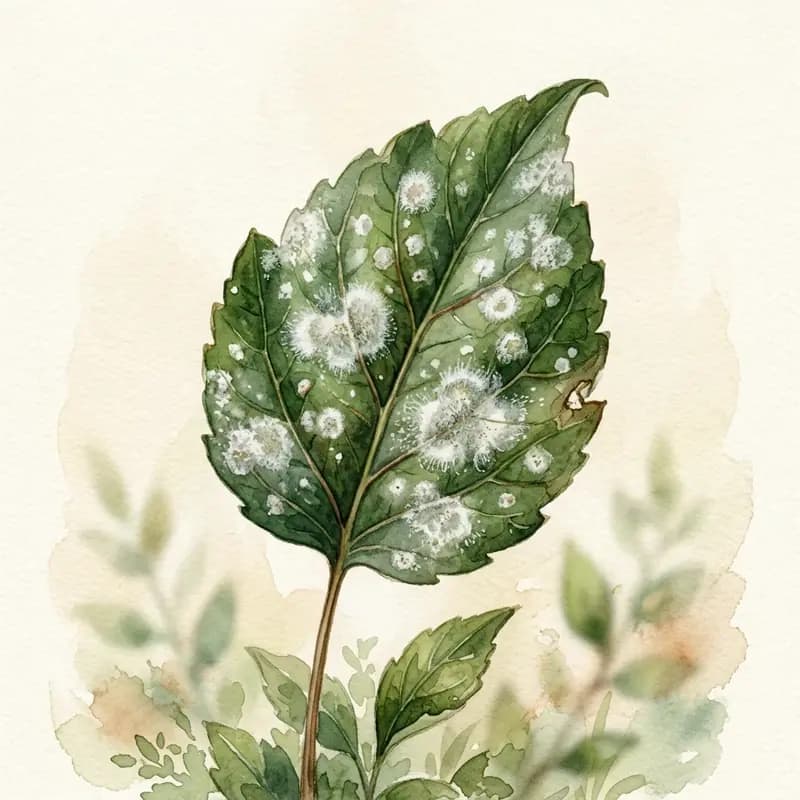
Powdery mildew
Also known as: powdery mildew, mildew, white mould on leaves, Erysiphe, Podosphaera
A fungus that covers the leaves in a white, flour-like powder. It is very common on cucurbits, weakens the plant and reduces the harvest. The first step is to remove the most heavily coated leaves and treat early with sulphur or bicarbonate of soda.

How to recognise it (symptoms)
- White or greyish powder, like talc, on the upper surface of the leaves
- It spreads to stems, shoots and sometimes the fruit
- Badly affected leaves turn yellow, dry out and twist
- The powder rubs off with a finger but comes back, because it is the fungus itself
Crops affected
 CourgetteA cylindrical, very dark green courgette, productive and early, the classic bush type for continuous picking.
 CucumberThe 'Marketmore' cucumber is a classic salad cucumber resistant to several diseases.
 SquashButternut squash: elongated, sweet and long-keeping.
 MelonPiel de Sapo is the classic Spanish melon, one that keeps for a long time.
 TomatoMarmande tomato, flattened and ribbed, a good size for salads.
 GrapevineA white grape with large, oval berries and a mild muscat flavour.
What favours it
- Warm conditions with high relative humidity, even when the leaves are dry
- Sharp swings in temperature between day and night
- Poor air circulation between plants
- Too much nitrogen, which produces soft, very susceptible leaves
Prevention
- Plant at generous spacing and remove the lower leaves so that air can circulate
- Water at the base, ideally with drip irrigation and early in the morning, to keep the leaves healthy
- Choose resistant varieties where available
- Do not overdo nitrogen fertiliser: soft new growth gets diseased sooner
Organic treatment
Always start here: these remedies are kind to the garden, the soil and pollinators.
- First: remove the most heavily coated leaves and put them in the rubbish bin, not on the compost heap, and thin the foliage so that air can circulate. Then treat the rest with sulphur or bicarbonate of soda
- Wettable or dusting sulphur (2.5-3 g per litre as a spray): do not apply it above 30 °C, because it scorches the leaves, or less than 3 weeks before or after an oil
- Bicarbonate of soda (5 g per litre, one level teaspoon) with 5 ml of vegetable oil to help it stick: it changes the pH of the leaf surface and makes life difficult for the fungus. Do not exceed 3-4 consecutive applications, and reapply after rain
- Diluted milk (1 part to 9 of water) as a preventive or at the first symptoms: it helps slow powdery mildew in its early stages, but will not cure a badly affected plant
Chemical treatment (with caution)
There are specific fungicides for powdery mildew, registered for each crop. Use them as a last resort, alternating active ingredients and respecting the safety interval on the label.
Don't confuse it with…
With downy mildew. Powdery mildew is a white powder on the upper surface of the leaf; downy mildew causes yellowish, oily-looking patches on the upper surface and a greyish fuzz underneath.
In-depth guide — powdery mildew
Powdery mildew needs humid air but not wet leaves. On cucurbits it turns up almost every summer: take preventive steps and act as soon as you see the first patches.
Bicarbonate of soda with oil (recipe)
5 g of bicarbonate of soda (one level teaspoon) and 5 ml of vegetable oil per litre of water. The bicarbonate raises the pH of the leaf surface and the oil helps it stick. Spray every 7-10 days during high-risk periods, with no more than 3-4 applications, because the sodium builds up in the soil.
Diluted milk (home-made preventive)
100 ml of milk per litre of water (10 %). Spray at the first symptoms or as a preventive, every 7-10 days. It works better early on than when the plant is already badly affected. If you overuse it, it smells unpleasant and can encourage other fungi.
Wettable sulphur
Between 2.5 and 3 g per litre, with a maximum of 4 applications per season. It is very effective, but never use it above 30 °C, because it scorches the leaves. Some varieties of melon, squash and courgette are sensitive: test it first on a few leaves.
Managing the plant
- Remove badly affected leaves and put them in the rubbish bin, away from the garden: do not compost them, because the spores can survive in a home compost heap.
- Thin the foliage of cucurbits to let air through.
- Leave generous spacing between plants: moving air dries the leaves.
- Water at the base in the morning, never with sprinklers.
Use plant protection products responsibly, even organic ones. Always read and follow the label, the doses and the harvest interval, and never treat plants in flower or while bees are flying, in order to protect pollinators. If in doubt, put prevention and organic methods first.

In the plant catalogue you'll see what to plant, how and when: a well-tended plant resists pests much better.