
Parasitoid wasps
Trichogramma, Encarsia formosa and others
Also called: Trichogramma, Encarsia, tiny wasp, parasitoid wasp, parasitic wasps
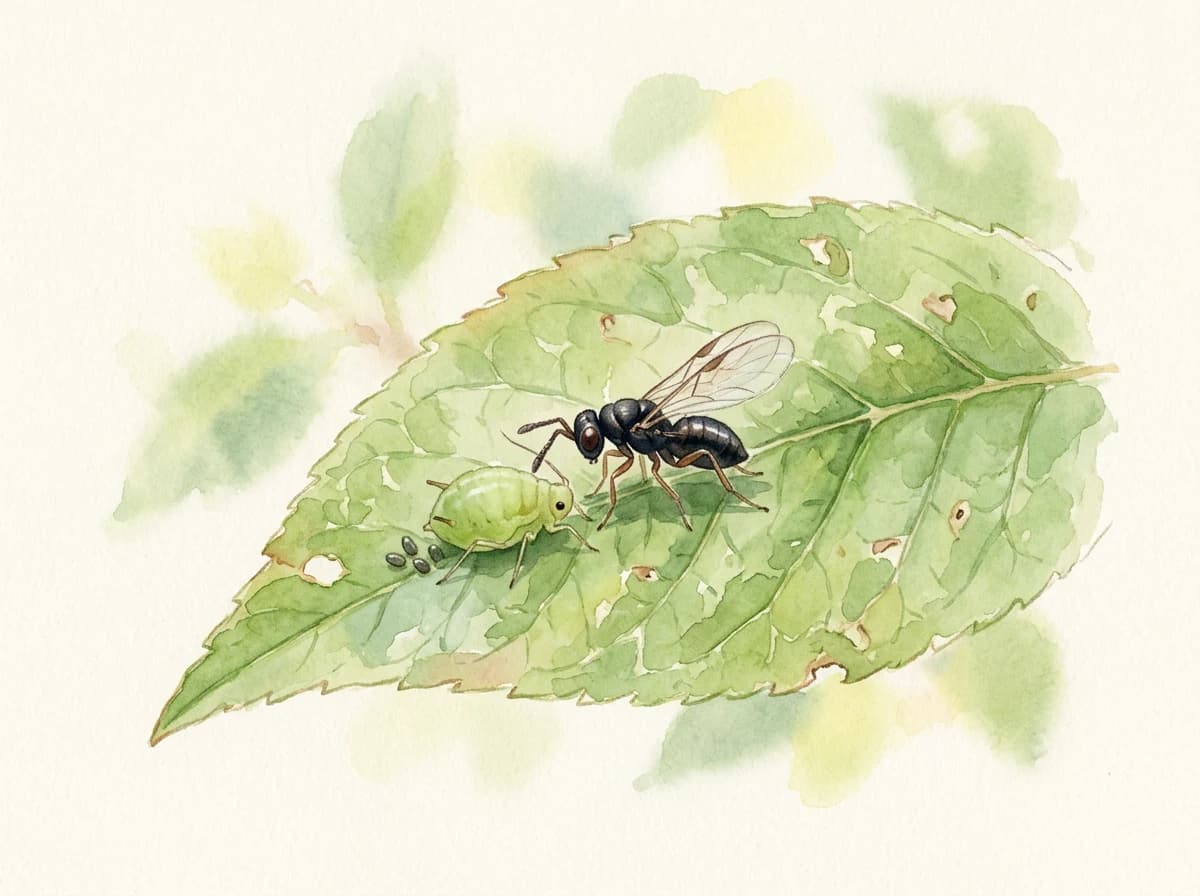
Microscopic wasps (1-3 mm) that lay their eggs INSIDE the garden's pests: aphids, whitefly, caterpillars. The larva eats the host from the inside. Although they are called wasps, they are harmless to people.

How to recognise it at every stage
Garden allyGarden ally: it lays its eggs inside aphids, whiteflies or caterpillars. It does not sting people.
Life cycle: Complete metamorphosis, almost entirely inside the host it parasitises: egg and larva develop inside the living aphid, which ends up as a "mummy"; the pupa forms inside and a tiny adult wasp comes out. In summer, about 10-14 days; many generations a year.
Tap a stage to see it full size. The photos are AI reference images checked against real photographs; stages without a reliable photo are shown as text only.
Life-stage calendar
| Jan | Feb | Mar | Apr | May | Jun | Jul | Aug | Sep | Oct | Nov | Dec | |
|---|---|---|---|---|---|---|---|---|---|---|---|---|
| Egg | ||||||||||||
| Larva | ||||||||||||
| Aphid mummy (pupa) | ||||||||||||
| Adult | ||||||||||||
| Yellow cocoons next to a caterpillar |
Approximate months for mainland Spain; in cold areas they start later and in warm areas they last longer. Garden creatures this month
No reliable photo yet
1Protect itEgg
· MicroscopicIt cannot be seen: the female lays it inside the aphid with a lightning-fast jab.
- Where to find it
- Inside living aphids (Aphidius), whitefly nymphs (Encarsia) or caterpillars (Cotesia).
- When: Mar–Nov
- What to do
- Avoid insecticides when there are aphids: you would also kill the little wasps inside them.
No reliable photo yet
2Protect itLarva
It cannot be seen either: it grows inside the aphid, which stays alive for a few days.
- Where to find it
- Inside the aphid.
- When: Mar–Nov
- What to do
- Be patient: in a week that aphid will be a mummy.
- 3Protect it
Aphid mummy (pupa)
· 2-3 mmSwollen, rounded, stiff aphids, golden, bronze or black, stuck to the leaf. Some have a small round hole: that is where the wasp came out.
- Where to find it
- Among the living aphids, on leaf undersides and shoots.
- When: Mar–Nov
- What to do
- Do not remove them or wash the leaves: each mummy is an ally wasp about to emerge.
- Often confused with
- Mummies versus aphids killed by fungi. Those killed by fungi look furry or powdery, whitish or beige. Mummies are smooth, shiny and hard.
- Mummies versus aphid moults. Moults are empty, white, flat and transparent skins that fall off by themselves. Mummies are swollen and bronze-coloured. See profile
- 4Protect it
Adult
· 2-3 mmA tiny black or brown wasp with a slim waist and long antennae. To sting the aphid it bends its abdomen forward between its legs.
- Where to find it
- Walking nervously among aphid colonies and on small flowers.
- When: Mar–Nov
- What to do
- Attract it with flowers with easy-to-reach nectar: fennel, dill, coriander, sweet alyssum, buckwheat.
Nests, egg clutches and shelters
- Protect it
Yellow cocoons next to a caterpillar
A cluster of little yellow silk cocoons, like grains of rice, stuck to a dead or dying cabbage caterpillar.
- Where to find it
- On cabbages, walls and fences near cabbages.
- When: May–Oct
- What to do
- They are not butterfly eggs! They are cocoons of Cotesia, a tiny ally wasp. Leave them where they are.
- Often confused with
- Cotesia cocoons versus cabbage white butterfly eggs. The butterfly's eggs stand upright, are ribbed and sit on the leaf underside; the cocoons are silky, cottony and sit next to a caterpillar. See profile
Often confused with
- Mummies versus aphids killed by fungi. Those killed by fungi look furry or powdery, whitish or beige. Mummies are smooth, shiny and hard.
- Mummies versus aphid moults. Moults are empty, white, flat and transparent skins that fall off by themselves. Mummies are swollen and bronze-coloured. See profile
- Cotesia cocoons versus cabbage white butterfly eggs. The butterfly's eggs stand upright, are ribbed and sit on the leaf underside; the cocoons are silky, cottony and sit next to a caterpillar. See profile
What it eats
- Larvae: they parasitise aphids, whitefly, butterfly caterpillars and the eggs of moths or stink bugs (Trissolcus attacks the egg batches of the green shield bug).
- Adults: nectar from small flowers.
How it helps in the garden
How to attract this ally to your garden
- Umbellifers and daisy-family plants: dill, fennel, coriander, yarrow, chamomile and alyssum in flower.
- Do not remove the brown, swollen aphids: they are "mummies" with a tiny wasp inside.
- In greenhouses they are sold as biological control (for example, Encarsia against whitefly).
Plants in the catalogue that attract it
 DillAn aromatic annual dill, grown for both its leaves and its seed.
 Common fennelFennel grown for its leaves and aromatic seeds, hardier and wilder than bulb fennel.
 CorianderAn annual coriander, grown for its leaves and for its seed.
 YarrowA wild plant with very finely cut, feathery leaves and white flowers in flat clusters.
 FeverfewA short-lived aromatic, perennial or biennial, 30 to 60 cm tall, which forms a rounded clump of…
What to avoid so you do not harm it by accident
- Any insecticide, organic ones included: they are so small that very little product kills them, and with them you lose the natural control of aphids.
- Yellow sticky traps put up when they are not needed: they also catch the adult wasps. Use them only to monitor a specific pest and take them down afterwards.
How to recognise it
1-3 mm, black or brown, transparent wings, long antennae. A parasitised aphid swells up, turns golden brown (a mummy) and has a small round hole where the adult wasp came out.
Risk to people: None. They are too small to sting a mammal.
Many allies are protected by Spanish law: do not capture or keep in captivity toads, hedgehogs, bats or native reptiles. Attract them, watch them and thank them from a distance. Rules in other countries differ: check your local regulations.

Allies do better if the garden is varied. Learn to identify each visitor and to prevent problems with good habits.