
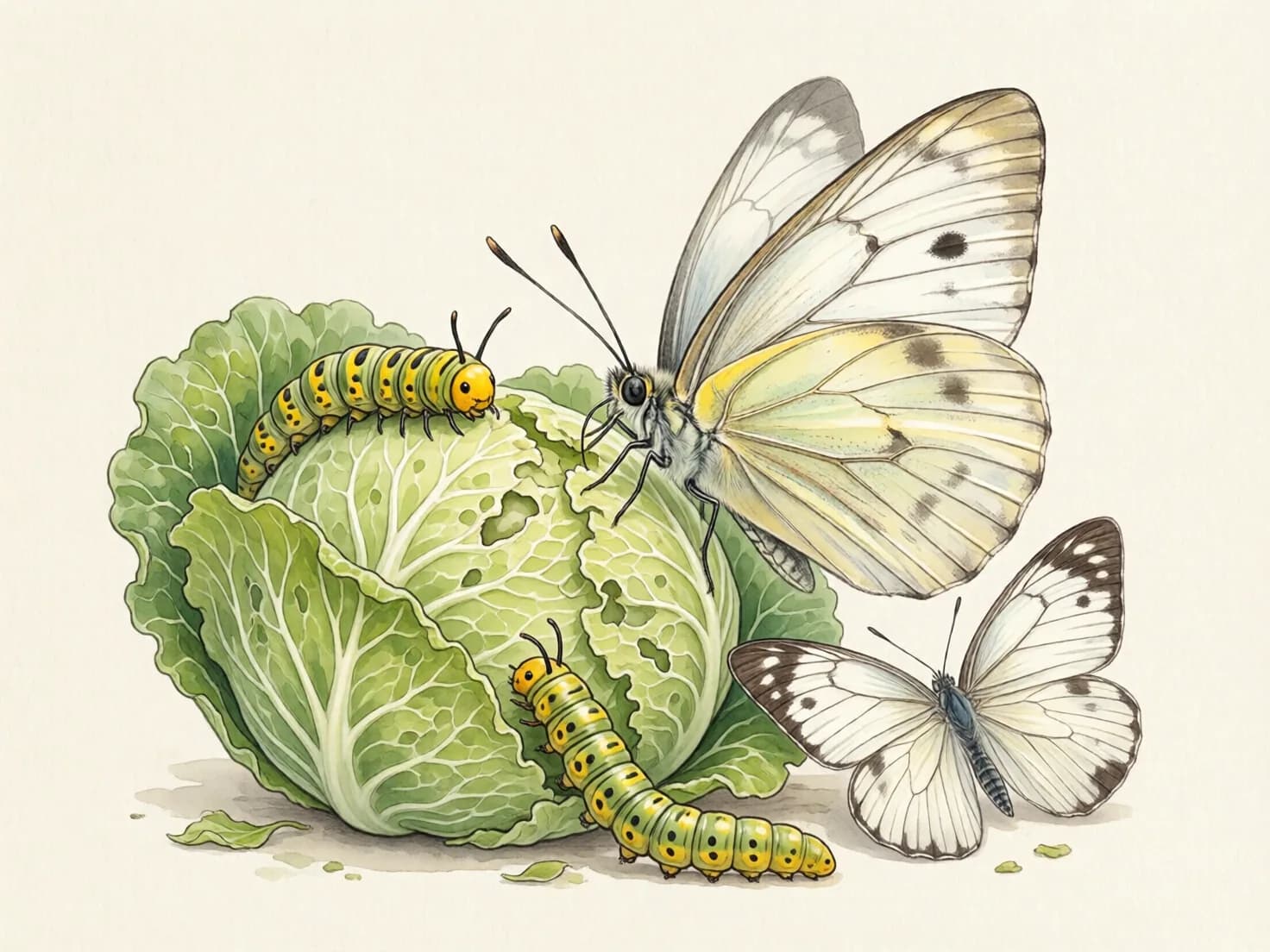
Cabbage white caterpillars (large and small white butterflies)
Also known as: cabbage white, cabbage white caterpillar, cabbage butterfly, large white, small white, Pieris brassicae, Pieris rapae, cabbage worm, imported cabbageworm
The caterpillars of the cabbage white butterflies (Pieris brassicae and P. rapae) eat the leaves of cabbages, broccoli, turnips and nasturtiums, and can leave them like lace. Checking the undersides every week, removing the egg clusters and covering with coarse netting almost always works; the caterpillars can be moved to wild brassicas.

How to recognise it at every stage
Shares your gardenIt may eat your cabbages. As an adult it is a white butterfly that also visits flowers.
Life cycle: Complete metamorphosis: egg (1-2 weeks), caterpillar (3-4 weeks), chrysalis (2 weeks in summer, the whole winter in the last generation) and butterfly. Two or three generations a year, up to four in the south.
Tap a stage to see it full size. The photos are AI reference images checked against real photographs; stages without a reliable photo are shown as text only.
Life-stage calendar
| Jan | Feb | Mar | Apr | May | Jun | Jul | Aug | Sep | Oct | Nov | Dec | |
|---|---|---|---|---|---|---|---|---|---|---|---|---|
| Eggs | ||||||||||||
| Caterpillar | ||||||||||||
| Chrysalis | ||||||||||||
| Butterfly |
Approximate months for mainland Spain; in cold areas they start later and in warm areas they last longer. Garden creatures this month
- 1Protect your plants
Eggs
· 1-1.5 mmGroups of 20 to 100 yellow, bottle-shaped, ribbed eggs standing upright. The small white (P. rapae) lays them singly, one at a time.
- Where to find it
- On the underside of the leaves of cabbages, broccoli, turnips and nasturtiums.
- When: Apr–Oct
- What to do
- Look at the underside of your cabbages once a week; if you would rather not have caterpillars, remove the eggs with your fingers or with the leaf.
- Often confused with
- Yellow cocoons of Cotesia. Clusters of little silk cocoons next to a dead caterpillar: they are allied tiny wasps. They are not butterfly eggs. See profile
- 2Protect your plants
Caterpillar
· Up to 4-5 cmYellowish green with black dots, yellow lines and fine hairs; they live in a group. The small white's is velvety green, solitary, with a thin yellow stripe.
- Where to find it
- On the underside and in the heart of cabbages, with holes and dark green droppings.
- When: Apr–Nov
- What to do
- Move them by hand to some nasturtiums or wild brassicas away from the bed, and put up insect netting. Bacillus thuringiensis only if needed and without touching other plants.
- Often confused with
- Diamondback moth caterpillar (Plutella). Much smaller (1 cm), green, wriggles and drops down on a thread if you touch it. See profile
- Cutworm caterpillars. Smooth, hairless, brown or green, they curl up and come out at night. See profile
- 3Keep an eye on it
Chrysalis
· 2-2.5 cmAngular, greenish grey with little black dots, held upright by a silk girdle.
- Where to find it
- On walls, fences, posts and stems, sometimes far from the cabbages.
- When: May–Mar
- What to do
- Leave it be: in winter it eats nothing and sometimes it is parasitised by allied tiny wasps.
- 4Keep an eye on it
Butterfly
· 5-6.5 cm wingspanWhite with black tips on the forewings; the female also has two black spots.
- Where to find it
- Fluttering over cabbages and flowers (lavender, clover, thistles).
- When: Mar–Oct
- What to do
- It is also a pollinator. If you want to protect your cabbages, fine netting in spring and summer prevents egg-laying.
Often confused with
- Yellow cocoons of Cotesia. Clusters of little silk cocoons next to a dead caterpillar: they are allied tiny wasps. They are not butterfly eggs. See profile
- Diamondback moth caterpillar (Plutella). Much smaller (1 cm), green, wriggles and drops down on a thread if you touch it. See profile
- Cutworm caterpillars. Smooth, hairless, brown or green, they curl up and come out at night. See profile
How to recognise it (symptoms)
- Large, irregular holes in the leaves, sometimes only the veins are left
- Dark green droppings between the leaves and in the heart
- Clusters of yellow, bottle-shaped eggs on the underside
- Yellowish-green caterpillars with black dots, in a group, or velvety green ones on their own
Crops affected
 CabbageSavoy cabbage, with blistered, crinkled leaves, which grows sweeter with the cold; it does best in autumn…
- White cabbageSavoy cabbage, with blistered, crinkled leaves, which grows sweeter with the cold; it does best in autumn…
 BroccoliCalabrese broccoli, with a compact green head.
 CauliflowerA classic cauliflower with a compact white curd.
 Brussels sproutsBrussels sprouts: small buttons that form along the stem and improve after light frosts.
 TurnipPurple Milan turnip, a quick root crop in cool weather.
 RocketFast-growing rocket with a peppery flavour.
 NasturtiumA climbing or trailing plant with edible flowers and leaves, with a peppery taste reminiscent of watercress…
What favours it
- Mild spring and late summer, when more butterflies fly
- Unprotected cabbages near nectar-rich flowers where the adults feed
Prevention
- Cover cabbages with insect netting from transplanting (spring to autumn)
- Check the underside of the leaves once a week and remove the egg clusters
- Plant nasturtiums as a trap crop at one end of the garden
- Attract parasitoid wasps (Cotesia) with flowering umbellifers
Organic treatment
Always start here: these remedies are kind to the garden, the soil and pollinators.
- Remove the egg clusters with the leaf or with your fingers
- Move the caterpillars by hand to nasturtiums or wild brassicas away from the bed
- Leave the clusters of yellow cocoons next to dead caterpillars alone: they are allied wasps
- Only if needed, Bacillus thuringiensis var. kurstaki on the affected cabbages, in the evening and following the label
Don't confuse it with…
With the diamondback moth (Plutella), whose caterpillar is much smaller and drops down on a thread, and with cutworms, smooth, nocturnal caterpillars. The yellow cocoons of Cotesia are not butterfly eggs.
Use plant protection products responsibly, even organic ones. Always read and follow the label, the doses and the harvest interval, and never treat plants in flower or while bees are flying, in order to protect pollinators. If in doubt, put prevention and organic methods first.

In the plant catalogue you'll see what to plant, how and when: a well-tended plant resists pests much better.