
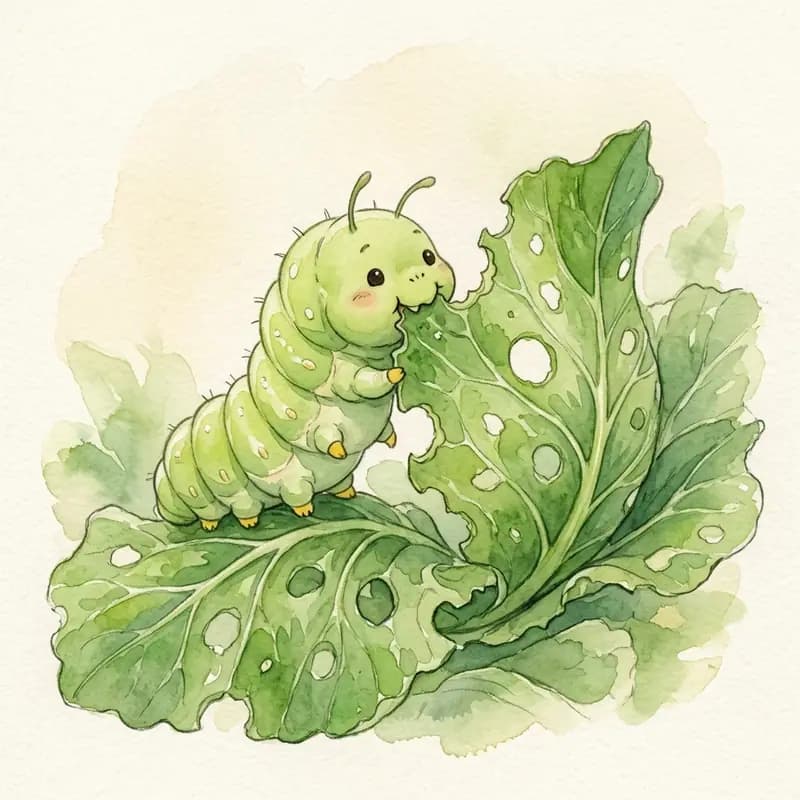
Caterpillars and armyworms
Also known as: caterpillars, armyworms, cutworms, cotton bollworm, tomato fruitworm, Spodoptera, Helicoverpa
The larvae of various moths and butterflies, which devour leaves and fruit, mostly at night. They include armyworms, which curl up when touched. The first step is to look for them at dusk, pick them off by hand and cover the crop with mesh.

Its best ally
Blue tit
A natural predator that helps to keep this pest under control. Tap to see how to attract it.

How to recognise it at every stage
Shares your gardenThey like your tomatoes, peppers, sweetcorn and lettuces, especially at night.
Life cycle: Complete metamorphosis: egg (3-5 days), caterpillar (2-4 weeks), pupa in the soil (1-3 weeks) and night-flying moth. Four to six generations a year in warm areas; they spend the winter as buried pupae.
Tap a stage to see it full size. The photos are AI reference images checked against real photographs; stages without a reliable photo are shown as text only.
Life-stage calendar
| Jan | Feb | Mar | Apr | May | Jun | Jul | Aug | Sep | Oct | Nov | Dec | |
|---|---|---|---|---|---|---|---|---|---|---|---|---|
| Eggs | ||||||||||||
| Caterpillar | ||||||||||||
| Pupa | ||||||||||||
| Moth |
Approximate months for mainland Spain; in cold areas they start later and in warm areas they last longer. Garden creatures this month
- 1Keep an eye on it
Eggs
· 0.5 mmThe cotton bollworm (Helicoverpa) lays them singly: ribbed white spheres. Armyworms lay them in groups covered with brown fluff.
- Where to find it
- On tender leaves, flowers and sweetcorn silks.
- When: Apr–Oct
- What to do
- A pheromone trap tells you when the moths are flying: that is when to check the plants.
- 2Protect your plants
Caterpillar
· Up to 3-4 cmSmooth or with few hairs, green, brown or pinkish, with pale lines along the body. It curls up when touched.
- Where to find it
- Eating leaves and boring into fruit (tomatoes, cobs); hidden by day.
- When: May–Nov
- What to do
- Look for them at dusk with a torch and move them away from the garden. If there are many and they are small, Bacillus thuringiensis. Ground beetles, birds and tiny wasps help.
- Often confused with
- Cutworms (Agrotis). They live in the soil and cut seedlings off at ground level at night. See profile
- Cabbage white caterpillar. Hairy with black dots, in groups and only on brassicas. See profile
- 3Keep an eye on it
Pupa
· 1.5-2 cmReddish-brown, shiny and smooth, with no cocoon.
- Where to find it
- Buried a few centimetres under the plant.
- When: May–Mar
- What to do
- A shallow dig in autumn leaves them in view of the birds.
- 4Keep an eye on it
Moth
· 3-4 cm wingspanA brown, ochre or greyish night moth with faint markings on the forewings.
- Where to find it
- Flies at night and is drawn to lights; by day, still among the leaves.
- When: Apr–Oct
- What to do
- Let bats do the work: each one eats hundreds of moths a night.
Often confused with
- Cutworms (Agrotis). They live in the soil and cut seedlings off at ground level at night. See profile
- Cabbage white caterpillar. Hairy with black dots, in groups and only on brassicas. See profile
How to recognise it (symptoms)
- Leaves with large bites and irregular holes
- Green or black droppings, like little pellets, on the leaves
- Fruit bored from the inside (tomato, pepper, sweetcorn)
- Seedlings cut off at ground level overnight, typical of cutworms (Agrotis) and some armyworms
Crops affected
 Cabbages and other brassicasSavoy cabbage, with blistered, crinkled leaves, which grows sweeter with the cold; it does best in autumn…
 LettuceCos lettuce, with a long, crisp heart.
 TomatoMarmande tomato, flattened and ribbed, a good size for salads.
 PepperCalifornia Wonder pepper, a blocky bell type with thick flesh, for stuffing or eating fresh.
 SweetcornMaize with tender, sugary kernels for eating on the cob.
 ChardA chard with broad white stalks that produces a great many leaves.
What favours it
- Mild spring and summer nights, when moths are most active
- Weeds and plant debris where they shelter and lay eggs
- Soils with lots of undecomposed plant matter, which feeds and shelters the larvae
Prevention
- Cover brassicas with insect-proof mesh or fleece: it stops cabbage white butterflies laying eggs on the leaves
- Check the undersides of the leaves and squash the egg clusters before the caterpillars hatch
- Keep the edges of the garden tidy: many butterflies and moths lay first on weeds and then move on to the crop
- Encourage insect-eating birds and parasitic wasps with hedges, water and flowers
Organic treatment
Always start here: these remedies are kind to the garden, the soil and pollinators.
- First: pick the caterpillars off by hand at dusk, when they come out to feed (they hide during the day), and cover brassicas with mesh to keep more from getting in
- If there are a lot, apply Bacillus thuringiensis var. kurstaki (a registered product) at dusk: the smaller the caterpillars, the better it works. It also affects the caterpillars of wild butterflies, so do not apply it to flowers
- Pheromone traps for adult moths: they tell you when they are flying and when it is worth hand-picking or applying Bt
- To protect seedlings from cutworms and armyworms, place a collar (a ring of cardboard or plastic) around the stem, pushed a few centimetres into the soil
Chemical treatment (with caution)
Bt is usually enough. If not, there are insecticides registered for each crop: apply them at dusk, respect the safety interval and protect pollinators.
Don't confuse it with…
Slugs and snails also make large holes, but they leave a shiny slime trail rather than dry droppings.
In-depth guide — caterpillars on vegetables and fruit trees
The larvae of butterflies and moths, which strip leaves and bore into fruit. In a home garden, frequent inspection and Bacillus cover most cases.
Working out which caterpillar it is
- Hairy caterpillar: it may have stinging hairs (like the pine processionary); do not touch it without gloves.
- Smooth green caterpillar on brassicas: probably the cabbage white butterfly or the diamondback moth.
- Large holes in tomatoes and peppers: possibly a noctuid moth caterpillar.
Hand-picking
Go out at dawn or after dark with a torch. Take a bucket with a lid and do not leave the caterpillars you collect on the ground in the garden.
Bacillus thuringiensis
It is effective against the leaf-eating larvae of butterflies and moths. Apply it at dusk, because sunlight breaks down the toxin quickly, and follow the label of the registered product.
Protecting the fruit
- Fine mesh over tomatoes and peppers when the first holes appear (allowing for pollination).
- Remove tall weeds that serve as daytime shelter.
- In large gardens, use pheromone traps to find out when each species is flying.
Use plant protection products responsibly, even organic ones. Always read and follow the label, the doses and the harvest interval, and never treat plants in flower or while bees are flying, in order to protect pollinators. If in doubt, put prevention and organic methods first.

In the plant catalogue you'll see what to plant, how and when: a well-tended plant resists pests much better.