
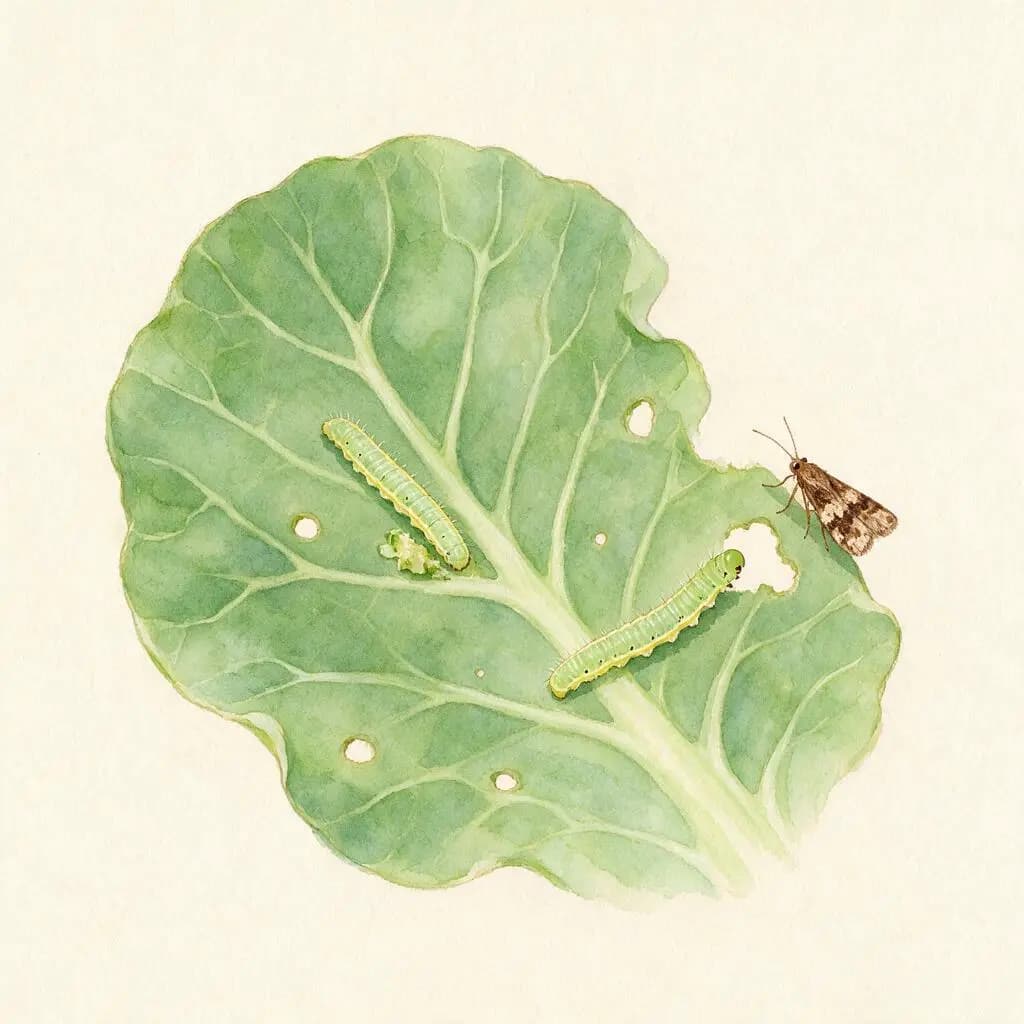
Diamondback moth
Also known as: diamondback moth, cabbage moth, Plutella xylostella, brassica moth, DBM
A small moth whose greenish caterpillars (5 to 10 mm long) make small holes and tunnels in the leaves of brassicas. It easily becomes resistant to insecticides because it has many generations a year. The first step is to cover the crop with fine mesh and remove leaves with caterpillars on them.
Its best ally
Parasitic wasp
A natural predator that helps to keep this pest under control. Tap to see how to attract it.

How to recognise it at every stage
Shares your gardenIt likes your cabbages, broccoli and radishes.
Life cycle: Complete metamorphosis: egg (3-6 days), caterpillar (1-3 weeks), pupa in a net-like cocoon (1-2 weeks) and moth. In warm weather, a cycle in 2-3 weeks: many generations a year.
Tap a stage to see it full size. The photos are AI reference images checked against real photographs; stages without a reliable photo are shown as text only.
Life-stage calendar
| Jan | Feb | Mar | Apr | May | Jun | Jul | Aug | Sep | Oct | Nov | Dec | |
|---|---|---|---|---|---|---|---|---|---|---|---|---|
| Eggs | ||||||||||||
| Caterpillar | ||||||||||||
| Pupa in a net cocoon | ||||||||||||
| Moth |
Approximate months for mainland Spain; in cold areas they start later and in warm areas they last longer. Garden creatures this month
- 1Keep an eye on it
Eggs
· 0.5 mmOval, flattened, pale yellow; laid singly or in twos and threes.
- Where to find it
- On leaf undersides, next to the veins.
- When: Mar–Nov
- What to do
- Fine mesh from transplanting and there will be no eggs.
- 2Protect your plants
Caterpillar
· Up to 1 cmLight green, slim and pointed at both ends. If you touch it, it wriggles wildly and drops on a silk thread.
- Where to find it
- On the undersides and in the heart; leaves small transparent windows and holes.
- When: Mar–Nov
- What to do
- Pick off leaves with caterpillars. Bacillus thuringiensis only if there are many.
- Often confused with
- Cabbage white caterpillar. Much bigger (up to 4-5 cm), hairy with black dots; it does not drop on a thread. See profile
- 3Keep an eye on it
Pupa in a net cocoon
· 8 mmA white silk cocoon like a loose net, through which the green or brown pupa can be seen.
- Where to find it
- Stuck to leaf undersides or stems.
- When: Mar–Nov
- What to do
- Remove it with the leaf if you like; if it is dark and open, an ally wasp probably came out of it.
- 4Keep an eye on it
Moth
· 8 mmA small, slim grey-brown moth; with the wings folded a pale wavy band along the back forms diamond shapes.
- Where to find it
- Hidden among leaves; flies at dusk.
- When: Mar–Nov
- What to do
- Flowering umbellifers near the brassicas attract the tiny wasps (Diadegma, Cotesia) that keep it in check.
Often confused with
- Cabbage white caterpillar. Much bigger (up to 4-5 cm), hairy with black dots; it does not drop on a thread. See profile
How to recognise it (symptoms)
- Small, regular holes in the leaves of cabbage, broccoli and cauliflower
- Very slender green caterpillars that wriggle and drop down on a silk thread when disturbed
- Whitish, net-like cocoons on the undersides of the leaves
- Hearts eaten and soiled with black droppings
Crops affected
 CabbageSavoy cabbage, with blistered, crinkled leaves, which grows sweeter with the cold; it does best in autumn…
- Round cabbageSavoy cabbage, with blistered, crinkled leaves, which grows sweeter with the cold; it does best in autumn…
 BroccoliCalabrese broccoli, with a compact green head.
 CauliflowerA classic cauliflower with a compact white curd.
 RocketFast-growing rocket with a peppery flavour.
 Radish'Cherry Belle' is a round and very fast radish: it is harvested in three or four weeks.
What favours it
- Hot, dry summers, which speed up its life cycle and allow more generations
- Brassica monocultures without rotation, which keep the pest within constant reach
Prevention
- Cover the crop with fine insect-proof mesh from transplanting, sealing the edges well
- Rotate brassicas so they do not return to the same plot for at least 3-4 years
- Strong-smelling herbs (thyme, rosemary, sage) among the brassicas may confuse the moths, although the effect is modest
- Clear away crop debris when you finish harvesting
Organic treatment
Always start here: these remedies are kind to the garden, the soil and pollinators.
- First: cover the brassicas with well-secured fine mesh and pick off by hand any leaves with webbing or caterpillars
- If there are many caterpillars, spray Bacillus thuringiensis var. kurstaki (a registered product) on the undersides of the leaves at dusk, according to the label; it works best on small caterpillars
- Pheromone traps to find out when the adults are flying
- Encourage parasitoid wasps (Diadegma, Cotesia) with umbellifer flowers such as fennel or dill along the edge of the garden
Don't confuse it with…
With the caterpillars of the cabbage white butterfly (Pieris), which are thicker, velvety and yellowish green with black dots.
In-depth guide — diamondback moth (Plutella xylostella)
A small moth whose larvae leave webbing and holes in brassicas. Mesh from transplanting plus Bacillus is the usual combination in the organic vegetable garden.
Fine mesh
Put it in place when you transplant cabbage, cauliflower and broccoli, keeping it off the leaves, and seal the edges with soil or stones. The moth is small, so the mesh must be fine and free of holes.
Bacillus thuringiensis kurstaki
Spray at dusk when you see webbing or green larvae, using a registered product and following the label. Repeat if it has rained or you have used sprinklers since treating.
Refuge plants and allies
- Umbellifer flowers along the edge for the parasitoids.
- Clear away brassica debris after harvest.
- Rotate with crops that are not crucifers.
Hand-picking
In a light infestation, remove the leaves with webbing and larvae before they pupate on the leaf.
Use plant protection products responsibly, even organic ones. Always read and follow the label, the doses and the harvest interval, and never treat plants in flower or while bees are flying, in order to protect pollinators. If in doubt, put prevention and organic methods first.

In the plant catalogue you'll see what to plant, how and when: a well-tended plant resists pests much better.