
Insectary plants and flowering borders
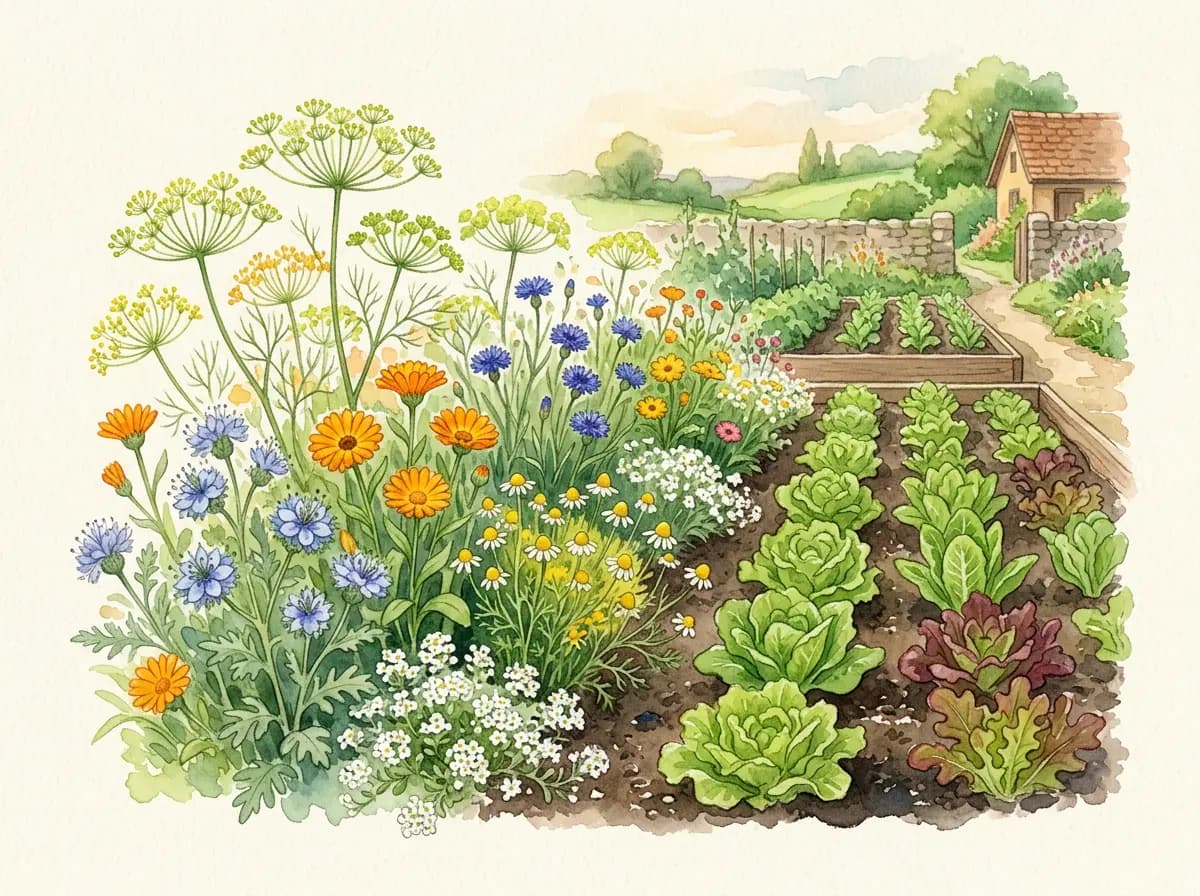
A flowering border is the simplest “habitat”: a strip of flowers, stems and grasses next to the crops. It feeds ladybirds, lacewings, hoverflies, bees and parasitoid wasps, which then work in your garden.
- Difficulty: easy
- Border width: 50 cm at least; 1 m is ideal
What it helps with
- To give pollen and nectar all year round to the adults of the insects that eat aphids.
- To attract pollinators to fruit trees and vegetables.
- To give shelter and an overwintering place to many allies.
Materials
- Seeds or plants of the species in the guide
- A rake and a hoe
- Watering at sowing and in the first months
- No fertiliser needed
Measurements
- Border width
- 50 cm at least; 1 m is ideal
- Length
- as much as fits; best along the bed
- Mix
- 3–4 species with different flowering times: winter, spring, summer and autumn
- Sowing
- broadcast, covering with 0.5 cm of soil and watering
Step by step
1. Choose the border
A sunny strip of 50–100 cm beside the bed, under the fruit trees or at the edge of the garden. The closer to the crops, the better.

2. Prepare the soil
Remove the most aggressive weeds (couch grass, Johnson grass), loosen 5–10 cm and rake finely. Do not fertilise: wildflowers prefer poor soil.

3. Sow
Broadcast in autumn (spring flowers) and in spring (summer flowers). Cover with 0.5 cm of soil and water. Cover with a light straw mulch to keep the moisture in.

4. Combine by season
Winter: rosemary, heather. Spring: borage, phacelia, sweet alyssum. Summer: dill, fennel, coriander, calendula, cornflower, chamomile, yarrow, sunflower. Autumn: aster, ivy.

5. Let it go to seed
Let it self-seed. Umbellifers (dill, fennel, carrot) in flower are ideal for lacewings and hoverflies.

Where and when to put it
- Sowing: autumn (September–November) or spring (March–April).
- Direct sun for most of the day.
- Beside the beds, at the edges of the garden or under fruit trees.
Maintenance
- Mow once a year, at the end of winter, leaving the stems until then.
- Cut back only half each time, so there is always shelter.
- Do not fertilise or use insecticides.
- Every few years, replace any annuals that have disappeared.
Common mistakes
What comes up most often, so you can avoid it from the start.
Sowing double garden flowers.
They have so many petals that they hide the centre of the flower, where the pollen and nectar are, and insects cannot feed. Choose single-flowered varieties.
Buying seed mixes without checking which species they contain.
Some mixes include invasive plants that escape from the garden and displace the local plants. Check the label and look for species from your area.
Sowing too thickly.
The plants come up crowded, compete for light and water and turn out weak, with fewer flowers. A handful of seed per square metre is enough.
Mowing everything in summer.
That is exactly when most insects are using it: you take away their food in the middle of the season and destroy eggs and larvae. Mow at the end of winter, and only half each time.
Over-fertilising and over-watering.
With lots of fertiliser and water, wild plants put out many leaves and few flowers, and the strongest grasses end up smothering the rest.
Plants that help
 PhaceliaA green manure with violet-blue flowers that grows fast and attracts bees like few other plants.
It flowers 6–8 weeks after sowing and gives a huge amount of nectar and pollen; it is one of the fastest for starting a border.
 Sweet alyssumA ground-covering plant with tiny, highly scented flowers in dense clusters, perfect for the edges of beds…
A low plant that flowers almost all year, with honey-scented little flowers; perfect for the edge of the bed.
 CalendulaAn annual with almost continuous orange or yellow edible flowers that self-sows year after year with hardly…
It flowers almost all year, even in winter in mild areas, and gives food when there are few flowers.
 DillAn aromatic annual dill, grown for both its leaves and its seed.
Its umbrella flowers, in summer, have the nectar close to hand for ladybirds, lacewings, hoverflies and parasitic wasps.
 FennelFennel grown for its leaves and aromatic seeds, hardier and wilder than bulb fennel.
It flowers from summer to autumn with umbrella flowers and its dry stems serve as shelter in winter.
 CorianderAn annual coriander, grown for its leaves and for its seed.
If you let it bolt, it fills with little white flowers in a few weeks, much visited by helpful insects.
 BorageA leaf and flower vegetable, very hardy and typical of Aragon and Navarre in northern Spain, where the stems…
It flowers in spring with blue flowers that fill with nectar very quickly; bees and bumblebees visit it non-stop.
 CornflowerA hardy annual with slender stems and narrow grey-green leaves that produces deep blue flower heads with…
As well as the flowers, it releases nectar from glands on the buds, and many helpful insects drink it.
 YarrowA wild plant with very finely cut, feathery leaves and white flowers in flat clusters.
A perennial that flowers from spring to autumn in flat clusters, easy for small insects to visit.
 ChamomileCommon chamomile, grown for its flowers to make herbal tea.
Its open flowers, like little daisies, leave the pollen within reach of almost any insect.
 CosmosA free-flowering annual with feathery foliage, bearing flowers in shades of pink, white or crimson all…
Its simple, open flowers last from summer until the first frosts and lengthen the season.
 French marigoldA compact marigold, widely used in the vegetable garden alongside tomatoes.
It flowers all summer; choose the single-flowered varieties, which are the ones hoverflies visit.
 White cloverA low-growing legume that covers the ground all year round and fixes nitrogen, so it works in paths between…
It covers the soil, flowers from spring to autumn and is a very important source of nectar for bees and bumblebees.
 Nasturtium (aphid trap plant)A climbing or trailing plant with edible flowers and leaves, with a peppery taste reminiscent of watercress…
Black aphids prefer it to other plants: it draws them away from your crops and that colony serves as food for ladybirds and hoverflies.
More information on the site
Sources
The measurements are a synthesis of these conservation guides; where each author gives different figures, they appear as a range.