
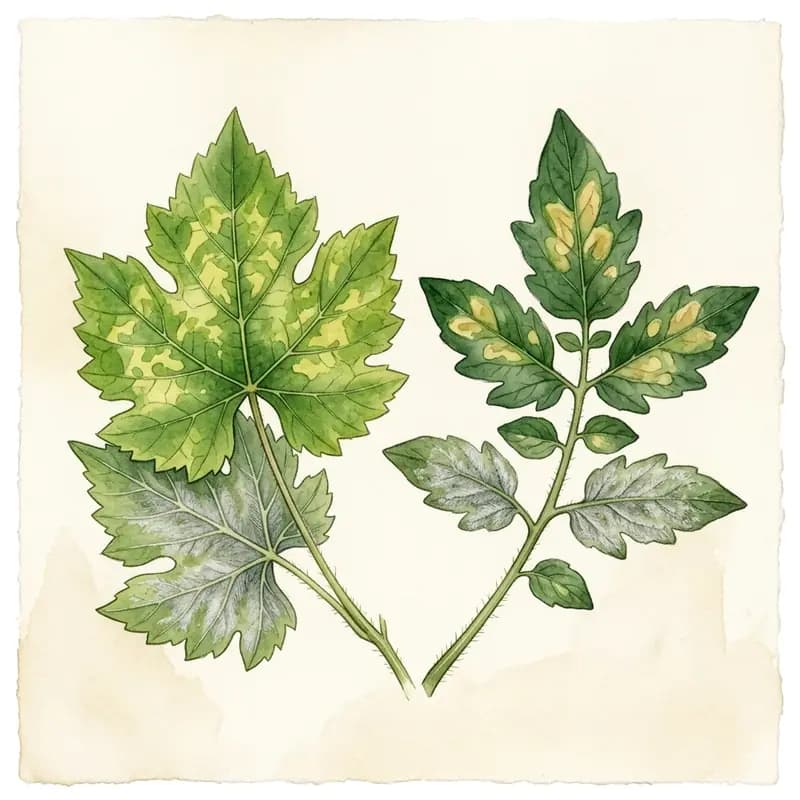
Downy mildew
Also known as: downy mildew, late blight, potato blight, tomato blight, Phytophthora, Peronospora
A very destructive disease encouraged by damp conditions. It causes oily-looking patches on the upper surface of the leaves and a greyish fuzz underneath, and can wipe out a tomato patch in a few days. The first step is to remove spotted leaves immediately and protect the rest with copper.

How to recognise it (symptoms)
- Yellowish or oily-looking patches on the upper surface of the leaves
- Grey or whitish fuzz on the underside, right below those patches, especially in damp weather
- Brown patches that spread and dry out the whole leaf
- Hard brown patches on stems and fruit (tomato, potato), which eventually rot
Crops affected
 TomatoMarmande tomato, flattened and ribbed, a good size for salads.
 PotatoThe 'Kennebec' potato is versatile in the kitchen, with pale skin.
 GrapevineA white grape with large, oval berries and a mild muscat flavour.
 OnionThe Figueres onion is a sweet onion with purplish skin, typical of Catalonia in Spain.
 LettuceCos lettuce, with a long, crisp heart.
 CucumberThe 'Marketmore' cucumber is a classic salad cucumber resistant to several diseases.
What favours it
- High humidity and leaves that stay wet for many hours, allowing the spores to germinate and penetrate
- Frequent rain, dew and mist
- Mild temperatures (15-22 °C), at which the disease spreads faster
Prevention
- Use drip irrigation or water at the base and do not wet the foliage: damp leaves encourage downy mildew and other diseases
- Space and stake plants well so that they dry quickly
- Rotate crops and do not plant tomatoes where potatoes have grown: both share the same blight (late blight), which survives in debris and tubers
- Remove the lower leaves and diseased debris to break the cycle from one season to the next
Organic treatment
Always start here: these remedies are kind to the garden, the soil and pollinators.
- First: remove spotted leaves and fruit straight away, put them in the rubbish bin (not on the compost heap) and stop wetting the foliage. Then protect the healthy plants with a copper preparation before rain
- Bordeaux mixture or other copper preparations, mainly as a preventive and in moderation (maximum 3-4 treatments per season). Copper builds up in the soil and harms earthworms, so do not apply it during flowering or near watercourses
- Horsetail decoction diluted 1:5, once a week: it provides silica and helps as a preventive, but does not cure plants that are already diseased
- Water less often and improve ventilation between plants to lower the humidity the fungus needs
Chemical treatment (with caution)
There are specific fungicides for downy mildew, registered for each crop. Use them as a last resort, following the label and the safety interval. Copper, although permitted in organic farming, should not be overused.
Don't confuse it with…
With powdery mildew, which is a white powder on the upper surface of the leaf, and with early blight (Alternaria). Downy mildew can be recognised by the grey fuzz on the underside beneath the oily patches.
In-depth guide — downy mildew
Late blight on potatoes and tomatoes can destroy the crop in a few days. If in summer or autumn there are several days of rain or mist with mild temperatures (15-22 °C), it is worth checking the plants daily.
Horsetail (recipe)
Soak 1 kg of fresh horsetail (or 100-150 g dried) in 10 litres of water for 24 hours, then boil for 20-30 minutes. Strain, leave to cool and dilute 1 part decoction in 5 parts water. Spray once a week as a preventive. It strengthens the plant, but is no substitute for copper.
Bordeaux mixture
A mixture of copper sulphate and lime. The usual concentration is 0.5-1 % (5-10 g of copper sulphate and the same amount of lime per litre of water), starting at 0.5 % on tomatoes and young plants. It is mainly a preventive. Do not use it on open flowers or near water, and limit it to 3-4 applications per season, because copper builds up in the soil. In a small garden it is simpler and safer to buy ready-made Bordeaux mixture.
Remove it now and do not compost
- At the first symptom, remove spotted leaves and fruit and take them out of the garden.
- A mulch prevents soil splashing onto the leaves, which carries spores with it.
- Remove the lower leaves and leave space between plants so that they are well ventilated.
- If you live in a damp area, look for tomato or potato varieties with resistance to downy mildew (late blight).
Monitoring during high-risk periods
- Check the undersides of the leaves every 3 days.
- If you see a suspicious patch, remove the leaf and step up the copper protection.
- After each long spell of rain, consider repeating the preventive copper, without exceeding the maximum number of applications.
Acting within 24 hours makes the difference between saving the crop and losing it.
Use plant protection products responsibly, even organic ones. Always read and follow the label, the doses and the harvest interval, and never treat plants in flower or while bees are flying, in order to protect pollinators. If in doubt, put prevention and organic methods first.

In the plant catalogue you'll see what to plant, how and when: a well-tended plant resists pests much better.