In this article (21 sections)
- Balcony check-up
- Sample layout (south-facing balcony of 2 m², 22 sq ft usable)
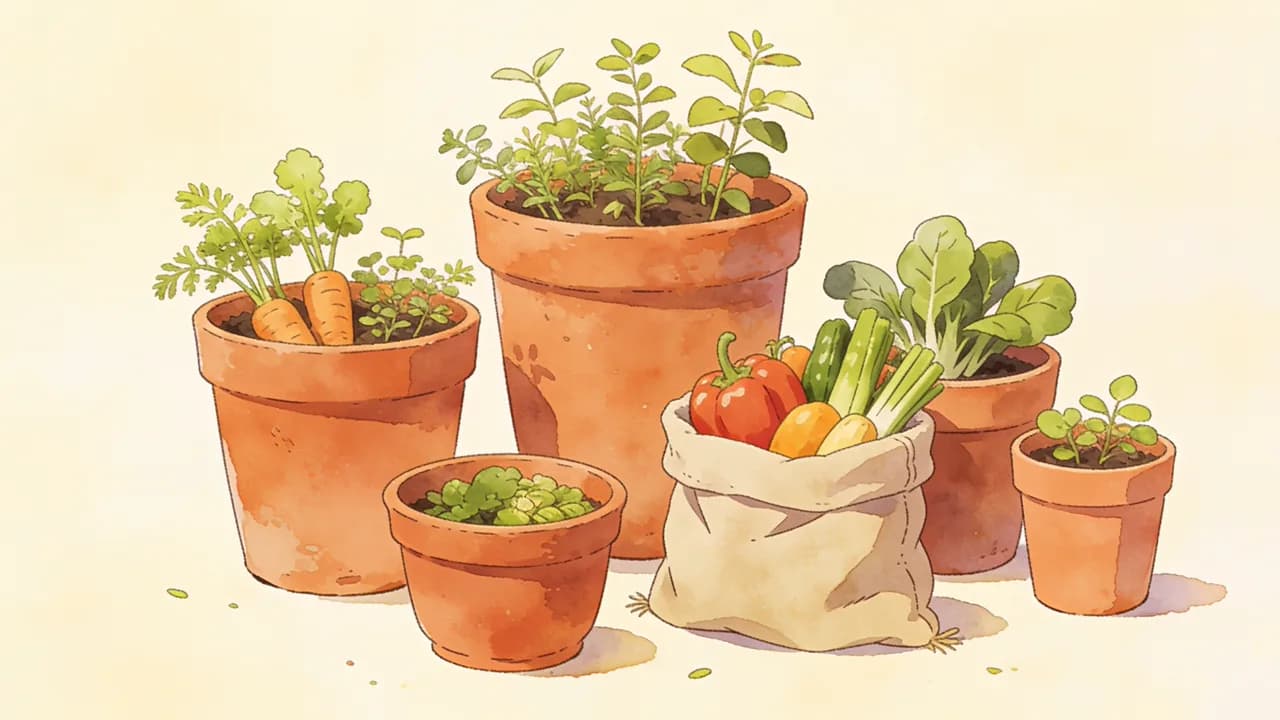
- Pots and containers
- Potting mix
- Yearly calendar
- March-April
- May-June
- July-August
- September
- October-December
- January-February
- Watering
- Windbreak and shade
- Minimum tools
- Expected harvest
- Common mistakes
- Pots that are too small
- Garden soil in a pot
- Not feeding during the season
- Little water but every day
- If you want to grow
An ordinary balcony measures between 3 and 8 m² (86 sq ft). With just 2 m² (22 sq ft) of usable surface you can have salad, herbs and some fruit for almost the whole year. This is a realistic plan, designed for a Mediterranean balcony.
Balcony check-up

Before buying anything, check five things:
- Orientation: the best is south, followed by east and west. North only suits leafy plants and shade-loving herbs.
- Real hours of sun: watch it for a whole day and write it down. You need at least 4 hours of sun for leafy plants and 6 for fruiting ones (tomato, pepper, courgette).
- Permitted weight: a litre of wet growing mix weighs close to a kilo, so a 30 L (about 7.9 US gal) pot is over 25 kg (55.1 lb). A balcony loaded with several large pots and a growing table can approach 300-500 kg (661.4–1102.3 lb), so it is wise to spread the weight and to check your building's rules and the state of the structure.
- Water point: a hose, a nearby tap or, at the very least, a large water container.
- Wind: from the third or fourth floor up it usually blows hard. A reed screen or some tall plants on the railing help slow it down.
Sample layout (south-facing balcony of 2 m², 22 sq ft usable)

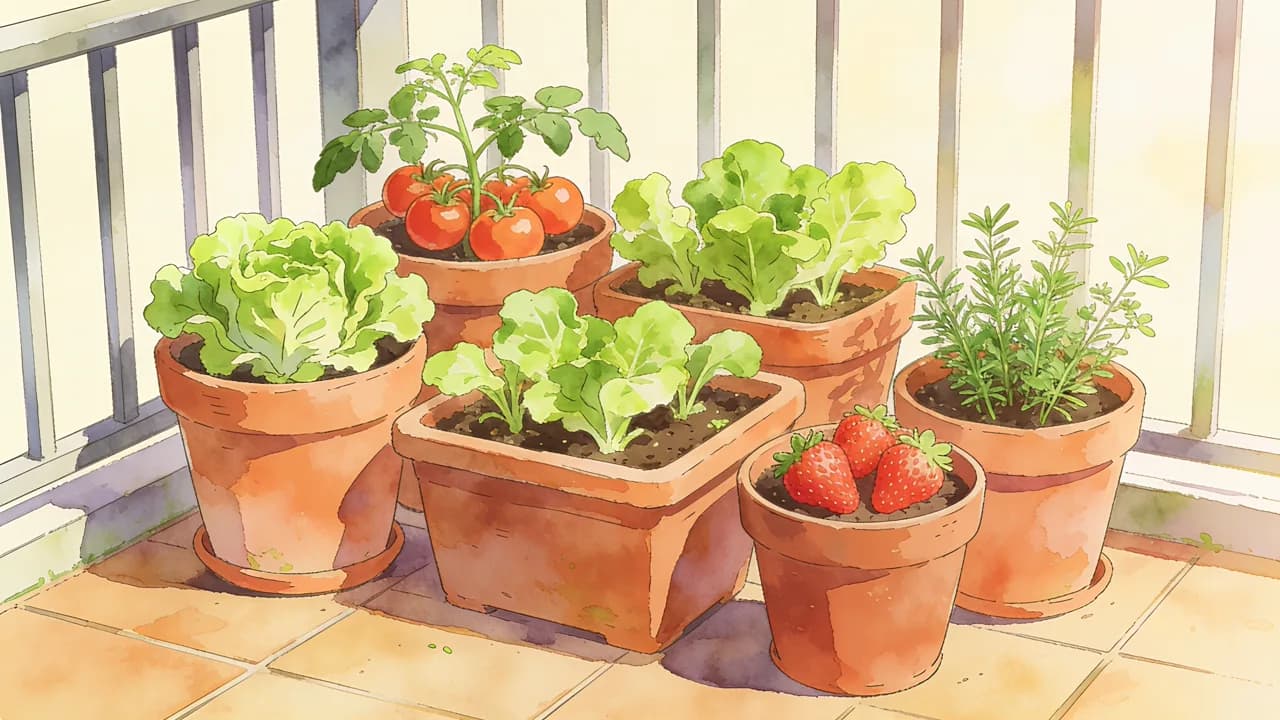
This is how that balcony is organised, by zones:
Growing table — 100 × 40 × 50 cm (19.7 in)
Large pots in the sun
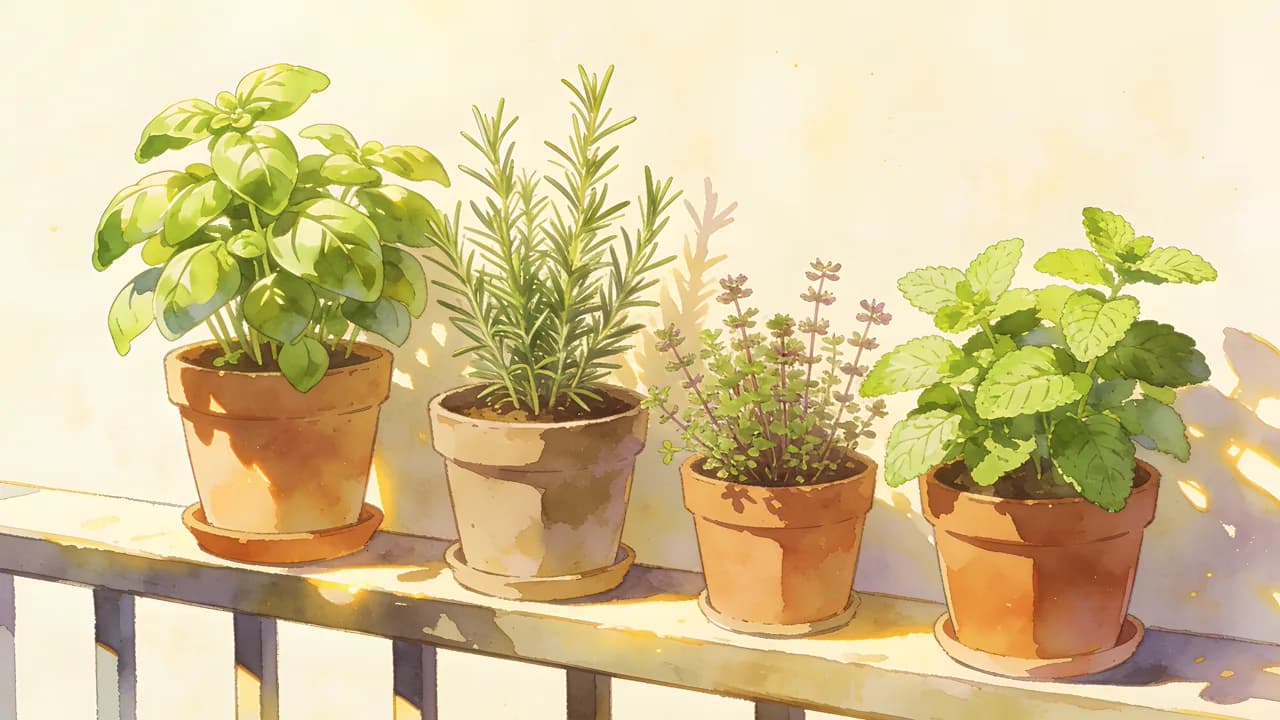
Railing and wall
Pots and containers

| Crop | Minimum size | Ideal |
|---|---|---|
| Lettuce | 3-5 L (about 0.8–1.3 US gal) | 10 L (about 2.6 US gal) (several) |
| Radish | 3-5 L (about 0.8–1.3 US gal) | Planter 15 cm (5.9 in) deep |
| Chard | 10 L (about 2.6 US gal) | 15 L (about 4 US gal) |
| Rocket | 3-5 L (about 0.8–1.3 US gal) | 5 L (about 1.3 US gal) |
| Spinach | 5 L (about 1.3 US gal) | 8 L (about 2.1 US gal) |
| Cherry tomato | 20 L (about 5.3 US gal) | 30-40 L (about 7.9–10.6 US gal) |
| Pepper | 15 L (about 4 US gal) | 20 L (about 5.3 US gal) |
| Courgette | 30 L (about 7.9 US gal) | 40-50 L (about 10.6–13.2 US gal) |
| Strawberry | 3 L (about 3.2 quarts) per plant | Planter 40 L (about 10.6 US gal) |
| Herbs | 5 L (about 1.3 US gal) each | Shared planter |
Potting mix

A simple, light mix that doesn't overload the balcony is this:
- 50 % coir or peat.
- 30 % mature compost or worm castings.
- 20 % perlite.
If the mix seems too fluffy for tall plants such as tomato, add a little coarse sand, although it will weigh more.
See The best potting mix for containers.
Yearly calendar
March-April
- Transplant cherry tomato and pepper once the risk of frost has passed (in April, or earlier on the coast). If you don't have a seed starter, buy the young plant.
- Direct-sow lettuce, rocket and radish.
- Strawberry, which is perennial, regrows by itself.
- Plant or sow the annual herbs (basil, parsley).
May-June
- Transplant the courgette (at the end of April or in May, when there is no more frost).
- Harvest the first lettuce and rocket.
- The tomato harvest begins.
July-August
- Peak production of tomato, courgette and pepper.
- Daily watering, and twice a day for small pots or in very hot weather.
- Give tomato and pepper light shade at midday if the sun scorches the leaves.
September
- Sow lettuce, rocket, spinach and lamb's lettuce for autumn.
- Pick the last tomato harvests.
- Remove the exhausted courgette.
October-December
- Continuous leaf harvest.
- Perennial herbs carry on (rosemary, thyme, chives).
- Remove the dried annual plants and add compost on the surface.
January-February
- It is a time of relative rest.
- Lightly prune the woody herbs towards the end of winter.
- Prepare fresh mix for spring transplants.
Watering

On a Mediterranean balcony, watering is the big challenge, because pots dry out quickly with heat and wind. The golden rule is to water thoroughly, until water comes out of the drainage holes, and to water again when the mix is dry at about 2 cm (0.8 in) deep. That frequency depends on the season and the size of the pot:
- Summer: a daily watering is usual, and two (one in the morning and one in the afternoon) for small pots or on days of great heat and wind.
- Spring and autumn: a daily watering or every two days.
- Winter: only when the mix is dry at 2 cm (0.8 in).
For holidays you have two options:
- Automatic watering with a battery timer and drippers on each pot (30-50 €). It is the most reliable if you are away for more than a few days.
- Small ollas of about 500 ml (16.9 fl oz) buried in the larger pots, which work for short absences.
Windbreak and shade

- 30 % shade cloth over the top of the growing table for July-August. It lowers the temperature under it by a few degrees.
- Reed or heather screen on the railing if there is strong wind.
- Group pots together: they shade one another.
Minimum tools
- 5 L (about 1.3 US gal) watering can.
- 1 L (about 1.1 quarts) spray bottle.
- Small pruning shears.
- Hand trowel.
- A 30-40 L (about 7.9–10.6 US gal) bokashi bin for kitchen scraps, which is the most practical thing in a flat.
Without the bokashi bin, all of this costs less than 40 €.
Expected harvest

The figures depend a lot on sun and care, but a well-kept balcony can give something like this in high summer:
- Cherry tomato: several kilos per plant over the season.
- Courgette: one plant can give between 10 and 15 fruits.
- Pepper: one or two kilos per plant.
- Lettuce and rocket: continuous harvest if you sow in succession.
- Strawberries: from 1 to 2 kg (2.2–4.4 lb).
- Herbs: during almost the whole year.
And it isn't only about kilos: going out to the balcony, cutting a few leaves and tossing them into the salad has a value that can't be measured in euros.
Common mistakes
Pots that are too small
A tomato in 10 L (about 2.6 US gal) yields very little and suffers in the heat. Respect the minimum capacities in the table.
Garden soil in a pot
It compacts with watering and the roots suffocate. Use a mix made specifically for pots.
Not feeding during the season
The nutrients in fresh mix last between 6 and 8 weeks. After that, feed every 15 days with liquid guano or liquid worm-castings tea, following the dose on the package.
Little water but every day
Always water thoroughly, until it drains out of the bottom of the pot, and let the top 2 cm (0.8 in) dry before watering again. A scanty daily watering only wets the surface and the roots don't go deeper.
If you want to grow
If you get hooked, the next step could be:
- Expanding gradually, for example with another 3 m² (32 sq ft) of pots and planters, until you have a medium-sized garden.
- Installing automatic watering to cut down on the time you spend.
- Setting up a worm bin to get your own humus.
- Adding every month a little compost or humus to the pots in production.
In two or three seasons, your balcony can become a real little pantry.

Design your balcony, terrace or pots by zones.