
Credits and licences
- #1 — vueltaalhuerto illustration
- #2 — vueltaalhuerto illustration
- #3 — vueltaalhuerto illustration
- #4 — vueltaalhuerto illustration
- #5 — vueltaalhuerto illustration
- #6 — vueltaalhuerto illustration
- #7 — vueltaalhuerto illustration
- #8 — vueltaalhuerto illustration
- #9 — vueltaalhuerto illustration
- #10 — vueltaalhuerto illustration
Yellow mangosteen
and 1 more names
Garcinia xanthochymusYellow mangosteen is sown in seed trays from April to June, and planted out from April to June. It is harvested from July to September (about 365 days to the first harvest). Grow it in sun or partial shade, 500 cm apart, with plenty of watering. Dates are for a mild temperate climate in the northern hemisphere; the calendar below adjusts them to your zone.
What else to sow in April, May and June
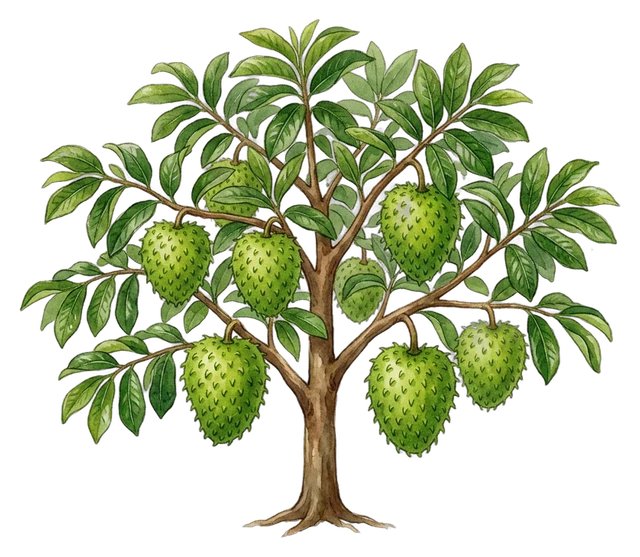
An evergreen tropical tree with a dense, conical crown and upright habit, 6 to 10 m or more in the ground and much less in a pot. The leaves are very large, leathery, lance-shaped and glossy dark green, with a pale midrib, and the branches, with dark bark, contain a yellow latex. The flowers are small and white, in clusters in the leaf axils, and the rounded fruits, with a small point, about 5 to 8 cm across, turn from green to deep yellow when ripe; the yellow flesh is juicy and sour, with one to four large seeds. It is used in juices, jams and savoury dishes. It is not the true mangosteen (Garcinia mangostana), which is a different species that needs more heat. It is hardier than that, but it is still a tropical plant: in Spain it only thrives in the Canary Islands or in a very sheltered frost-free spot, and in the rest of the country in a pot kept under cover in winter.
Family and origin: Mangosteen family (Clusiaceae) · native to South and South-East Asia, from the eastern Himalayas, India and Burma to Thailand · More plants from South Asia
01In your area
How will it do in your garden?
Year calendar
| Task | J | F | M | A | M | J | J | A | S | O | N | D |
|---|---|---|---|---|---|---|---|---|---|---|---|---|
| Seed trayApr–Jun | no | no | no | yes | yes | yes | no | no | no | no | no | no |
| Plant / transplantApr–Jun | no | no | no | yes | yes | yes | no | no | no | no | no | no |
| HarvestJul–Sep | no | no | no | no | no | no | yes | yes | yes | no | no | no |
| PruningMar–Apr | no | no | yes | yes | no | no | no | no | no | no | no | no |
Its life cycle at a glance
Swipe and tap a stage to see its details.
02Planting
Where and how to plant it
Sow the seed 2 cm deep; leave 5 m between plants and 6 m between rows.
5 m between plants · 6 m between rows
Seed at a depth of 2 cm; seedlings go in with the root ball level with the soil.
- In a square-foot bed
- 1 plant every 289 squares30 × 30 cm squares
- Transplanting
- Apr–Jun
- Seed tray
- Apr–Jun
- Germination
- ~45 days
03Care
Care through the year
Sun and aspectSun and shade · 5 h of sun · shade in summer
- Too little sun
- Ideal range
- Plenty of sun
East, or south with light shade during the middle of the day
Moderate sun: Copes with full sun, but give it some shade during heatwaves.
Bright light and morning sun, with light shade during the hottest hours in summer, especially in the first few years. It does not tolerate frost: damage starts at around 0 °C and the plant dies at about -2 °C. In a pot, the greenhouse or bright indoor spot must be kept above about 5 to 10 °C.
WateringConstantly moist · summer: daily or every 2 days when above 30 °C
- Summerdaily or every 2 days when above 30 °C53 L per tree/week
- Spring / Autumnevery 3-4 days24 L per tree/week
- Winterevery 2 weeks if dry6 L per tree/week
Constantly moist: The soil should always feel cool and damp. Ideal with mulch and drip irrigation. Mulch: straw or dry plant material cuts watering by 30-50 %.
Regular, generous watering in spring and summer, without waterlogging, in a rich, loose, slightly acidic potting mix, with humid air. Water less in winter. It does not like prolonged dryness or too much lime.
When to water? Push your finger 2 cm into the soil next to the base of the plant:
- Damp: soil sticks to your finger. Do not water, although for this plant it is just right — check again tomorrow.
- Cool but clean, no mud. Water today: it likes to stay constantly moist.
- Dry and dusty. Water urgently and add mulch to hold in moisture.
Soil and feedingpH 5.5–7 · A deep planting hole and well-drained soil
A deep planting hole and well-drained soil.
The site's own topsoil + 1/3 well-rotted compost + a handful of sand if there is clay.
Good: prolonged waterlogging rots the roots.
This plant prefers a pH between 5.5 and 7.0 (slightly acidic to neutral).
- Dig a hole at least 60×60×60 cm before planting.
- A thick mulch around the tree (not touching the trunk) reduces water stress.
- Spread compost on the surface every autumn; never bury the graft union.
- A narrow hole in hard ground: the roots end up trapped as if in a pot.
- Burying the graft encourages rot and takes vigour away from the rootstock.
- TipGrow it in a large pot with good drainage and a potting mix rich in organic matter, repotting when the roots fill the container.
- TipFeed with organic or balanced fertiliser in spring and summer.
- Common mistakeDo not bury the graft union (the bulge on the trunk): if it ends up below ground it rots. Leave it a little above the soil.
PruningWhen: Mar–Apr
Pruning time for this plant: Mar–Apr.
- TipPrune lightly: remove broken branches and thin the crown.
- TipPlant while dormant (autumn to winter) and shape the canopy by pruning in the first few years.
Common mistakes and tips
- TipYou can keep it outdoors in summer and move it to a bright, frost-free place in winter.
- TipWatch out for scale insects and mites.
04Harvest
Harvesting and storing
Harvest in Jul–Sep; the first, about 365 days after sowing.
- TipThe fruits are harvested when yellow and can be eaten fresh, although they are very sour.
- TipThe yellow latex in the branches and fruits stains clothes and skin and can be irritating: wear gloves when pruning and picking the fruit.
- TipThe harvest calendar and cold tolerance are only a guide.
- TipA good mulch and drip irrigation in summer make all the difference to the harvest.
05Propagation
Make new plants
The usual method is seed, sown fresh, straight out of a ripe fruit and washed well, about 2 cm deep, with constant warmth and moist potting mix; it comes up in a few weeks, but the plants grow slowly and take several years to fruit, a rough figure. To get a tree of a particular selection it can be grafted, and in the tropical plant trade this species is also used as a rootstock for the true mangosteen. There are no reliable data on how long dry seed keeps: do not store it, sow it promptly.
Seeds: how to germinate them~45 days
06Uses and health
What it is used for, and with what care
The ripe fruit is edible, although very sour. The yellow latex in the branches, leaves and fruits stains clothes and skin, can be irritating and should not be swallowed; wear gloves when pruning and picking the fruit. There are no solid data on its effect on pets. Do not confuse it with the true mangosteen (Garcinia mangostana), a different species.
- Properties
- A sour fruit with vitamin C and antioxidant compounds; studies on its health effects are still limited.
- Uses
- The ripe, juicy, sour flesh is eaten fresh with sugar or made into juice, jam, chutney and sauce for savoury dishes. The seeds are not eaten.
For guidance only; this is not medical treatment and does not replace advice from a doctor or vet.
07Companions and related plants
What to plant it with
Group it in the same bedPlants with the same watering or the same sun
They are not essential companions, but you will not have to water or position them differently.