Credits and licences
- #1 — vueltaalhuerto illustration
- #2 — vueltaalhuerto illustration
- #3 — vueltaalhuerto illustration
- #4 — vueltaalhuerto illustration
- #5 — vueltaalhuerto illustration
- #6 — vueltaalhuerto illustration
- #7 — vueltaalhuerto illustration
- #8 — vueltaalhuerto illustration
- #9 — vueltaalhuerto illustration
Sageretia (Chinese sweet plum)
and 4 more names
mock buckthorn, sageretia bonsai, Sageretia thea, Sageretia theezansSageretia (Chinese sweet plum) is planted from March to April. Grow it in sun or partial shade, 100 cm apart, with moderate watering. Dates are for a mild temperate climate in the northern hemisphere; the calendar below adjusts them to your zone.
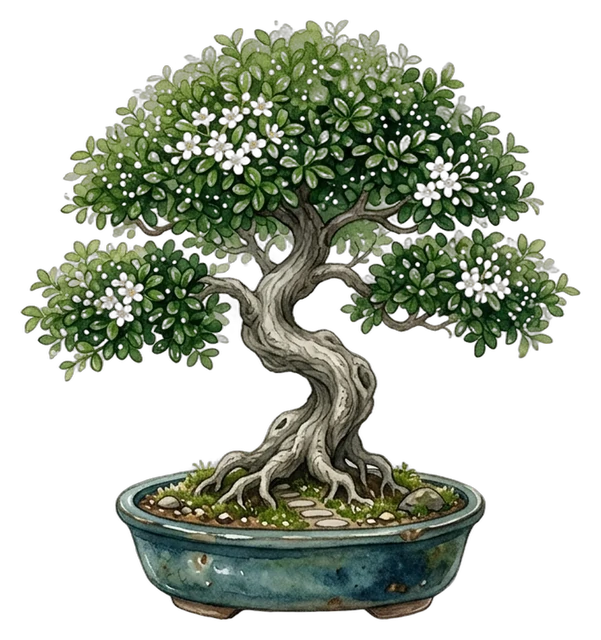
An evergreen shrub with thin, sometimes thorny branches and small, oval, glossy dark green leaves that form dense foliage. It is one of the most prized bonsai species for bright indoor spots, thanks to its bark, which flakes off in grey and orange plates, its easily shaped trunk and its strong ability to resprout. It bears tiny greenish-white flowers in small spikes, followed by round fruits of about 5 mm that turn from red to almost black purple and attract birds. It is sold mainly as a potted bonsai; in the ground it is a scrambling or untidy shrub. In Spain it is an indoor bonsai or one for a sheltered terrace, and grows outdoors in mild areas. The accepted name is Sageretia thea, and Sageretia theezans, the name used in the trade, is a synonym. It is not edible.
Family and origin: Buckthorn family (Rhamnaceae) · native to Southern China, Taiwan and South-East Asia · More plants from Far East
01In your area
How will it do in your garden?
Year calendar
| Task | J | F | M | A | M | J | J | A | S | O | N | D |
|---|---|---|---|---|---|---|---|---|---|---|---|---|
| Plant / transplantMar–Apr | no | no | yes | yes | no | no | no | no | no | no | no | no |
| PruningMar–Jul | no | no | yes | yes | yes | yes | yes | no | no | no | no | no |
| CuttingsMar–Aug | no | no | yes | yes | yes | yes | yes | yes | no | no | no | no |
Its life cycle at a glance
Swipe and tap a stage to see its details.
02Planting
Where and how to plant it
Leave 1 m between plants.
1 m between plants
Seedlings are planted with the root ball level with the soil.
- Transplanting
- Mar–Apr
- Common mistakePlanting too deep smothers the crown of the plant.
03Care
Care through the year
Sun and aspectSun and shade · 5 h of sun · shade in summer
- Too little sun
- Ideal range
- Plenty of sun
East, or south with light shade in the middle of the day
Moderate sun: Copes with full sun, but give it some shade during heatwaves.
Morning sun and afternoon shade, or very bright light indoors. It tolerates sun all day, but then needs much more water and dries out easily. In winter keep it in a bright spot above about 10 to 12 °C: it does not withstand hard frosts and below that temperature it loses leaves.
WateringMoist but never waterlogged · summer: daily or nearly so, depending on heat and pot
- Summerdaily or nearly so, depending on heat and pot6 L per plant/week
- Spring / Autumnevery 4-5 days3 L per plant/week
- Winterevery 3 to 5 days0.9 L per plant/week
Moist but never waterlogged: Water before the surface is completely dry. Never puddles.
Keep the root ball moist but not waterlogged: it suffers badly if it dries out completely, all the more so as a bonsai with very little potting mix. Water thoroughly until water runs out of the drainage holes and let the surface dry slightly before the next watering.
When to water? Push your finger 1 cm into the soil next to the base of the plant:
- Damp: soil sticks to your finger. Do not water today. The moisture is fine.
- Cool but clean, no mud. Water early tomorrow if it stays like this, or this evening.
- Dry and dusty. Water now, and deeply. This is not where it likes to be.
- TipTemperatures, watering and timings are approximate.
- TipWater generously in the first year until it is established; after that it looks after itself.
Soil and feedingpH 6–7 · Deep soil with good drainage
Deep soil with good drainage.
Medium/high.
This plant prefers a pH between 6.0 and 7.0 (slightly acidic to neutral).
- Water generously in the first year until it is established.
- A thick mulch all year round, not touching the trunk.
- TipIf you grow it as a bonsai, use a free-draining mix and repot it every two years in spring, trimming the roots carefully.
- TipFeed every two weeks from spring to summer with a balanced bonsai fertiliser, and do not feed in winter.
PruningWhen: Mar–Jul
Pruning time for this plant: Mar–Jul.
- TipPrune and pinch in spring and early summer to encourage branching; pruning late in summer reduces flowers and fruit.
- TipFormative pruning after flowering keeps the shape compact.
- Common mistakePruning at the wrong time removes the year's flower buds.
Common mistakes and tips
- TipThe bark flakes off in plates: this is normal.
- TipWatch for aphids and whitefly, especially under glass, and for powdery mildew if ventilation is poor.
04Propagation
Make new plants
It is propagated by cuttings, which root easily during the growing season, better if treated with rooting hormone. Take shoots 8 to 10 cm long, remove the lower leaves, insert them in a very free-draining mix and keep them in high humidity and gentle warmth; rooting takes several weeks.
05Uses and health
What it is used for, and with what care
There are no reliable toxicity data for people, dogs and cats. Although some sources say the fruit is edible, other species in its family (Rhamnaceae) are toxic, so to be on the safe side do not eat the leaves, bark or fruit, and stop animals from chewing them. The branches sometimes have small thorns: take care when handling and pruning.
- Properties
- A highly valued ornamental and bonsai plant; its small fruits feed birds. It has no home medicinal uses.
- Uses
- Some sources describe the fruits as edible in their native region, but they are tiny and of little interest; we do not recommend them as food.
For guidance only; this is not medical treatment and does not replace advice from a doctor or vet.
06Companions and related plants