Credits and licences
- #1 — vueltaalhuerto illustration
- #2 — vueltaalhuerto illustration
- #3 — vueltaalhuerto illustration
- #4 — vueltaalhuerto illustration
- #5 — vueltaalhuerto illustration
- #6 — vueltaalhuerto illustration
- #7 — vueltaalhuerto illustration
- #8 — vueltaalhuerto illustration
- #9 — vueltaalhuerto illustration
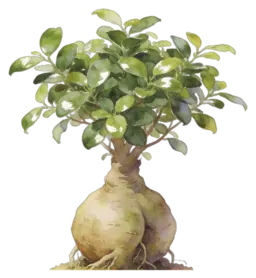
Fukien tea (Carmona)
and 3 more names
Carmona microphylla, Ehretia microphylla, Ehretia buxifoliaFukien tea (Carmona) is planted from March to April. Grow it in sun or partial shade, 40 cm apart, with moderate watering. Dates are for a mild temperate climate in the northern hemisphere; the calendar below adjusts them to your zone.
A slow-growing, tropical evergreen shrub grown mainly as an indoor bonsai. It has small leaves, 1 to 3 cm long, glossy and dark green with tiny white dots, slightly toothed at the tip, and a trunk that thickens and twists very attractively over the years. It often produces small white five-lobed flowers, followed by tiny round orange-red fruits. Its currently accepted botanical name is Ehretia microphylla, although it is sold as Carmona microphylla or as Fukien tea; it is not a tea plant and cannot be used for infusions. It is a demanding bonsai, because it does not tolerate cold or sudden changes of position, watering or light, and responds to any of them by dropping its leaves: it needs plenty of light, constant warmth, regular watering and some air humidity. In a mild Mediterranean climate it can spend the warm months outdoors, but it must come back indoors before night temperatures drop below about 15 °C.
Family and origin: Borage family (Boraginaceae) · native to Southern China, Taiwan and South-East Asia; grown as an indoor bonsai all over the world · More plants from Far East
01In your area
How will it do in your home?
Year calendar
| Task | J | F | M | A | M | J | J | A | S | O | N | D |
|---|---|---|---|---|---|---|---|---|---|---|---|---|
| Plant / transplantMar–Apr | no | no | yes | yes | no | no | no | no | no | no | no | no |
| PruningMar–Aug | no | no | yes | yes | yes | yes | yes | yes | no | no | no | no |
| CuttingsMay–Jul | no | no | no | no | yes | yes | yes | no | no | no | no | no |
Its life cycle at a glance
Swipe and tap a stage to see its details.
02Care
Care through the year
Sun and aspectSun and shade · 5 h of sun · shade in summer
- Too little sun
- Ideal range
- Plenty of sun
East or west, next to a bright window
Gentle sun: Morning or afternoon sun. Midday summer sun stresses and scorches it.
Plenty of light, with gentle morning or afternoon sun; avoid direct midday sun through glass. In low light it drops its leaves and becomes straggly; turn it a quarter turn each week so it grows evenly.
- TipTurn the pot every week so it grows evenly towards the light.
WateringMoist but never waterlogged · summer: every 2-3 days
- Summerevery 2-3 days0.6 L per plant/week
- Spring / Autumnevery 4-5 days0.3 L per plant/week
- Winterevery 2-3 weeks0.1 L per plant/week
Moist but never waterlogged: Water before the surface is completely dry. Never puddles. Mulch: straw or dry plant material cuts watering by 30-50 %.
Water when the top centimetre of the potting mix feels dry, until water runs out of the drainage holes, and empty the saucer. Keep the potting mix moist but not waterlogged: both dryness and overwatering make it lose its leaves. In summer it may need watering daily, and less often in winter.
When to water? Push your finger 1 cm into the soil next to the base of the plant:
- Damp: soil sticks to your finger. Do not water today. The moisture is fine.
- Cool but clean, no mud. Water early tomorrow if it stays like this, or this evening.
- Dry and dusty. Water now, and deeply. This is not where it likes to be.
- TipKeep air humidity high with a tray of damp gravel, and do not place it near radiators, air conditioning or draughts.
- TipThe dates, minimum temperature and watering are only a guide.
- TipAdjust watering to the light and the season: in winter almost all of them need much less water.
- Common mistakeOverwatering is the number one killer: let it dry out as the species requires.
Potting mix and feedingpH 5.5–6.5 · Multi-purpose compost lightened with perlite
Multi-purpose compost lightened with perlite.
70 % multi-purpose compost · 20 % perlite · 10 % coir.
High: always a pot with a drainage hole and a shallow saucer.
This plant prefers a pH between 5.5 and 6.5 (slightly acidic to neutral).
- Repot every 2-3 years into a pot a finger's width wider, not much more.
- A handful of worm castings a year keeps the potting mix alive.
- Reusing old potting mix without refreshing it compacts and rots the roots.
- No drainage in the pot = waterlogged roots = dead plant.
- TipGrow it in a shallow, well-drained pot with a bonsai potting mix containing pumice or coarse sand, at 18-25 °C and never below about 15 °C.
- TipFeed every two weeks during the growing season with a bonsai fertiliser and every six weeks while it is resting.
- Common mistakePots without drainage waterlog the roots and rot the plant.
PruningWhen: Mar–Aug
Pruning time for this plant: Mar–Aug.
- TipPinch out new shoots during the growing season to keep its shape.
- TipDo hard pruning in spring and repot it every two years, also in spring, trimming the roots a little.
03Propagation
Make new plants
It is propagated from semi-ripe cuttings 6 to 8 cm long, taken in spring or summer from shoots that have already hardened slightly and planted in a light mix of coarse sand and peat, with constant warmth and high air humidity; rooting is slow and the success rate is modest. A rooting hormone helps. For home growing, almost all specimens are bought already trained, because raising a bonsai trunk from a cutting takes many years.
04Uses and health
What it is used for, and with what care
WARNING: there are no reliable data on the toxicity of this species to people, dogs and cats, so as a precaution do not eat the leaves, flowers or fruits and stop children and pets from chewing them. If a significant amount is swallowed, consult a doctor or a vet.
- Properties
- It is an indoor bonsai full of character, with tiny glossy leaves, white flowers almost all year round and a trunk that grows more beautiful with age.
- Uses
- It is not grown for food and is not used in cooking, infusions or home remedies. Despite the name 'Fukien tea', it is not a tea plant and must not be made into an infusion.
For guidance only; this is not medical treatment and does not replace advice from a doctor or vet.
05Companions and related plants