
Credits and licences
- #1 — vueltaalhuerto illustration
- #2 — vueltaalhuerto illustration
- #3 — vueltaalhuerto illustration
- #4 — vueltaalhuerto illustration
- #5 — vueltaalhuerto illustration
- #6 — vueltaalhuerto illustration
- #7 — vueltaalhuerto illustration
- #8 — vueltaalhuerto illustration
- #9 — vueltaalhuerto illustration
- #10 — vueltaalhuerto illustration
Oca (New Zealand yam)
and 1 more names
oca tuberOca (New Zealand yam) is sown in seed trays from February to March, and planted out from March to May. It is harvested from November to January (about 210 days to the first harvest). Grow it in full sun, 40 cm apart, with moderate watering. Dates are for a mild temperate climate in the northern hemisphere; the calendar below adjusts them to your zone.
What else to sow in February and March
An Andean tuber shaped like a wrinkled finger, yellow, pink or reddish in colour, with a flavour somewhere between sour and sweet and a floury texture. It is a low, spreading plant with clover-like leaves that forms its tubers as the days shorten in autumn. It contains oxalic acid, especially in the skin and in the more acidic varieties, so it should not be eaten in large quantities or raw on a regular basis (see the health warning). Do not confuse it with sorrel or with other ornamental or weedy Oxalis, or with the potato.
Family and origin: Wood sorrel family (Oxalidaceae) · native to Andes (Peru and Bolivia) · More plants from Andes
01In your area
How will it do in your garden?
Year calendar
| Task | J | F | M | A | M | J | J | A | S | O | N | D |
|---|---|---|---|---|---|---|---|---|---|---|---|---|
| Seed trayFeb–Mar | no | yes | yes | no | no | no | no | no | no | no | no | no |
| Plant / transplantMar–May | no | no | yes | yes | yes | no | no | no | no | no | no | no |
| HarvestNov–Jan | yes | no | no | no | no | no | no | no | no | no | yes | yes |
| Divide the clumpMar–Apr | no | no | yes | yes | no | no | no | no | no | no | no | no |
Its life cycle at a glance
Swipe and tap a stage to see its details.
02Planting
Where and how to plant it
Sow the seed 10 cm deep; leave 40 cm between plants and 80 cm between rows.
40 cm between plants · 80 cm between rows
Seed at a depth of 10 cm; seedlings go in with the root ball level with the soil.
- In a square-foot bed
- 1 plant every 4 squares30 × 30 cm squares
- Transplanting
- Mar–May
- Seed tray
- Feb–Mar
03Care
Care through the year
Sun and aspectFull sun · 8 h of sun · South or south-west, with nothing casting shade at midday
- Too little sun
- Ideal range
- Plenty of sun
South or south-west, with nothing casting shade at midday
Strong sun: Loves full midday sun and high temperatures.
- TipBefore eating them, leave them in the sun for a few days: they sweeten and the acidity drops.
WateringMoist but never waterlogged · summer: every 2-3 days
- Summerevery 2-3 days2 L per plant/week
- Spring / Autumnevery 4-5 days1 L per plant/week
- Winterevery 2-3 weeks0.3 L per plant/week
Moist but never waterlogged: Water before the surface is completely dry. Never puddles. Mulch: straw or dry plant material cuts watering by 30-50 %.
Water regularly without waterlogging throughout the summer; the plant struggles in long droughts and the tubers come out small. Water less once the foliage starts to turn yellow.
When to water? Push your finger 3 cm into the soil next to the base of the plant:
- Damp: soil sticks to your finger. Do not water today. The moisture is fine.
- Cool but clean, no mud. Water early tomorrow if it stays like this, or this evening.
- Dry and dusty. Water now, and deeply. This is not where it likes to be.
Soil and feedingpH 5.5–7 · Loose, deep, stone-free soil
Loose, deep, stone-free soil.
High: constant moisture deforms the root.
This plant prefers a pH between 5.5 and 7.0 (slightly acidic to neutral).
- TipKeep anything that pokes out covered with soil: light turns tubers green.
04Harvest
Harvesting and storing
Harvest in Nov–Jan; the first, about 210 days after sowing.
- TipThe tubers begin to form with the short days of late summer and autumn, so they are harvested very late, usually from November to January, once frost has killed off the top growth.
- Common mistakeHarvesting in waterlogged soil or leaving them in the sun: they rot or turn green.
05Propagation
Make new plants
It is propagated from the tubers themselves, which are planted like potatoes about 8 to 10 cm deep once the cold weather is over; in cold areas it is worth chitting them in a bright place for a few weeks beforehand. Seed is not practical. Store the tubers from one year to the next as you would potatoes, in a cool, dark, frost-free place.
06Uses and health
What it is used for, and with what care
HEALTH WARNING: oca contains oxalic acid (oxalates), especially in the skin and in the more acidic varieties. The leaves, stems and raw tubers should not be eaten in large quantities; leave the tubers in the sun for a few days and cook them to reduce the sour taste. Avoid it or consult your doctor if you have (oxalate) kidney stones, rheumatism, gout or kidney problems. For dogs and cats, plants of the genus Oxalis contain soluble oxalates that can cause digestive upset and, in large quantities, kidney damage: keep your pets away from them.
- Properties
- The tuber provides carbohydrates, fibre and some vitamin C; the coloured varieties contain anthocyanins.
- Uses
- The tubers are eaten roasted, boiled, fried or baked, like potatoes, and are sweet after a few days in the sun; some varieties are eaten raw in small amounts. The young, sour leaves and stems are used in salads only occasionally and in small quantities.
For guidance only; this is not medical treatment and does not replace advice from a doctor or vet.
07Companions and related plants
What to plant it with
Good companions
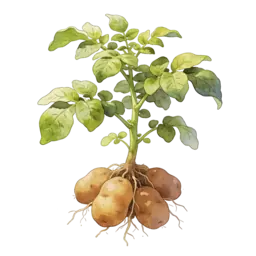
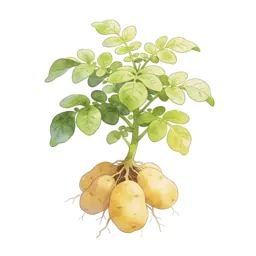
Group it in the same bedPlants with the same watering or the same sun
They are not essential companions, but you will not have to water or position them differently.