
Credits and licences
- #1 — vueltaalhuerto illustration
- #2 — vueltaalhuerto illustration
- #3 — vueltaalhuerto illustration
- #4 — vueltaalhuerto illustration
- #5 — vueltaalhuerto illustration
- #6 — vueltaalhuerto illustration
- #7 — vueltaalhuerto illustration
- #8 — vueltaalhuerto illustration
- #9 — vueltaalhuerto illustration
- #10 — vueltaalhuerto illustration
Mammee apple
and 2 more names
South American apricot, Mammea americanaMammee apple is sown in seed trays from April to June, and planted out from April to June. It is harvested from July to September (about 365 days to the first harvest). Grow it in full sun, 800 cm apart, with moderate watering. Dates are for a mild temperate climate in the northern hemisphere; the calendar below adjusts them to your zone.
What else to sow in April, May and June
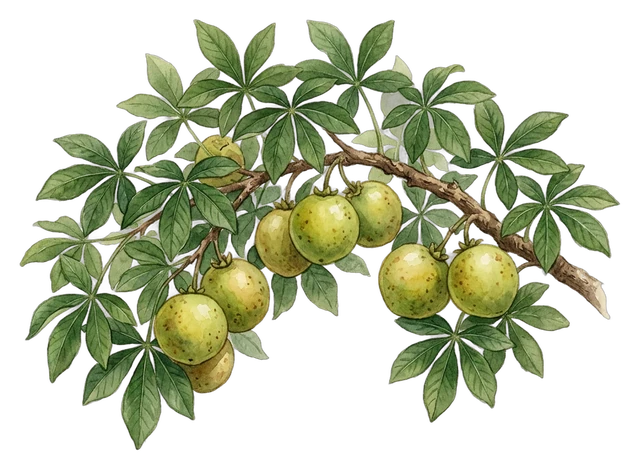
The mammee apple is an evergreen tropical tree that in its native land reaches 18 or 20 m, with a dense, oval crown of large, thick, glossy dark green leaves. The flowers are white and fragrant with orange stamens, and appear singly or in small clusters; on some trees they are single-sex and on others hermaphrodite. The fruit is round, 10 to 20 cm across, with thick, rough brown skin; beneath it is a very bitter white layer and then the yellow or orange flesh, firm and aromatic, sweet with a hint of sharpness, surrounding one to four large seeds. In Spain it is a rarity: it only has a chance on the warmest, frost-free coast of the Canary Islands, Málaga or Granada, or in a large pot in a greenhouse. Do not confuse it with the red mamey or mamey sapote (Pouteria sapota), which is a different tree.
Family and origin: Calophyllaceae · native to The West Indies, northern South America and Central America · More plants from South America
01In your area
How will it do in your garden?
Year calendar
| Task | J | F | M | A | M | J | J | A | S | O | N | D |
|---|---|---|---|---|---|---|---|---|---|---|---|---|
| Seed trayApr–Jun | no | no | no | yes | yes | yes | no | no | no | no | no | no |
| Plant / transplantApr–Jun | no | no | no | yes | yes | yes | no | no | no | no | no | no |
| HarvestJul–Sep | no | no | no | no | no | no | yes | yes | yes | no | no | no |
| PruningMar–Apr | no | no | yes | yes | no | no | no | no | no | no | no | no |
Its life cycle at a glance
Swipe and tap a stage to see its details.
02Planting
Where and how to plant it
Sow the seed 3 cm deep; leave 8 m between plants and 9 m between rows; give it a stake from the start.
8 m between plants · 9 m between rows
Seed at a depth of 3 cm; seedlings go in with the root ball level with the soil.
- In a square-foot bed
- 1 plant every 729 squares30 × 30 cm squares
- Transplanting
- Apr–Jun
- Seed tray
- Apr–Jun
- Germination
- ~60 days
- TipPlant it in spring in the warmest, most sheltered spot, staked for the first years, or in a large, well-drained container where there is a risk of frost.
- Common mistakeNot thinning the fruit overloads the branches and gives small fruit, with a good crop only every other year.
03Care
Care through the year
Sun and aspectFull sun · 8 h of sun · South or south-west, with nothing casting shade at midday
- Too little sun
- Ideal range
- Plenty of sun
South or south-west, with nothing casting shade at midday
Strong sun: Loves full midday sun and high temperatures.
Full sun and a sheltered spot. It is very sensitive to cold: a drop to -2 °C has killed mature trees in Florida, and young trees need protection in their first winters.
WateringMoist but never waterlogged · summer: every 2-3 days
- Summerevery 2-3 days30 L per tree/week
- Spring / Autumnevery 4-5 days15 L per tree/week
- Winterevery 2-3 weeks4.5 L per tree/week
Moist but never waterlogged: Water before the surface is completely dry. Never puddles. Mulch: straw or dry plant material cuts watering by 30-50 %.
Regular, deep watering while it is growing, without waterlogging, and much less in winter. It prefers deep, fertile, well-drained soil, although it copes with sandy and chalky soils. A mulch at the base helps keep the soil moist in summer.
When to water? Push your finger 3 cm into the soil next to the base of the plant:
- Damp: soil sticks to your finger. Do not water today. The moisture is fine.
- Cool but clean, no mud. Water early tomorrow if it stays like this, or this evening.
- Dry and dusty. Water now, and deeply. This is not where it likes to be.
Soil and feedingpH 5.5–7.5 · A deep planting hole and well-drained soil
A deep planting hole and well-drained soil.
The site's own topsoil + 1/3 well-rotted compost + a handful of sand if there is clay.
Good: prolonged waterlogging rots the roots.
This plant prefers a pH between 5.5 and 7.5 (slightly acidic to slightly alkaline).
- Dig a hole at least 60×60×60 cm before planting.
- A thick mulch around the tree (not touching the trunk) reduces water stress.
- Spread compost on the surface every autumn; never bury the graft union.
- A narrow hole in hard ground: the roots end up trapped as if in a pot.
- Burying the graft encourages rot and takes vigour away from the rootstock.
- Common mistakeDo not bury the graft union (the bulge on the trunk): if it ends up below ground it rots. Leave it a little above the soil.
PruningWhen: Mar–Apr
Pruning time for this plant: Mar–Apr.
- TipPlant while dormant (autumn to winter) and shape the canopy by pruning in the first few years.
Common mistakes and tips
- TipPeel it, remove the bitter white layer and the seeds, and eat the flesh raw, in fruit salad, in compote or in jam.
- TipIt has few pests, but its wood is attacked by termites.
04Harvest
Harvesting and storing
Harvest in Jul–Sep; the first, about 365 days after sowing.
- TipFeed with compost or an organic fertiliser in spring and summer and prune little: remove crossing or broken branches once the harvest is over.
- TipThe fruit is picked when the skin turns from green to yellowish brown and gives slightly when pressed; leave it to ripen indoors for a few days.
- TipThe harvest dates, height in cultivation and years to first crop are only a guide.
- TipA good mulch and drip irrigation in summer make all the difference to the harvest.
05Propagation
Make new plants
It is propagated by seed and by grafting. The seed is large and must be sown fresh, straight from a ripe fruit and well washed, about 3 cm deep and with warmth; it comes up in one or two months. Seedling trees take about six to ten years to fruit (a rough figure) and may turn out male, with no crop. That is why it is advisable to buy a grafted tree of a known variety. Grafting is done onto a young rootstock of the same species; semi-ripe cuttings have been tried in greenhouses, but are not a usual method.
Seeds: how to germinate them~60 days
06Uses and health
What it is used for, and with what care
WARNING: the seeds, the resin in the skin and the unripe fruit contain insecticidal substances and are toxic. Poisoning of dogs and cats by the seed resin has been described, and the flesh disagrees with some people. Eat only fully ripe flesh, without the bitter layer or the seeds; do not use the unripe fruit or the seeds for home purposes (insecticide, remedies) and do not let animals or children chew them. The juice of the seed stains clothes permanently. Do not confuse it with the red mamey (Pouteria sapota).
- Properties
- A fruit with firm, aromatic flesh, with vitamins and fibre; only the ripe flesh is eaten, carefully peeled.
- Uses
- The ripe flesh is eaten raw or in fruit salads, compotes, jams, juices and ice creams. The skin, the bitter white layer beneath it and the seeds are not eaten.
For guidance only; this is not medical treatment and does not replace advice from a doctor or vet.
07Companions and related plants
What to plant it with
Group it in the same bedPlants with the same watering or the same sun
They are not essential companions, but you will not have to water or position them differently.