Credits and licences
- #1 — vueltaalhuerto illustration
- #2 — vueltaalhuerto illustration
- #3 — vueltaalhuerto illustration
- #4 — vueltaalhuerto illustration
- #5 — vueltaalhuerto illustration
- #6 — vueltaalhuerto illustration
- #7 — vueltaalhuerto illustration
- #8 — vueltaalhuerto illustration
- #9 — vueltaalhuerto illustration
- #10 — vueltaalhuerto illustration
Myrtle-leaf milkwort (Polygala myrtifolia)
and 2 more names
Polygala myrtifolia, Polygala × dalmaisianaMyrtle-leaf milkwort (Polygala myrtifolia) is sown in seed trays from March to April, and planted out from March to May and from September to October. It flowers from March to October. Grow it in full sun, 100 cm apart, with moderate watering. Dates are for a mild temperate climate in the northern hemisphere; the calendar below adjusts them to your zone.
What else to sow in March and April
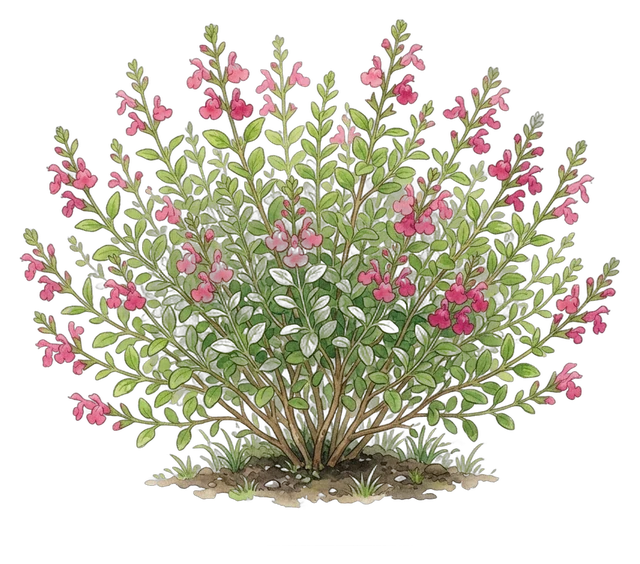
An evergreen shrub 1 to 2 m tall and wide, with a rounded or somewhat straggly habit and small, oval, bluish-green leaves about 2 to 3 cm long. It is famous for its purple or magenta pea-like flowers, with the tip of the keel yellowish-green and as if frayed, which open almost all year round, peaking in spring and summer, and attract bees. The fruits are small, flat, rounded capsules. In gardens on the Spanish Mediterranean coast it is very popular because it withstands wind, salt, sun and drought once established, and grows in poor, sandy or chalky soils with good drainage. It does not withstand hard frosts: it suffers below 0 °C and in cold areas it is best grown in a pot and sheltered. It has become naturalised elsewhere; in Spain it is not on the Catalogue of Invasive Alien Species, but it is best to stop it escaping into natural areas. It is not edible.
Family and origin: Milkwort family (Polygalaceae) · native to South Africa (coasts and slopes of the Cape, among the shrubs of the fynbos vegetation) · More plants from Africa
01In your area
How will it do in your garden?
Year calendar
| Task | J | F | M | A | M | J | J | A | S | O | N | D |
|---|---|---|---|---|---|---|---|---|---|---|---|---|
| Seed trayMar–Apr | no | no | yes | yes | no | no | no | no | no | no | no | no |
| Plant / transplantMar–May, Sep–Oct | no | no | yes | yes | yes | no | no | no | yes | yes | no | no |
| FloweringMar–Oct | no | no | yes | yes | yes | yes | yes | yes | yes | yes | no | no |
| PruningApr–May | no | no | no | yes | yes | no | no | no | no | no | no | no |
| CuttingsJun–Aug | no | no | no | no | no | yes | yes | yes | no | no | no | no |
Its life cycle at a glance
Swipe and tap a stage to see its details.
02Planting
Where and how to plant it
Sow the seed 3 mm deep; leave 1 m between plants and 1 m between rows.
1 m between plants · 1 m between rows
Seed at a depth of 3 mm; seedlings go in with the root ball level with the soil.
- Transplanting
- Mar–May, Sep–Oct
- Seed tray
- Mar–Apr
- Germination
- ~30 days
- TipIn climates with frost, grow it in a pot and shelter it in winter; aphids and whitefly can attack it under cover.
- Common mistakePlanting too deep smothers the crown of the plant.
03Care
Care through the year
Sun and aspectFull sun · 8 h of sun · South or south-west, with nothing casting shade at midday
- Too little sun
- Ideal range
- Plenty of sun
South or south-west, with nothing casting shade at midday
Strong sun: Loves full midday sun and high temperatures.
Full sun or partial shade; in full sun it flowers more and has a more compact habit. It withstands the heat and intense sun of the coast and salty winds. In areas with frost, plant it in a sheltered spot against a south-facing wall, and protect young plants with fleece.
WateringLet it dry out between waterings · summer: every 7 to 10 days the first year; after that, every 2 to 3 weeks in drought
- Summerevery 7 to 10 days the first year; after that, every 2 to 3 weeks in drought6 L per plant/week
- Spring / Autumnevery 4-5 days3 L per plant/week
- Winteronly if it does not rain0.9 L per plant/week
Let it dry out between waterings: A Mediterranean favourite: better thirsty than overwatered. Mulch: straw or dry plant material cuts watering by 30-50 %.
It needs regular watering in the first year to get established and after that it tolerates drought well. It flowers more and better with an occasional deep watering in summer. It does not tolerate waterlogging or soils that compact: in a pot, water when the surface dries and use a very free-draining potting mix.
When to water? Push your finger 4 cm into the soil next to the base of the plant:
- Damp: soil sticks to your finger. Do not water yet. It has more than enough; wait for it to dry out more.
- Cool but clean, no mud. Wait another 1-2 days before watering.
- Dry and dusty. Water now, but moderately. Do not overdo it: it prefers thirst to excess.
- TipWater generously in the first year until it is established; after that it looks after itself.
Soil and feedingpH 5.5–8 · Deep soil with good drainage
Deep soil with good drainage.
Medium/high.
This plant prefers a pH between 5.5 and 8.0 (slightly acidic to alkaline).
- Water generously in the first year until it is established.
- A thick mulch all year round, not touching the trunk.
PruningWhen: Apr–May
Pruning time for this plant: Apr–May.
- TipTo keep it compact, prune it in spring, after winter, cutting back shoots damaged by cold and lightly tipping back after flowering; avoid cutting into old wood, which regrows poorly.
- TipIf you live next to a natural area, do not plant it at the edge or throw prunings onto wild land, because it has become naturalised in other countries.
- TipFormative pruning after flowering keeps the shape compact.
- Common mistakePruning at the wrong time removes the year's flower buds.
Common mistakes and tips
- TipIt is a shrub widely sold in coastal nurseries.
- TipHeights, minimum temperatures and timings are a guide only.
04Propagation
Make new plants
The usual method is semi-ripe cuttings 8 to 10 cm long from the current year's shoots, in mid to late summer, with rooting hormone, in a moist sandy potting mix, with warmth and out of direct sun; they root in one or two months. Softwood cuttings can also be taken in early summer. It can be propagated from seed, but the plant takes longer to flower and some cultivars do not come true.
Seeds: how to germinate them~30 days
05Uses and health
What it is used for, and with what care
WARNING: there are no reliable data on the toxicity of this species. It does not usually appear among highly toxic plants, but to be safe do not eat it and stop children and pets from chewing the leaves, flowers or fruits. If a significant amount is swallowed, consult a doctor or vet. It has become naturalised in other countries: do not throw prunings onto wild land.
- Properties
- It is a very decorative shrub with long-lasting purple flowers that attracts bees and withstands wind, salt and drought. It is good for informal hedges, banks and low-maintenance coastal gardens.
- Uses
- It is not grown for food, nor used in cooking or home remedies. It is not suitable for infusions: other milkworts, such as Polygala senega, are used in herbal medicine in other countries, but not this one.
For guidance only; this is not medical treatment and does not replace advice from a doctor or vet.
06Companions and related plants