
Credits and licences
- #1 — vueltaalhuerto illustration
- #2 — vueltaalhuerto illustration
- #3 — vueltaalhuerto illustration
- #4 — vueltaalhuerto illustration
- #5 — vueltaalhuerto illustration
- #6 — vueltaalhuerto illustration
- #7 — vueltaalhuerto illustration
- #8 — vueltaalhuerto illustration
- #9 — vueltaalhuerto illustration
Ti plant (Cordyline fruticosa)
and 4 more names
Cordyline fruticosa, Cordyline terminalis, Cordyline fruticosa 'Tango', Cordyline fruticosa 'Red Sister'Ti plant (Cordyline fruticosa) is planted from April to June. Grow it in sun or partial shade, 40 cm apart, with moderate watering. Dates are for a mild temperate climate in the northern hemisphere; the calendar below adjusts them to your zone.
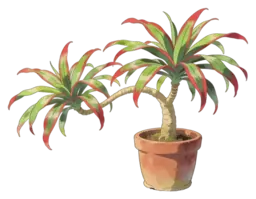
A houseplant with a slender, unbranched stem topped by a rosette of broad, lance-shaped, glossy leaves about 30 to 60 cm long, in shades of burgundy, purplish red and vivid pink depending on the variety. The variety 'Tango', sold in many shops, has wine-coloured leaves with pink edges. Indoors it stays 60 to 150 cm tall and gradually loses its lower leaves over the years, leaving a little trunk with ring-shaped scars. It is the ‘ti plant’ of the Pacific islands and South-East Asia, where it reaches 3 or 4 m and produces panicles of small lilac and cream flowers, followed by red berries; indoors it almost never flowers. It needs plenty of light without direct sun, temperatures always above 12 °C, a slightly moist potting mix and fairly high humidity: in dry air, or with very hard tap water, the leaf tips dry out and scorch. It is not the garden cordyline of temperate climates (Cordyline australis), which copes much better with cold. It is toxic to dogs and cats: keep it out of their reach.
Family and origin: Asparagus family (Asparagaceae) · native to South-East Asia, New Guinea and the Pacific islands, in humid forests and clearings · More plants from Southeast Asia
01In your area
How will it do in your home?
Year calendar
| Task | J | F | M | A | M | J | J | A | S | O | N | D |
|---|---|---|---|---|---|---|---|---|---|---|---|---|
| Plant / transplantApr–Jun | no | no | no | yes | yes | yes | no | no | no | no | no | no |
| CuttingsApr–Aug | no | no | no | yes | yes | yes | yes | yes | no | no | no | no |
Its life cycle at a glance
Swipe and tap a stage to see its details.
02Care
Care through the year
Sun and aspectSun and shade · 4 h of sun · shade in summer
- Too little sun
- Ideal range
- Plenty of sun
East, or south with light shade during the middle of the day
Gentle sun: Morning or afternoon sun. Midday summer sun stresses and scorches it.
Place it by a bright window, out of direct midday or afternoon sun, which bleaches and scorches the leaves. In poor light the red tones turn greenish and the plant becomes leggy. Avoid cold draughts and radiators. Below about 10-12 °C it suffers and may drop its leaves. In the subtropical climate of the Canary Islands (Spain) it can live outdoors, in partial shade and sheltered.
- TipTurn the pot every week so it grows evenly towards the light.
WateringMoist but never waterlogged · summer: every 5 to 7 days, when the top 3 cm are dry
- Summerevery 5 to 7 days, when the top 3 cm are dry0.6 L per plant/week
- Spring / Autumnevery 4-5 days0.3 L per plant/week
- Winterevery 10 to 15 days, with the potting mix almost dry between waterings0.1 L per plant/week
Moist but never waterlogged: Water before the surface is completely dry. Never puddles.
Water with rainwater or tap water that has been left to stand, preferably not too limy, and do not leave water in the saucer: waterlogging rots the roots and prolonged dryness dries the tips. Mist the leaves or stand it on a saucer of pebbles and water in centrally heated homes. If the tips turn brown, the cause is usually very dry air, excess salts or very hard water.
When to water? Push your finger 3 cm into the soil next to the base of the plant:
- Damp: soil sticks to your finger. Do not water today. The moisture is fine.
- Cool but clean, no mud. Water early tomorrow if it stays like this, or this evening.
- Dry and dusty. Water now, and deeply. This is not where it likes to be.
- TipHeights, timings and watering are approximate.
- TipAdjust watering to the light and the season: in winter almost all of them need much less water.
- Common mistakeOverwatering is the number one killer: let it dry out as the species requires.
Potting mix and feedingpH 5.5–6.5 · Multi-purpose compost lightened with perlite
Multi-purpose compost lightened with perlite.
70 % multi-purpose compost · 20 % perlite · 10 % coir.
High: always a pot with a drainage hole and a shallow saucer.
This plant prefers a pH between 5.5 and 6.5 (slightly acidic to neutral).
- Repot every 2-3 years into a pot a finger's width wider, not much more.
- A handful of worm castings a year keeps the potting mix alive.
- Reusing old potting mix without refreshing it compacts and rots the roots.
- No drainage in the pot = waterlogged roots = dead plant.
- TipUse a multipurpose potting mix with perlite and a pot with drainage holes, and repot every two years, in spring, into a slightly larger one.
- TipFeed once a month from April to September with a liquid fertiliser for foliage plants, at half strength.
- Common mistakePots without drainage waterlog the roots and rot the plant.
Common mistakes and tips
- TipRemove dead leaves from the base, and trim brown tips only as much as necessary, following the shape of the leaf.
- TipWatch out for red spider mite, thrips and scale insects, especially in dry air.
03Propagation
Make new plants
It is propagated from cuttings. A tip cutting 10 to 15 cm long, cut below the leaf rosette, roots in water or in a light, moist potting mix at 22-26 °C in four to eight weeks. A leafless piece of cane 8 to 10 cm long, with the top end marked, is stood upright or laid flat and half-buried in a light potting mix, and it shoots from its buds. You can also air-layer a tall, bare plant. Seed is little used: indoors it hardly ever sets, and coloured varieties do not come true.
- TipWhen the plant becomes bare, cut the cane at whatever height you like and it will reshoot; the piece you cut off can be used as a cutting.
04Uses and health
What it is used for, and with what care
WARNING FOR PETS: cordylines contain saponins and are listed as toxic to dogs and cats: if they chew or swallow leaves they may suffer vomiting, drooling, diarrhoea and lethargy. Keep it out of their reach and call the vet if you suspect they have eaten some. For people its toxicity is mild: eating it can cause digestive upset and the sap can irritate the skin of sensitive people. Keep an eye on children around the berries, if it ever produces any. Wear gloves when pruning or taking cuttings.
- Properties
- It is an ornamental plant; it is not grown for any health benefit and has no safe medicinal or culinary uses.
- Uses
- It is not edible. Do not use it in food, infusions or remedies.
For guidance only; this is not medical treatment and does not replace advice from a doctor or vet.
05Companions and related plants
What to plant it with
Compare with similar varieties
| Variety | Sowing | Harvest | Days | Spacing | Difficulty |
|---|---|---|---|---|---|
| Cabbage palm (Cordyline australis) | Mar–Apr | — | ~1095 | 200 cm | Easy |
| Mountain cabbage tree (Cordyline indivisa) | Mar–Apr | — | ~1825 | 120 cm | Moderate |
| Ti plant (Cordyline fruticosa) | Apr–Jun | — | — | 40 cm | Moderate |