
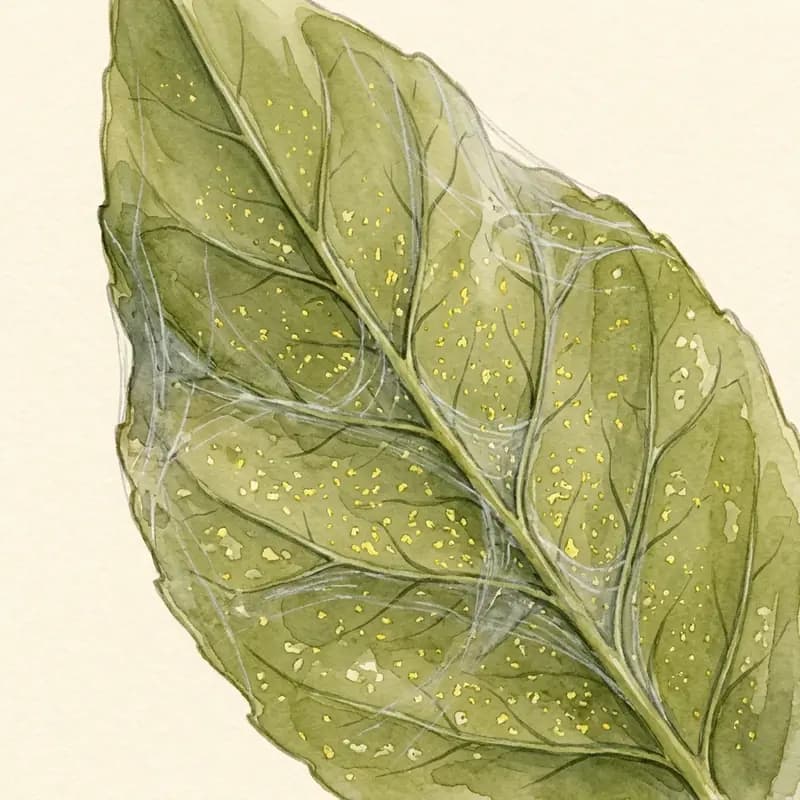
Red spider mite
Also known as: red spider mite, spider mites, two-spotted spider mite, glasshouse red spider mite, Tetranychus
A minute, almost invisible mite that settles on the undersides of leaves in hot, dry weather. It pierces the cells and causes a characteristic mottling and fine webbing. The first step is to wash the undersides of the leaves with water every day and raise the humidity.
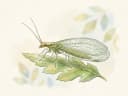
Its best ally
Lacewing
A natural predator that helps to keep this pest under control. Tap to see how to attract it.

How to recognise it at every stage
Shares your gardenIt likes your beans, tomatoes and cucumbers in hot, dry weather.
Life cycle: Egg, six-legged larva, two nymphal stages and adult, with no pupa. In hot dry weather (30 °C) it completes the cycle in 7-10 days. In autumn the females turn orange and spend the winter in hiding.
Tap a stage to see it full size. The photos are AI reference images checked against real photographs; stages without a reliable photo are shown as text only.
Life-stage calendar
| Jan | Feb | Mar | Apr | May | Jun | Jul | Aug | Sep | Oct | Nov | Dec | |
|---|---|---|---|---|---|---|---|---|---|---|---|---|
| Eggs | ||||||||||||
| Larvae and nymphs | ||||||||||||
| Adult | ||||||||||||
| Fine webbing on the tips |
Approximate months for mainland Spain; in cold areas they start later and in warm areas they last longer. Garden creatures this month
- 1Keep an eye on it
Eggs
· 0.1 mmTransparent pearl-like spheres that turn pearly before hatching.
- Where to find it
- On leaf undersides, among the silk threads.
- When: Apr–Oct
- What to do
- You need a 10x hand lens. If you see eggs and pale speckles on the leaves, act early.
No reliable photo yet
2Keep an eye on itLarvae and nymphs
· 0.2-0.4 mmLike the adults but smaller and paler; the larva has six legs.
- Where to find it
- On leaf undersides, next to the eggs.
- When: May–Oct
- What to do
- Spray the undersides with water at dusk: they hate humidity.
- 3Protect your plants
Adult
· 0.4-0.5 mmA tiny oval dot with eight legs, yellowish-green with a dark spot on each side; orange-red in autumn.
- Where to find it
- On leaf undersides; the leaves look speckled white and turn yellow.
- When: May–Oct
- What to do
- Keep humidity up (morning watering, mulch) and encourage predatory mites. Remove heavily webbed leaves.
- Often confused with
- Predatory mites (Phytoseiulus). Uniformly orange-red, pear-shaped, without spots and much faster. They eat spider mites: they are allies.
- Red velvet mite (Trombidium). Large (3-4 mm), velvety red and on the ground. It does not harm plants.
- Tomato russet mite. Invisible even with an ordinary lens, makes no webbing and turns stems bronze. See profile
Nests, egg clutches and shelters
- Protect your plants
Fine webbing on the tips
A very fine sheet of silk over shoots and leaves, full of moving dots: the colony is already large.
- Where to find it
- On the plant tips, in high summer.
- When: Jun–Sep
- What to do
- Carefully cut off the webbed tips, put them in a bag and wet the rest of the plant well.
Often confused with
- Predatory mites (Phytoseiulus). Uniformly orange-red, pear-shaped, without spots and much faster. They eat spider mites: they are allies.
- Red velvet mite (Trombidium). Large (3-4 mm), velvety red and on the ground. It does not harm plants.
- Tomato russet mite. Invisible even with an ordinary lens, makes no webbing and turns stems bronze. See profile
How to recognise it (symptoms)
- Very fine yellowish or silvery speckling on the leaves, giving them a dusty look
- Fine webbing on the undersides of the leaves and between leaves in advanced attacks
- Leaves that turn bronze, dry out and drop
- Tiny moving dots on the undersides of the leaves, visible with a magnifying glass
Crops affected
 TomatoMarmande tomato, flattened and ribbed, a good size for salads.
 PepperCalifornia Wonder pepper, a blocky bell type with thick flesh, for stuffing or eating fresh.
 AubergineAn aubergine with glossy black fruit, for warm climates.
 BeansA dwarf green bean that does not need a support and is easy to grow in a bed.
 CucumberThe 'Marketmore' cucumber is a classic salad cucumber resistant to several diseases.
 WatermelonA large watermelon with a green rind striped in dark green and very sweet red flesh.
What favours it
- Strong heat and very dry air, in which it breeds much faster
- Dust on the leaves, which favours the pest
- Plants stressed by lack of water
- Previous use of broad-spectrum insecticides, which wipe out its natural predators
Prevention
- Raise the humidity by watering and, first thing in the morning, a jet of water on the undersides of the leaves: red spider mite slows down in humid conditions
- Water regularly to avoid drought stress: a thirsty plant is easy prey
- In hot spells, check the undersides of the leaves every few days: colonies can build up in less than a week
- Encourage predatory mites (phytoseiids), which hunt red spider mite if you do not use broad-spectrum insecticides
Organic treatment
Always start here: these remedies are kind to the garden, the soil and pollinators.
- First: wash the undersides of the leaves with a fine jet of water early in the morning, every day for a week, and remove the worst-affected leaves. Also raise the humidity around the plants by watering and providing shade
- If it persists, spray potassium soap (10-20 g per litre) or a registered neem product (at the rate on its label) on the undersides of the leaves, repeating every 5-7 days
- Wettable sulphur (2.5-3 g per litre) in moderate heat, never in full sun or above 30 °C: it controls mites and powdery mildew, but scorches the leaves if it is too hot. Do not mix it with oils or apply them less than 3 weeks apart
- In a greenhouse, release Phytoseiulus persimilis, the predatory mite that specifically targets red spider mite, before dense webbing appears
Chemical treatment (with caution)
There are specific registered acaricides; ordinary insecticides do not control it and usually make the problem worse by killing its natural enemies. Alternate active ingredients to avoid resistance and follow the label.
Don't confuse it with…
The early mottling is easily confused with nutrient deficiencies or thrips damage. Look for the fine webbing and the moving dots on the undersides of the leaves with a magnifying glass.
In-depth guide — red spider mite (Tetranychus)
It is not an insect but a mite that thrives in dry heat. Increase the humidity around the plants and release predators before webbing covers the leaves.
Conditions that favour it
- Dry summers and dust on the leaves.
- Monocultures with no diversity in the greenhouse.
- Previous use of insecticides that wiped out the predators.
Immediate measures
- A jet of water on the undersides of the leaves first thing in the morning, daily or at least every other day for a week, without high pressure on delicate leaves.
- Raise the humidity around the plants by watering the soil and providing shade, not by spraying at dusk, which leaves the leaves wet overnight.
- Remove badly curled or scorched leaves and put them in the rubbish bin.
Phytoseiulus persimilis
This is the specific predator of red spider mite and works best with enough humidity and without extreme heat. Release it as directed by the supplier, as soon as you see the first speckling and before dense webbing appears.
Neem oil, soap or sulphur
Spray the undersides of the leaves with potassium soap (10-20 g per litre) or a registered neem product, at the rate on its label, or with wettable sulphur (2.5-3 g per litre) on dry leaves and out of the sun. Alternate products to avoid resistance.
Do not apply sulphur on hot days or on sensitive cucurbits (melon, squash, courgette) without first testing it on a few leaves.
Use plant protection products responsibly, even organic ones. Always read and follow the label, the doses and the harvest interval, and never treat plants in flower or while bees are flying, in order to protect pollinators. If in doubt, put prevention and organic methods first.

In the plant catalogue you'll see what to plant, how and when: a well-tended plant resists pests much better.