
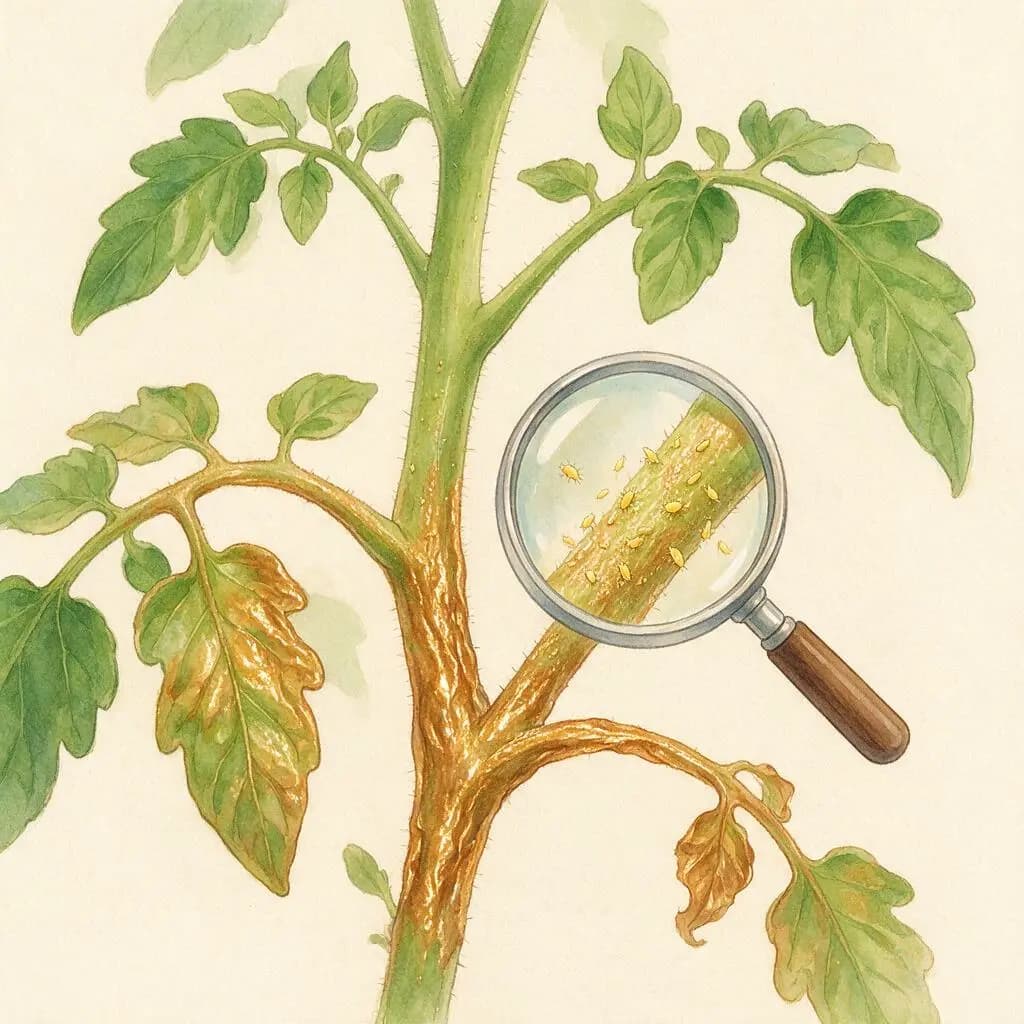
Tomato russet mite
Also known as: tomato russet mite, russet mite, Aculops lycopersici, eriophyid mite, tomato rust mite
A tiny mite (about 0.15 mm), invisible to the naked eye, that bronzes the stems and lower leaves of tomatoes. It takes off in dry heat. The first step is to confirm it with a magnifying glass and treat with wettable sulphur below 30 °C.

How to recognise it at every stage
Shares your gardenIt likes your tomatoes in hot, dry weather.
Life cycle: Egg, two nymphal stages and adult, all microscopic. In hot weather (over 25 °C), one week per generation. Only its effects can be seen: stems and leaves turning bronze from the bottom up.
Tap a stage to see it full size. The photos are AI reference images checked against real photographs; stages without a reliable photo are shown as text only.
Life-stage calendar
| Jan | Feb | Mar | Apr | May | Jun | Jul | Aug | Sep | Oct | Nov | Dec | |
|---|---|---|---|---|---|---|---|---|---|---|---|---|
| Eggs | ||||||||||||
| Nymphs | ||||||||||||
| Adult |
Approximate months for mainland Spain; in cold areas they start later and in warm areas they last longer. Garden creatures this month
No reliable photo yet
1Keep an eye on itEggs
· 0.05 mmInvisible even with a hand lens.
- Where to find it
- On stems and leaf undersides.
- When: May–Sep
- What to do
- Watch the colour of the lower stems in summer.
No reliable photo yet
2Keep an eye on itNymphs
· 0.1 mmMicroscopic, cream-coloured.
- Where to find it
- On stems, leaf stalks and undersides.
- When: May–Sep
- What to do
- Same as for the adults.
No reliable photo yet
3Protect your plantsAdult
· 0.15 mmA carrot-shaped yellowish mite; it can only be seen with a 20x lens or stronger.
- Where to find it
- On stems and lower leaves, which turn bronze and dry from the bottom up.
- When: May–Sep
- What to do
- Regular watering and some shade in heatwaves; sulphur where the crop tolerates it, avoiding extreme heat.
- Often confused with
- Spider mite. Visible with an ordinary lens, makes webbing and leaves yellow speckling on the leaves. See profile
Often confused with
- Spider mite. Visible with an ordinary lens, makes webbing and leaves yellow speckling on the leaves. See profile
How to recognise it (symptoms)
- Stems and leaf stalks with a bronzed, shiny, rough look, spreading from the bottom upwards
- Yellowish, brittle leaves that eventually drop
- Fruit with bronzed, cracked skin
- You need a powerful magnifying glass (20x magnification) to see them: they look like tiny yellow dots
Crops affected
 TomatoMarmande tomato, flattened and ribbed, a good size for salads.
 AubergineAn aubergine with glossy black fruit, for warm climates.
 PepperCalifornia Wonder pepper, a blocky bell type with thick flesh, for stuffing or eating fresh.
 PotatoThe 'Kennebec' potato is versatile in the kitchen, with pale skin.
What favours it
- Dry heat (above 30 °C) and low relative humidity
- Debris from plants of the same family left on the plot
- Wild Solanaceae nearby, which keep the pest going
Prevention
- Clear away crop debris when you finish, and wild Solanaceae from the edges
- Rotate crops for at least 2-3 years
- Keep reasonable humidity in the greenhouse (with drip irrigation to the soil)
Organic treatment
Always start here: these remedies are kind to the garden, the soil and pollinators.
- First: confirm with a magnifying glass, remove the worst-affected lower leaves and put the debris in the rubbish bin
- Wettable sulphur (as a guide, 2.5-3 g per litre, according to the label) at temperatures below 30 °C and out of strong sun
- For localised outbreaks, paraffin oil or other oils registered for the crop, without mixing them with sulphur or applying them within 3 weeks of a sulphur treatment
- In a greenhouse, you can release predatory mites (such as Amblyseius), if your supplier recommends them for this pest
Don't confuse it with…
With red spider mite damage, which leaves visible webbing and yellow speckling, not an even bronzing.
In-depth guide — russet mite versus the virus
The Aculops mite causes bronzing and fine cracking. The TSWV virus (transmitted by thrips) produces ring spots and dead tissue. They are not treated in the same way.
Telling them apart
Mite: rough stems and leaf undersides, with bronzing that moves from the bottom of the plant upwards; they can be seen with a magnifying glass. TSWV: rings, sudden distortion and, often, thrips.
- Inspect the undersides of the leaves with a magnifying glass of 10x magnification or more.
- If there are thrips and rings, prioritise controlling the thrips and pulling up virus-infected plants.
Mite
Sulphur or oils where the crop tolerates them, avoiding application in extreme heat.
- Watering and shade reduce the stress that makes the symptoms worse.
- Do not confuse it with simple lack of water.
Use plant protection products responsibly, even organic ones. Always read and follow the label, the doses and the harvest interval, and never treat plants in flower or while bees are flying, in order to protect pollinators. If in doubt, put prevention and organic methods first.

In the plant catalogue you'll see what to plant, how and when: a well-tended plant resists pests much better.