
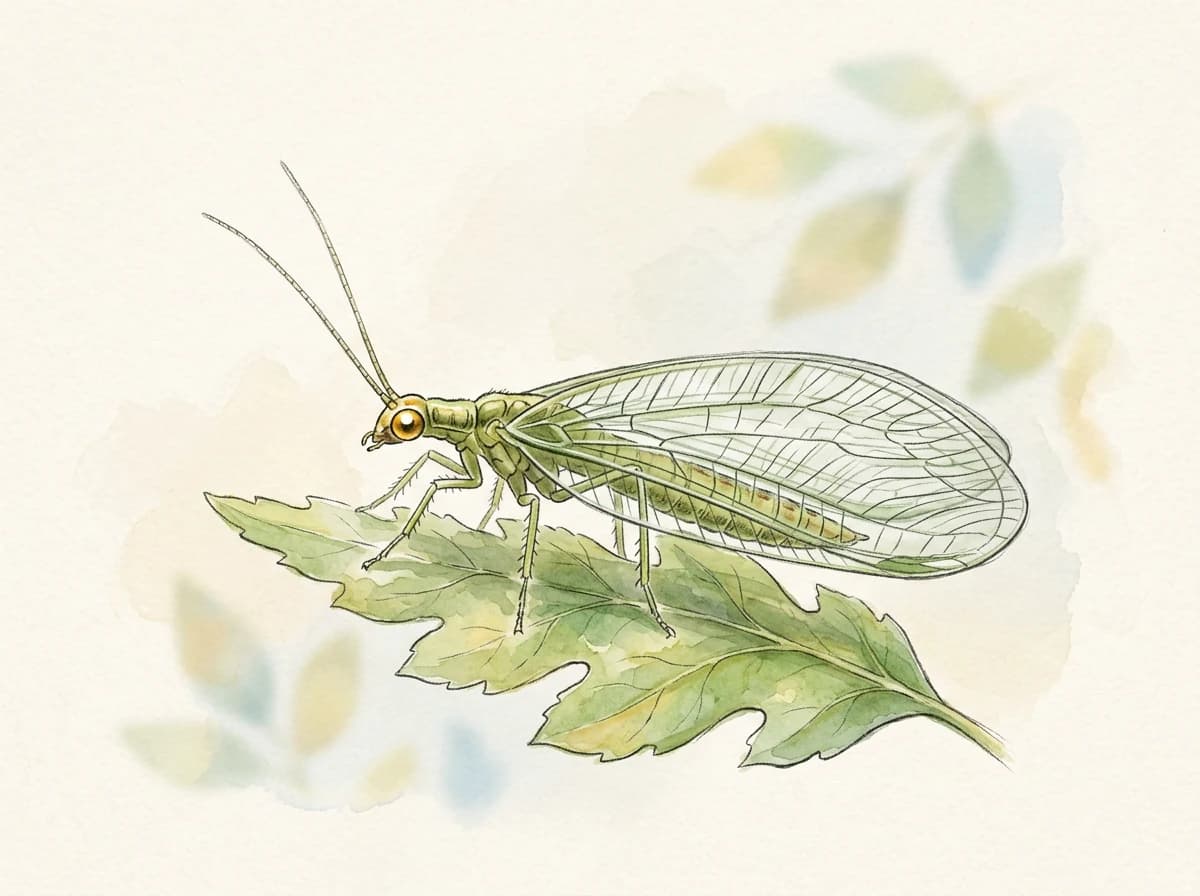
Lacewing (aphid lion)
Chrysoperla carnea
Also called: green lacewing, aphid lion, Chrysoperla, lacewings
A translucent green insect with golden eyes. The adult feeds on nectar and pollen, but the larva is a voracious hunter: it eats aphids, thrips, scale insects and whitefly eggs, several hundred prey during its development.

How to recognise it at every stage
Garden allyGarden ally: its larva is the "aphid lion".
Life cycle: Complete metamorphosis: egg (3-6 days), larva (2-3 weeks), pupa inside a silk cocoon (1-2 weeks) and adult. Two to four generations a year; the adults overwinter under cover and turn a yellowish brown.
Tap a stage to see it full size. The photos are AI reference images checked against real photographs; stages without a reliable photo are shown as text only.
Life-stage calendar
| Jan | Feb | Mar | Apr | May | Jun | Jul | Aug | Sep | Oct | Nov | Dec | |
|---|---|---|---|---|---|---|---|---|---|---|---|---|
| Eggs on stalks | ||||||||||||
| Larva | ||||||||||||
| Cocoon | ||||||||||||
| Adult | ||||||||||||
| Overwintering adults |
Approximate months for mainland Spain; in cold areas they start later and in warm areas they last longer. Garden creatures this month
- 1Protect it
Eggs on stalks
· 1 mm (with the hair, 1 cm)Pale green oval eggs, each on the tip of a fine white "hair" almost a centimetre long. They darken before hatching.
- Where to find it
- On leaf undersides and stems, single or in small groups, near aphids.
- When: Mar–Oct
- What to do
- Leave them: they are not mould or fungus. The hair protects the egg from ants and from its own siblings.
- Often confused with
- Lacewing eggs versus mould or fungus. They are stiff hairs, each with an egg on the tip; mould forms a fuzz with no neatly arranged little balls.
- 2Protect it
Larva
· 2-8 mmElongated, flattened and narrow at the back, brown or greyish with stripes, with two long jaws curved like sickles. Six legs and little bristles along the sides.
- Where to find it
- Hunting on shoots and undersides: aphids, thrips, whitefly eggs and mites.
- When: Apr–Oct
- What to do
- Protect it: it eats several hundred prey. It can give a gentle nip if you pick it up; better not to touch it.
- Often confused with
- Lacewing larva versus ladybird larva. The ladybird larva has orange spots and small jaws. The lacewing's is brown, flatter and carries two long "pincers" at the front. Both are allies. See profile
- 3Protect it
Cocoon
· 3-5 mmA little ball of white silk, round as a pearl, stuck to the leaf.
- Where to find it
- On leaf undersides, bark crevices and sheltered corners.
- When: Apr–Oct
- What to do
- Do not remove it: the pupa is inside. When the adult emerges it will leave a round hole with a little lid.
- 4Protect it
Adult
· 10-15 mm (2.5-3 cm with the wings)Pale green, delicate body, transparent wings with green veins folded like a little roof, golden eyes and long antennae. It flies at night and is drawn to light.
- Where to find it
- On flowers and hedges; in winter, inside sheds and houses, in brown colours.
- When: all year
- What to do
- Protect it: it feeds on nectar, pollen and honeydew. If it comes indoors in autumn, carry it out in a glass to a shed or a hedge.
Nests, egg clutches and shelters
- Protect it
Overwintering adults
Yellowish-brown lacewings, sitting still, in dry corners.
- Where to find it
- Sheds, lofts, window frames, lacewing boxes and dry leaf litter.
- When: Nov–Feb
- What to do
- Leave them until spring. In February-March they turn green again and fly out.
Often confused with
- Lacewing eggs versus mould or fungus. They are stiff hairs, each with an egg on the tip; mould forms a fuzz with no neatly arranged little balls.
- Lacewing larva versus ladybird larva. The ladybird larva has orange spots and small jaws. The lacewing's is brown, flatter and carries two long "pincers" at the front. Both are allies. See profile
What it eats
- Larva: aphids, thrips, red spider mites, butterfly eggs, mealybugs.
- The adult feeds on nectar and pollen without touching any plant in the garden.
How it helps in the garden
How to attract this ally to your garden
- Leave umbellifers in flower (carrot, fennel, dill, celery): their small flowers feed lacewings, hoverflies and parasitoid wasps.
- Plant sedum, tansy and other small-flowered daisy-family plants: they give the adults nectar for a long time.
- Give them shelter to get through the winter: an insect hotel with straw or hollow canes.
- Cut down on outdoor lighting at night: the adults fly at night and strong lights attract and disorient them.
Plants in the catalogue that attract it
 Nantes carrotThe Nantes carrot, cylindrical and sweet.
 Common fennelFennel grown for its leaves and aromatic seeds, hardier and wilder than bulb fennel.
 DillAn aromatic annual dill, grown for both its leaves and its seed.
 Green celeryA celery with green stalks that needs constant watering and rich soil.
 TansyA rhizomatous perennial 60 to 120 cm tall, with upright stems and very finely divided dark green leaves that…
What to avoid so you do not harm it by accident
- Contact insecticides: the larva is very sensitive.
- Strong white or bluish floodlights at night: they attract adult lacewings, which fly at night, and draw them away from your plants.
How to recognise it
Adult pale green, transparent wings with green veins, 15 mm. Larva about 8 mm, grey or brown, with clearly visible curved jaws.
Many allies are protected by Spanish law: do not capture or keep in captivity toads, hedgehogs, bats or native reptiles. Attract them, watch them and thank them from a distance. Rules in other countries differ: check your local regulations.

Allies do better if the garden is varied. Learn to identify each visitor and to prevent problems with good habits.