
Lacewings: a winter shelter and the plants that attract them
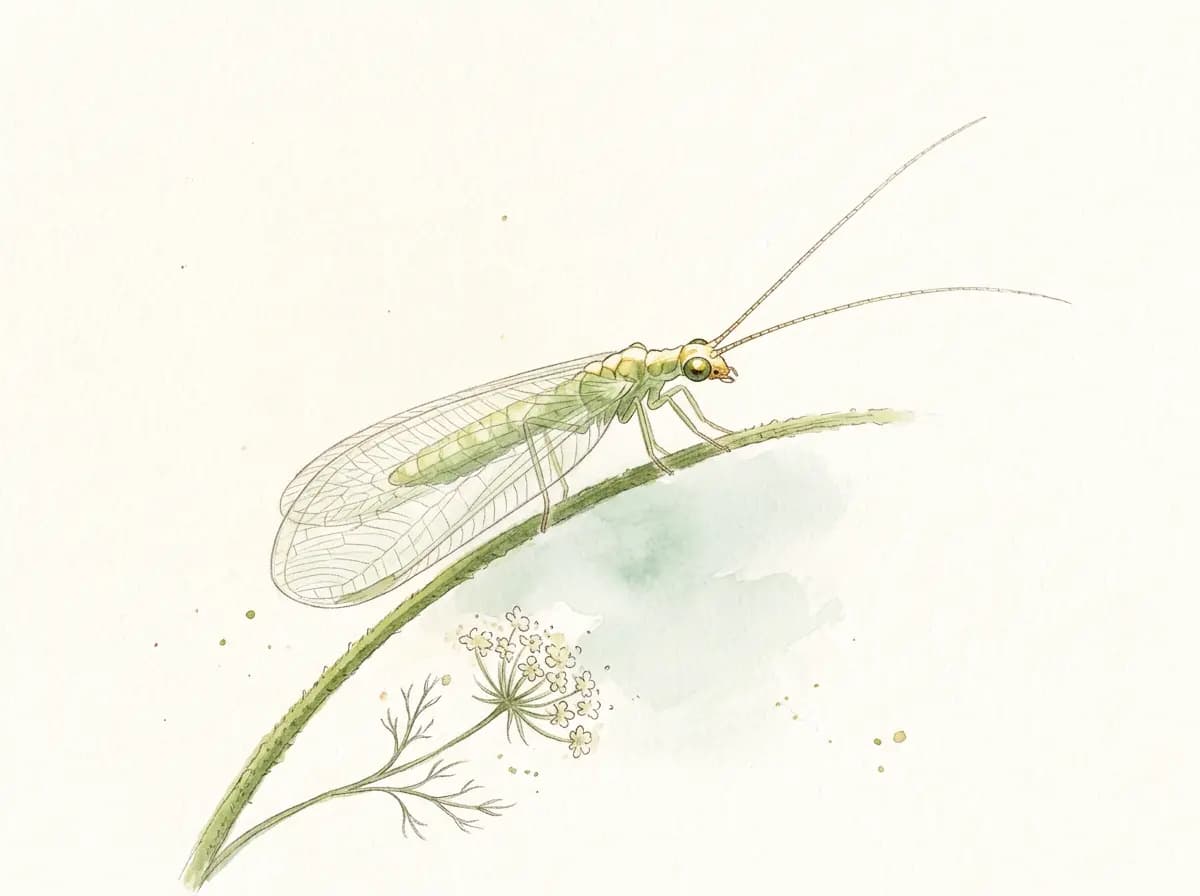
Lacewing larvae (“aphid lions”) eat aphids, thrips, insect eggs and mites. The adults, green with lace-like wings, live on pollen and nectar. All you have to do is give them flowers all summer and a dry shelter for the winter.
- Difficulty: easy
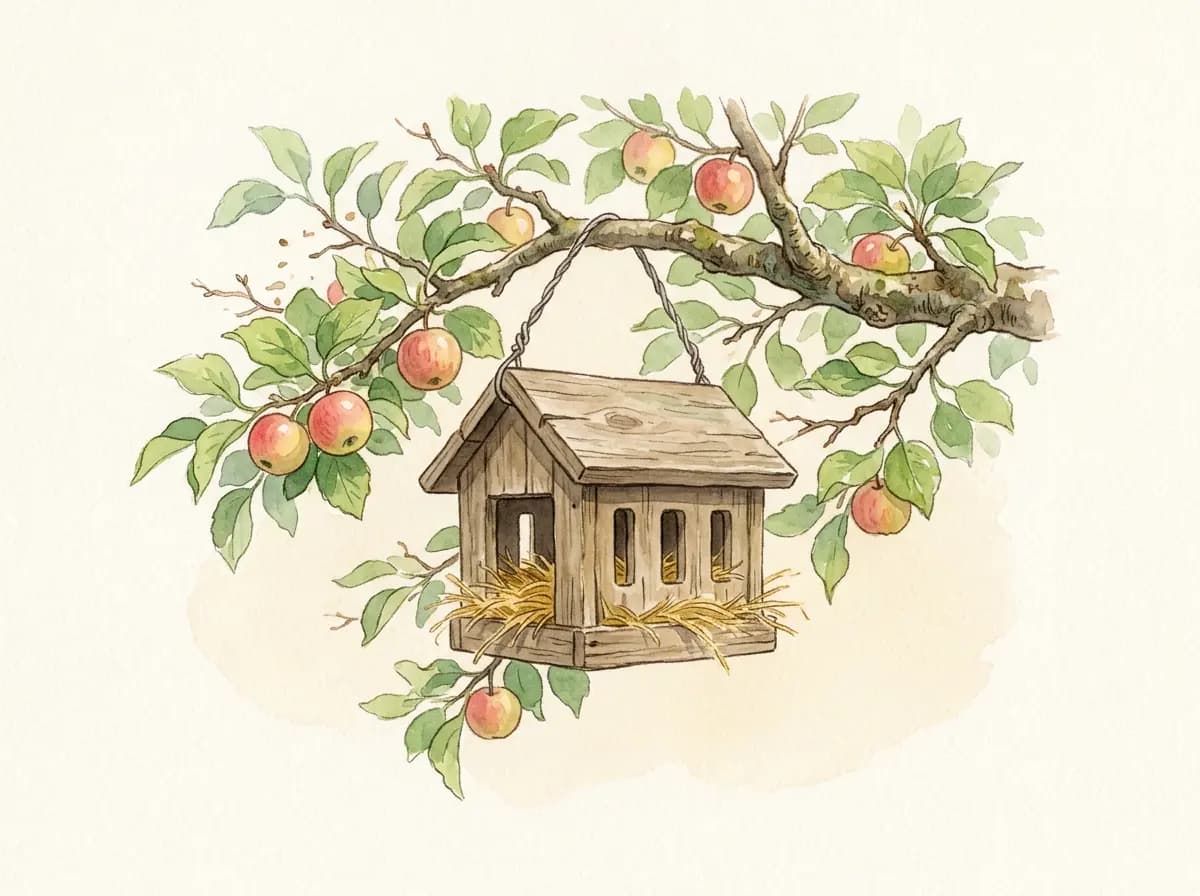
- Wooden box (indicative): approx. 15 × 15 × 25 cm, with a roof that overhangs by 3–5 cm
- Profile: Lacewing (aphid lion)
What it helps with
- The larva devours aphids, thrips, mites, young scale insects and the eggs of other insects.
- The adult pollinates modestly while taking nectar.
- With a winter shelter, the adults are close by when aphids start in spring.
Materials
- An untreated wooden box or a clay pot with a lid (or a large plastic bottle, cut)
- Straw, dry hay or rolled corrugated cardboard to fill it loosely
- A grille or coarse mesh to stop the filling falling out
- Wire or cord to hang it
- A piece of wood or a tile for the little roof
Measurements
- Wooden box (indicative)
- approx. 15 × 15 × 25 cm, with a roof that overhangs by 3–5 cm
- Entrance
- slits or holes of 1.5–2.5 cm in the lower part or at the side
- Filling
- loose straw or corrugated cardboard, filling three quarters of the box
- Hanging height
- 1.5–2 m, firm and not swinging
Step by step
1. Build the box
With untreated boards 1.5–2 cm thick, build a box of approx. 15 × 15 × 25 cm. Cut slits of 1.5–2.5 cm in the lower part of the front and leave an overhanging little roof so rain does not get in. Make the lid or the back openable so you can renew the filling.

2. Fill it loosely
Put in straw, dry hay or strips of corrugated cardboard upright, so there are dry, dark gaps. Hold the filling in with coarse mesh so it does not fall out.

3. Hang it in time
Hang it in late summer or early autumn, before the adults look for shelter, in a place sheltered from the wind, with morning sun and afternoon shade. Fix it firmly so it does not swing.

4. Plant for the adults
The adults need pollen and nectar: umbellifers (dill, fennel, coriander, carrot and parsley left to flower), daisy-family plants (calendula, cornflower, chamomile, yarrow) and small flowers such as sweet alyssum. Stagger the flowering.

5. Let them come on their own
Larvae and eggs appear where there are aphids: lacewing eggs hang from fine threads, like little white hairs. Do not move or remove them.

How to recognise it at every stage
Garden allyGarden ally: its larva is the "aphid lion".
Life cycle: Complete metamorphosis: egg (3-6 days), larva (2-3 weeks), pupa inside a silk cocoon (1-2 weeks) and adult. Two to four generations a year; the adults overwinter under cover and turn a yellowish brown.
Tap a stage to see it full size. The photos are AI reference images checked against real photographs; stages without a reliable photo are shown as text only.
Life-stage calendar
| Jan | Feb | Mar | Apr | May | Jun | Jul | Aug | Sep | Oct | Nov | Dec | |
|---|---|---|---|---|---|---|---|---|---|---|---|---|
| Eggs on stalks | ||||||||||||
| Larva | ||||||||||||
| Cocoon | ||||||||||||
| Adult | ||||||||||||
| Overwintering adults |
Approximate months for mainland Spain; in cold areas they start later and in warm areas they last longer. Garden creatures this month
- 1Protect it
Eggs on stalks
· 1 mm (with the hair, 1 cm)Pale green oval eggs, each on the tip of a fine white "hair" almost a centimetre long. They darken before hatching.
- Where to find it
- On leaf undersides and stems, single or in small groups, near aphids.
- When: Mar–Oct
- What to do
- Leave them: they are not mould or fungus. The hair protects the egg from ants and from its own siblings.
- Often confused with
- Lacewing eggs versus mould or fungus. They are stiff hairs, each with an egg on the tip; mould forms a fuzz with no neatly arranged little balls.
- 2Protect it
Larva
· 2-8 mmElongated, flattened and narrow at the back, brown or greyish with stripes, with two long jaws curved like sickles. Six legs and little bristles along the sides.
- Where to find it
- Hunting on shoots and undersides: aphids, thrips, whitefly eggs and mites.
- When: Apr–Oct
- What to do
- Protect it: it eats several hundred prey. It can give a gentle nip if you pick it up; better not to touch it.
- Often confused with
- Lacewing larva versus ladybird larva. The ladybird larva has orange spots and small jaws. The lacewing's is brown, flatter and carries two long "pincers" at the front. Both are allies. See profile
- 3Protect it
Cocoon
· 3-5 mmA little ball of white silk, round as a pearl, stuck to the leaf.
- Where to find it
- On leaf undersides, bark crevices and sheltered corners.
- When: Apr–Oct
- What to do
- Do not remove it: the pupa is inside. When the adult emerges it will leave a round hole with a little lid.
- 4Protect it
Adult
· 10-15 mm (2.5-3 cm with the wings)Pale green, delicate body, transparent wings with green veins folded like a little roof, golden eyes and long antennae. It flies at night and is drawn to light.
- Where to find it
- On flowers and hedges; in winter, inside sheds and houses, in brown colours.
- When: all year
- What to do
- Protect it: it feeds on nectar, pollen and honeydew. If it comes indoors in autumn, carry it out in a glass to a shed or a hedge.
Nests, egg clutches and shelters
- Protect it
Overwintering adults
Yellowish-brown lacewings, sitting still, in dry corners.
- Where to find it
- Sheds, lofts, window frames, lacewing boxes and dry leaf litter.
- When: Nov–Feb
- What to do
- Leave them until spring. In February-March they turn green again and fly out.
Often confused with
- Lacewing eggs versus mould or fungus. They are stiff hairs, each with an egg on the tip; mould forms a fuzz with no neatly arranged little balls.
- Lacewing larva versus ladybird larva. The ladybird larva has orange spots and small jaws. The lacewing's is brown, flatter and carries two long "pincers" at the front. Both are allies. See profile
Where and when to put it
- Box: put up from August to October, before temperatures drop.
- Plants: sown in spring so they flower from June to October.
- Position: near the crops and fruit trees, sheltered from wind and rain.
Maintenance
- In February–March, if you see no activity, open the box and renew the filling if it is damp or mouldy.
- Do not clean it in winter: there may be adults inside.
- Always keep something in flower nearby; without nectar, the adults leave.
- Do not spray during flowering or when there are larvae.
Common mistakes
What comes up most often, so you can avoid it from the start.
Packing the straw tightly into the box.
Lacewings need gaps between the straw to get in and stay still all winter. If it is pressed down, they cannot get in and the box stays empty.
Hanging it in the afternoon sun or under a drip.
The strong afternoon sun overheats it and drip water soaks the straw, which ends up rotting and filling with mould. Lacewings look for a dry shelter.
Buying eggs or larvae to release them unnecessarily.
Almost every garden already has wild lacewings; if you have flowers and a few aphids, they arrive on their own. Bought ones cost money and, without food nearby, they leave.
Cutting back all the hollow, dry stems in autumn.
Lacewings and other helpful insects spend the winter inside those stems. Leave them standing until the end of winter and cut them afterwards.
Plants that help
 DillAn aromatic annual dill, grown for both its leaves and its seed.
Its umbrella flowers are tiny and have the nectar close to hand, just what adult lacewings need. It flowers in summer.
 FennelFennel grown for its leaves and aromatic seeds, hardier and wilder than bulb fennel.
It flowers from summer to autumn with umbrella flowers similar to dill’s, and lengthens the nectar season.
 CorianderAn annual coriander, grown for its leaves and for its seed.
If you let it bolt, in a few weeks it is covered in little white flowers that lacewings and other helpful insects visit a lot.
 CalendulaAn annual with almost continuous orange or yellow edible flowers that self-sows year after year with hardly…
It flowers almost all year, so it gives pollen and nectar in spring and autumn too, when there are few flowers.
 YarrowA wild plant with very finely cut, feathery leaves and white flowers in flat clusters.
It is perennial and flowers from spring to autumn in flat clusters, easy for small insects to visit.
 Sweet alyssumA ground-covering plant with tiny, highly scented flowers in dense clusters, perfect for the edges of beds…
It is a low plant that flowers almost non-stop and smells of honey; its little flowers are ideal for adult lacewings.
 CornflowerA hardy annual with slender stems and narrow grey-green leaves that produces deep blue flower heads with…
Its buds have glands that give off nectar even before the flower opens, and lacewings take advantage of it.
More information on the site
Sources
The measurements are a synthesis of these conservation guides; where each author gives different figures, they appear as a range.