
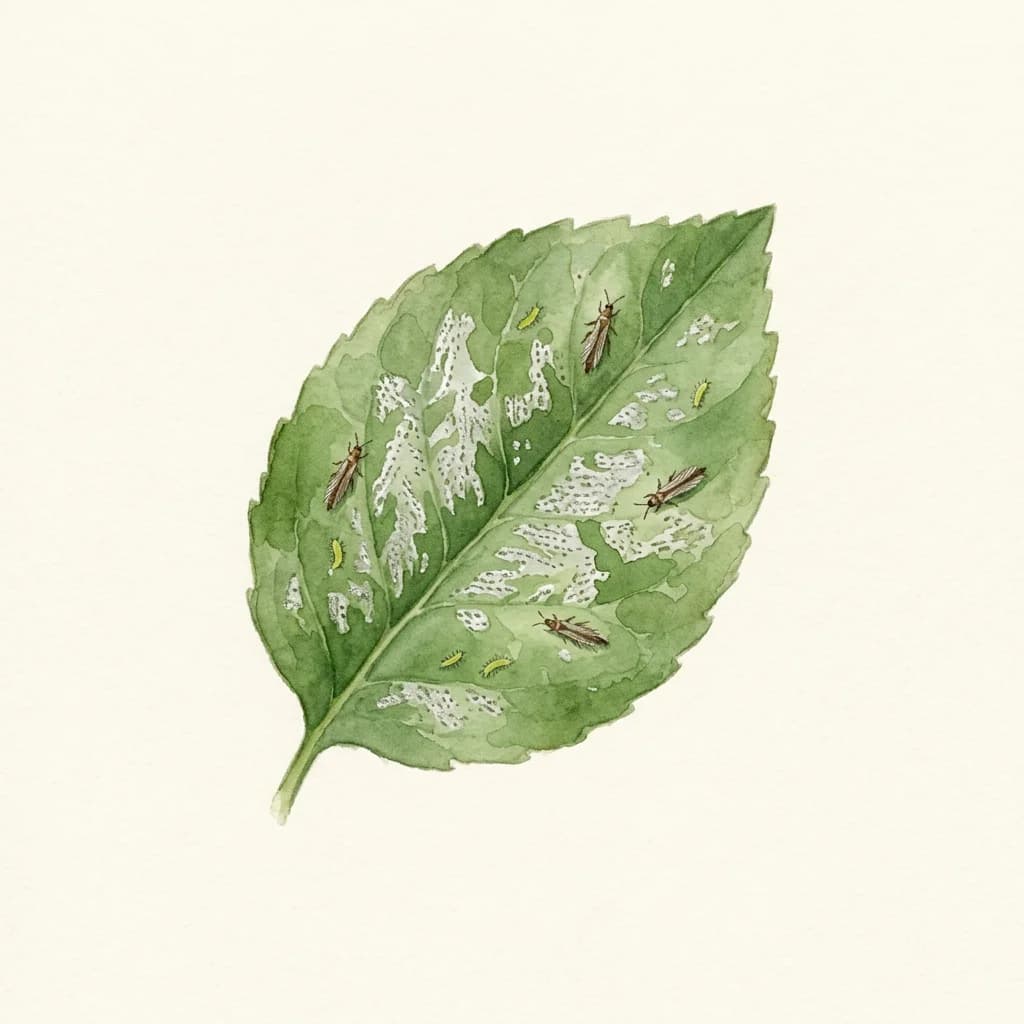
Thrips
Also known as: thrips, thunderflies, thunderbugs, western flower thrips, onion thrips
Tiny, elongated insects that rasp leaves and flowers to suck the sap. They leave a silvery look and can transmit viruses such as tomato spotted wilt virus. The first step is to hang blue traps and keep an eye on the flowers.
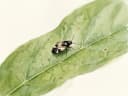
Its best ally
Predatory bug
A natural predator that helps to keep this pest under control. Tap to see how to attract it.

How to recognise it at every stage
Shares your gardenIt likes your flowers, onions and peppers; in hot weather it multiplies fast.
Life cycle: Egg inside the plant tissue, two larval stages, prepupa and pupa (usually in the soil) and adult. At 25 °C, about 2-3 weeks: many generations from spring to autumn.
Tap a stage to see it full size. The photos are AI reference images checked against real photographs; stages without a reliable photo are shown as text only.
Life-stage calendar
| Jan | Feb | Mar | Apr | May | Jun | Jul | Aug | Sep | Oct | Nov | Dec | |
|---|---|---|---|---|---|---|---|---|---|---|---|---|
| Eggs | ||||||||||||
| Larva | ||||||||||||
| Prepupa and pupa | ||||||||||||
| Adult |
Approximate months for mainland Spain; in cold areas they start later and in warm areas they last longer. Garden creatures this month
No reliable photo yet
1Keep an eye on itEggs
· 0.2 mmNot visible: the female inserts them into leaves, petals and fruits.
- Where to find it
- Inside the plant.
- When: Mar–Oct
- What to do
- Nothing to do at this stage; keep an eye on the flowers.
- 2Keep an eye on it
Larva
· 0.5-1.2 mmElongated, wingless, pale yellow or whitish, with reddish eyes.
- Where to find it
- In flowers and on leaf undersides, next to silvery scrapes and tiny black dots (its droppings).
- When: Apr–Oct
- What to do
- Shake a flower over white paper: if many fall out, hang blue sticky traps and encourage Orius bugs.
- Often confused with
- Orius nymphs. Orange or reddish, broader, with a beak. They are ally bugs that eat thrips. See profile
- 3Keep an eye on it
Prepupa and pupa
· 1 mmWhitish, with wing buds; it does not feed and barely moves.
- Where to find it
- In the top centimetres of soil or hidden in flowers.
- When: Apr–Oct
- What to do
- Living soil with predatory mites and a mulch means many never reach adulthood.
- 4Protect your plants
Adult
· 1-2 mmLong and thin like a splinter, yellow to brown, with narrow wings fringed with hairs.
- Where to find it
- Inside flowers and on tender leaves.
- When: Mar–Nov
- What to do
- Blue traps, fine mesh, removing old flowers and not overdoing nitrogen. It can spread tomato spotted wilt virus.
- Often confused with
- Aphid. Rounder and plumper, with two little tubes at the rear; thrips are as thin as a splinter and very fast. See profile
- Spider mite damage. Spider mites leave yellow speckling and webbing; thrips leave silvery patches with tiny black dots. See profile
Often confused with
- Aphid. Rounder and plumper, with two little tubes at the rear; thrips are as thin as a splinter and very fast. See profile
- Spider mite damage. Spider mites leave yellow speckling and webbing; thrips leave silvery patches with tiny black dots. See profile
- Orius nymphs. Orange or reddish, broader, with a beak. They are ally bugs that eat thrips. See profile
How to recognise it (symptoms)
- Silvery or whitish patches on leaves and petals
- Tiny black dots (droppings) on the silvery areas
- Distorted, scarred flowers and fruit
- Slender, dark insects that move about when you open a flower; check closed buds too
Crops affected
 TomatoMarmande tomato, flattened and ribbed, a good size for salads.
 PepperCalifornia Wonder pepper, a blocky bell type with thick flesh, for stuffing or eating fresh.
 OnionThe Figueres onion is a sweet onion with purplish skin, typical of Catalonia in Spain.
 GarlicLas Pedroñeras purple garlic, with a purple, very aromatic bulb: the benchmark garlic of La Mancha, in…
 BeansA dwarf green bean that does not need a support and is easy to grow in a bed.
What favours it
- Heat and dry air
- Flowering periods, when they gather in the flowers
- Flowering weeds that act as a reservoir between crops
Prevention
- Blue sticky traps to detect them and catch adults
- Clear weeds from the surrounding area to reduce the source
- Keep up some humidity (watering and mulch): thrips multiply more in hot, dry conditions
- Insect-proof mesh in the greenhouse to keep adults out
Organic treatment
Always start here: these remedies are kind to the garden, the soil and pollinators.
- First: hang blue sticky traps (one every 10 m² for monitoring, more if the infestation is heavy) and remove the most damaged flowers and leaves. This shows you how many there are and reduces the adult population
- Potassium soap (10-20 g per litre) or a registered neem product (at the rate on its label) on leaves and flowers, at dusk and avoiding flowers that bees are visiting
- In a greenhouse, releases of Orius laevigatus or of the predatory mites Amblyseius swirskii or cucumeris
- Natural pyrethrum, as a registered product, knocks down adults, but it is toxic to bees and to predators: use it only if the infestation is serious, and at dusk
Chemical treatment (with caution)
Thrips easily develop resistance and can transmit viruses. If you use insecticides, they must be products registered for the crop, and always combine them with biological control and traps.
Don't confuse it with…
The silvering is easily confused with red spider mite damage, but thrips leave tiny black droppings and do not make webbing.
In-depth guide — thrips
Tiny insects that rasp the leaf and can transmit viruses such as tomato spotted wilt. On peppers and tomatoes it pays to prevent them with mesh and act early.
Typical symptoms
- Silvering or bronzing on young leaves and petals.
- Black droppings on the undersides of the leaves.
- Distorted fruit and shoots in heavy attacks.
Insect-proof mesh
Use a thrips-proof mesh with a very fine aperture (about 0.3-0.6 mm, 0.8 mm mesh does not stop them) from transplanting to harvest on virus-sensitive crops. Watch out for heat build-up under the mesh. Seal any openings and avoid keeping infested plants nearby.
Biological and organic control
- Orius laevigatus in the greenhouse, at a stable temperature.
- Amblyseius cucumeris or swirskii on the leaves.
- Potassium soap or neem at dusk on new shoots.
Weeds and flowers
In spring, remove flowering weeds from the edges of the garden: they are a reservoir of thrips and of viruses too.
Use plant protection products responsibly, even organic ones. Always read and follow the label, the doses and the harvest interval, and never treat plants in flower or while bees are flying, in order to protect pollinators. If in doubt, put prevention and organic methods first.

In the plant catalogue you'll see what to plant, how and when: a well-tended plant resists pests much better.