
Credits and licences
- #1 — vueltaalhuerto illustration
- #2 — vueltaalhuerto illustration
- #3 — vueltaalhuerto illustration
- #4 — vueltaalhuerto illustration
- #5 — vueltaalhuerto illustration
- #6 — vueltaalhuerto illustration
- #7 — vueltaalhuerto illustration
- #8 — vueltaalhuerto illustration
- #9 — vueltaalhuerto illustration
- #10 — vueltaalhuerto illustration
Strawberry clover (Trifolium fragiferum)
and 1 more names
Trifolium fragiferumStrawberry clover (Trifolium fragiferum) is sown directly outdoors from March to April and from September to October. It is harvested from May to August. Grow it in full sun, 10 cm apart, with moderate watering. Dates are for a mild temperate climate in the northern hemisphere; the calendar below adjusts them to your zone.
What else to sow in March, April, September and October
A creeping perennial legume, 5 to 20 cm tall, that spreads by stems rooting at the nodes and forms a low, dense carpet. It has leaves of three oval leaflets, a slightly bluish green, and heads of pale pink flowers that attract honeybees and bumblebees. Its most striking feature comes after flowering: the calyx inflates, becomes hairy and turns pinkish or beige, so that each head looks like a pale, furry strawberry, hence its name; it is not edible and has nothing to do with a strawberry. It fixes nitrogen and tolerates trampling, frequent mowing, heavy, poorly drained soils and some salinity, which is why it is used as ground cover, pasture, a lawn alternative and green manure in damp or saline areas. It is not a kitchen plant. Do not confuse it with white clover (Trifolium repens) or crimson clover (Trifolium incarnatum).
Family and origin: Pea family (Fabaceae) · native to Europe, North Africa, the Near East and western Asia; it grows wild in Spain in damp meadows and slightly saline soils · More plants from Mediterranean basin
01In your area
How will it do in your garden?
Year calendar
| Task | J | F | M | A | M | J | J | A | S | O | N | D |
|---|---|---|---|---|---|---|---|---|---|---|---|---|
| Direct sowingMar–Apr, Sep–Oct | no | no | yes | yes | no | no | no | no | yes | yes | no | no |
| HarvestMay–Aug | no | no | no | no | yes | yes | yes | yes | no | no | no | no |
Its life cycle at a glance
Swipe and tap a stage to see its details.
02Planting
Where and how to plant it
Sow the seed 8 mm deep; leave 10 cm between plants and 20 cm between rows.
03Care
Care through the year
Sun and aspectFull sun · 7 h of sun · South or south-west, with nothing casting shade at midday
- Too little sun
- Ideal range
- Plenty of sun
South or south-west, with nothing casting shade at midday
Moderate sun: Copes with full sun, but give it some shade during heatwaves.
Full sun or light partial shade. In very hot climates it copes well if the soil is kept slightly moist; in heavy shade it thins out and flowers less.
WateringMoist but never waterlogged · summer: once or twice a week if it does not rain
- Summeronce or twice a week if it does not rain2 L per plant/week
- Spring / Autumnevery 4-5 days1 L per plant/week
- Winterhardly ever0.3 L per plant/week
Moist but never waterlogged: Water before the surface is completely dry. Never puddles.
Keep the soil moist until it comes up and establishes; after that it withstands moderate drought well and also heavy, damp soils, which other clovers tolerate poorly. In summer, in a dry climate, watering once a week keeps the carpet green.
When to water? Push your finger 3 cm into the soil next to the base of the plant:
- Damp: soil sticks to your finger. Do not water today. The moisture is fine.
- Cool but clean, no mud. Water early tomorrow if it stays like this, or this evening.
- Dry and dusty. Water now, and deeply. This is not where it likes to be.
Soil and feedingpH 6–8 · Soil low in nitrogen (they fix their own)
Soil low in nitrogen (they fix their own).
50 % topsoil · 30 % very well-rotted compost · 20 % sand or perlite.
Medium, with good air around the roots.
This plant prefers a pH between 6.0 and 8.0 (slightly acidic to alkaline).
- Do not add nitrogen: they fix their own in root nodules.
- Add wood ash or rock phosphate before sowing (more flowers and pods).
- Leave the roots in the soil after harvesting: they enrich the ground.
- Feeding with manure or urea produces lots of plant and few pods.
- Overwatering during germination rots the seed before it comes up.
- TipSow in weed-free, firm, finely broken-up soil, and do not let it dry out until it has established.
- TipAs permanent cover in a path or a lawn, mow it from time to time; as a green manure, cut it and leave it on the soil or dig it in shallowly before the heads set seed.
- TipIn soil where no clover has grown before, a commercial clover inoculant can improve nitrogen fixation.
- TipSow densely to cover the soil and cut it before it sets seed; leave it as mulch or work it into the surface.
- Common mistakeBurying it deep or in waterlogged soil: it breaks down poorly.
Common mistakes and tips
- TipIt attracts bees: do not mow it in full flower if you want to help them.
- TipDo not introduce it into protected natural areas.
- TipThe rates, timings and dates are only a guide and depend on the local climate.
04Harvest
Harvesting and storing
Harvest in May–Aug.
- TipNo extra feeding: its job is to improve the soil, not to give a crop.
05Propagation
Make new plants
It is sown from seed, broadcast, in spring (March and April) or autumn (September and October), in finely broken-up soil, about 5 to 10 mm deep, then raked and rolled so the seed is in contact with the soil. A rough garden sowing rate is 2 to 3 g per m², as for other small clovers. The seed has a hard coat: rubbing it gently with sandpaper or soaking it for a few hours helps. It germinates in one or two weeks at 15 to 25 °C. An established plant also spreads by itself through rooting runners, and can be divided in spring.
Seeds: how to germinate them~10 days
06Uses and health
What it is used for, and with what care
There are no reliable data on toxicity to people, dogs and cats. In livestock, like other clovers, eaten in large amounts it can cause bloat (swelling of the rumen). It is not known to be toxic, but as a precaution do not eat it or let children or pets chew large amounts. Do not mistake its seed heads for strawberries.
- Properties
- A legume useful as a green manure and ground cover, and a bee plant. It has no home medicinal uses worth recommending.
- Uses
- It is not a kitchen plant. Although its leaves and flowers are traditionally described as edible in small amounts, there is no culinary use to recommend, and its strawberry-like seed heads are not eaten.
For guidance only; this is not medical treatment and does not replace advice from a doctor or vet.
07Companions and related plants
What to plant it with
Good companions
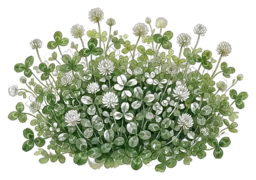
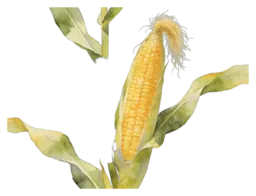
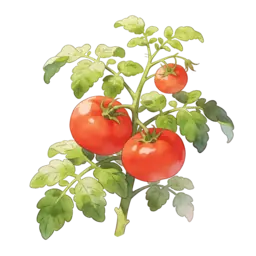
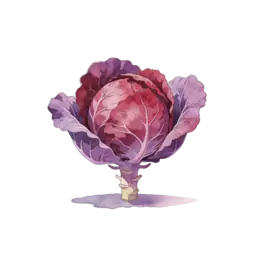
Group it in the same bedPlants with the same watering or the same sun
They are not essential companions, but you will not have to water or position them differently.