
Credits and licences
- #1 — vueltaalhuerto illustration
- #2 — vueltaalhuerto illustration
- #3 — vueltaalhuerto illustration
- #4 — vueltaalhuerto illustration
- #5 — vueltaalhuerto illustration
- #6 — vueltaalhuerto illustration
- #7 — vueltaalhuerto illustration
Rieger begonia (Begonia × hiemalis)
and 2 more names
Hiemalis begonia, begoniaRieger begonia (Begonia × hiemalis) is planted from March to May. It flowers from October to March. Grow it in sun or partial shade, 25 cm apart, with moderate watering. Dates are for a mild temperate climate in the northern hemisphere; the calendar below adjusts them to your zone.
A compact, very free-flowering pot Begonia 25 to 35 cm tall, with fleshy, brittle stems, glossy green, oval, lopsided leaves with toothed edges, and single or double flowers, sometimes resembling small roses, in red, orange, pink, yellow or white. It is a modern hybrid of the so-called ‘Hiemalis’ or ‘Elatior’ group, sold mainly as a gift plant to bring colour in autumn, winter and spring. Indoors it usually lasts a few months: after its big flush of flowers the plant is exhausted and many gardeners replace it with cuttings. It needs plenty of light without direct sun, mild temperatures and regular watering without waterlogging. It does not survive frost. It is ornamental and not edible: it contains oxalates and is best kept away from children and pets. It is not listed in the Spanish Catalogue of Invasive Alien Species or on the EU list.
Family and origin: Begonia family (Begoniaceae) · native to Cultivated hybrid (Begonia socotrana, from the island of Socotra, crossed with tuberous begonias from the Andes)
01In your area
How will it do in your home?
Year calendar
| Task | J | F | M | A | M | J | J | A | S | O | N | D |
|---|---|---|---|---|---|---|---|---|---|---|---|---|
| Plant / transplantMar–May | no | no | yes | yes | yes | no | no | no | no | no | no | no |
| FloweringOct–Mar | yes | yes | yes | no | no | no | no | no | no | yes | yes | yes |
| CuttingsApr–Jul | no | no | no | yes | yes | yes | yes | no | no | no | no | no |
Its life cycle at a glance
Swipe and tap a stage to see its details.
02Planting
Planting and transplanting
- TipChoose plants with plenty of closed buds and no yellow leaves.
- Common mistakeSowing out of season: many need warmth or a cold spell beforehand to sprout.
03Care
Care through the year
Sun and aspectSun and shade · 3 h of sun · shade in summer
- Too little sun
- Ideal range
- Plenty of sun
East, or south with light shade in the middle of the day
Gentle sun: Morning or afternoon sun. Midday summer sun stresses and scorches it.
Plenty of light, but no direct sun: a bright east-facing window, or a light corner near a south- or west-facing window with a net curtain. In low light the stems become leggy and it stops flowering; in direct sun the leaves and flowers scorch. It prefers 18 to 22 °C and should not drop below about 10 °C or be exposed to draughts.
WateringMoist but never waterlogged · summer: every 3 to 5 days
- Summerevery 3 to 5 days1.2 L per plant/week
- Spring / Autumnevery 4-5 days0.6 L per plant/week
- Winterevery 7 to 10 days0.2 L per plant/week
Moist but never waterlogged: Water before the surface is completely dry. Never puddles.
Keep the potting mix slightly moist, neither waterlogged nor allowed to dry out completely. Water from below, standing the pot in a saucer of water for a few minutes and then emptying the excess, and avoid wetting the leaves and flowers: water on the plant encourages powdery mildew and grey mould, and overwatering rots the stems. It appreciates humid air, but do not mist it directly.
When to water? Push your finger 2 cm into the soil next to the base of the plant:
- Damp: soil sticks to your finger. Do not water today. The moisture is fine.
- Cool but clean, no mud. Water early tomorrow if it stays like this, or this evening.
- Dry and dusty. Water now, and deeply. This is not where it likes to be.
Potting mix and feedingpH 5.5–6.5 · Loose soil with organic matter and good drainage
Loose soil with organic matter and good drainage.
50 % topsoil · 30 % well-rotted compost · 20 % sand or perlite.
Medium/high.
This plant prefers a pH between 5.5 and 6.5 (slightly acidic to neutral).
- Overfeeding gives lots of leaf and few flowers.
- Compacted, poorly drained soil rots the roots in winter.
- TipFeed every two weeks during flowering with a potassium-rich flowering-plant fertiliser, at half strength and onto moist potting mix.
- Common mistakeOverfeeding gives lush leaves but few flowers.
Pruning
- TipRemove faded flowers and pinch out long tips to keep it compact.
- TipRemove faded flowers to prolong flowering.
Common mistakes and tips
- TipWatch out for powdery mildew, grey mould (botrytis), aphids and whitefly.
04Propagation
Make new plants
It is propagated from softwood stem cuttings, which is the usual method: in spring or early summer, cut a tip about 8 to 10 cm long, remove the lower leaves and the flowers, and stand it in water or in light, moist potting mix (peat and sand or perlite), in bright light out of direct sun, at about 20 to 24 °C; it roots in about three to five weeks. Leaf cuttings can also be taken, with the leaf stalk inserted into moist mix, although they are slower. The seed is a fine dust, takes practice and commercial varieties do not come true, so it is not used. Many commercial varieties may be protected by plant breeders' rights: there is no problem for your own use at home, but they cannot be propagated for sale.
Seeds: how to germinate them~21 days
- TipWhen flowering ends, cut the stems back by a third, water less and renew it from cuttings.
05Uses and health
What it is used for, and with what care
SAFETY WARNING: begonias contain insoluble calcium oxalates, especially in the stems and roots, which can cause mouth irritation, drooling, vomiting and digestive upset in dogs, cats and people if chewed or eaten. Them is among the plants toxic to dogs and cats. Keep the plant out of reach of children and pets, and wash your hands after handling the cuttings. If swallowed, consult a vet or the Spanish Toxicology Information Service (91 562 04 20 in Spain).
- Properties
- A very showy ornamental houseplant that provides colour from autumn to spring. It has no home medicinal uses.
- Uses
- It is not grown for eating. Although begonia flowers are sometimes cited as edible, they contain oxalates, so this profile does not recommend them: do not use any part in cooking or in herbal teas.
For guidance only; this is not medical treatment and does not replace advice from a doctor or vet.
06Companions and related plants
What to plant it with
Compare with similar varieties
| Variety | Sowing | Harvest | Days | Spacing | Difficulty |
|---|---|---|---|---|---|
| Wax begonia (semperflorens) | Jan–Mar | May–Oct | — | 20 cm | Easy |
| Rieger begonia (Begonia × hiemalis) | Mar–May | — | — | 25 cm | Moderate |
| Polka dot begonia (Begonia maculata) | — | — | — | 40 cm | Moderate |
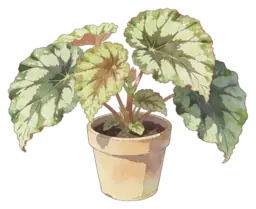
| Rex begonia (Begonia rex) | — | — | — | 30 cm | Moderate |
| Tuberous begonia | Feb–Mar | Jun–Oct | ~100 | 30 cm | Moderate |