Credits and licences
- #1 — vueltaalhuerto illustration
- #2 — vueltaalhuerto illustration
- #3 — vueltaalhuerto illustration
- #4 — vueltaalhuerto illustration
- #5 — vueltaalhuerto illustration
- #6 — vueltaalhuerto illustration
- #7 — vueltaalhuerto illustration
- #8 — vueltaalhuerto illustration
- #9 — vueltaalhuerto illustration
- #10 — vueltaalhuerto illustration
Lipstick plant
and 1 more names
basket vineLipstick plant is sown in seed trays from February to April, and planted out from March to May. It flowers from June to September. Grow it in sun or partial shade, 30 cm apart, with moderate watering. Dates are for a mild temperate climate in the northern hemisphere; the calendar below adjusts them to your zone.
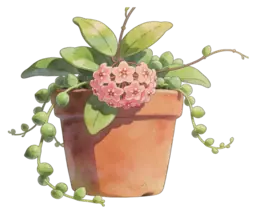
A trailing houseplant from the African violet family that in the wild lives as an epiphyte on trees in humid tropical forests. It forms long, arching stems 60 to 90 cm long with opposite, oval, fleshy, glossy leaves about 4 to 8 cm long. At the ends of the stems, mainly from spring to autumn, it bears clusters of tubular scarlet flowers 5 to 6 cm long, emerging from tubular dark red or burgundy calyces, and the whole thing looks like a lipstick freshly twisted out of its case; hence the name. It is grown in a hanging pot or on a tall stand, in a bright, mild room, and needs a humid atmosphere and a temperature that does not drop below about 12 °C. It is not edible. Do not confuse it with the wax plant (Hoya), which has similar leaves but star-shaped flowers grouped in umbels.
Family and origin: Gesneriad family (Gesneriaceae) · native to South-East Asia (Malay Peninsula, Sumatra, Java and Borneo) · More plants from Southeast Asia
01In your area
How will it do in your home?
Year calendar
| Task | J | F | M | A | M | J | J | A | S | O | N | D |
|---|---|---|---|---|---|---|---|---|---|---|---|---|
| Seed trayFeb–Apr | no | yes | yes | yes | no | no | no | no | no | no | no | no |
| Plant / transplantMar–May | no | no | yes | yes | yes | no | no | no | no | no | no | no |
| FloweringJun–Sep | no | no | no | no | no | yes | yes | yes | yes | no | no | no |
| PruningMar–Apr, Sep | no | no | yes | yes | no | no | no | no | yes | no | no | no |
| CuttingsApr–Sep | no | no | no | yes | yes | yes | yes | yes | yes | no | no | no |
Its life cycle at a glance
Swipe and tap a stage to see its details.
02Care
Care through the year
Sun and aspectSun and shade · 5 h of sun · shade in summer
- Too little sun
- Ideal range
- Plenty of sun
East, or south with light shade during the middle of the day
Moderate sun: Copes with full sun, but give it some shade during heatwaves.
Bright light without direct sun, which is what it needs to flower: an east- or west-facing window with a light curtain is ideal. In low light it produces lots of green stems and few flowers, and strong midday sun scorches the leaves. From spring to autumn it prefers 18 to 27 °C, and a slightly cooler winter, at 15 to 18 °C, helps it form flowers; it should not drop below 10-12 °C.
- TipTurn the pot every week so it grows evenly towards the light.
WateringMoist but never waterlogged · summer: every 2-3 days
- Summerevery 2-3 days0.6 L per plant/week
- Spring / Autumnevery 4-5 days0.3 L per plant/week
- Winterevery 2-3 weeks0.1 L per plant/week
Moist but never waterlogged: Water before the surface is completely dry. Never puddles. Mulch: straw or dry plant material cuts watering by 30-50 %.
Water when the top layer of potting mix has dried, with water at room temperature, without waterlogging, because as an epiphyte it has fine roots that rot easily; always empty the saucer. Water less in winter. It needs a humid atmosphere: a tray of wet pebbles under the pot or a humidifier helps, especially with central heating, and a lack of humidity shows in leaves that wrinkle or drop.
When to water? Push your finger 2 cm into the soil next to the base of the plant:
- Damp: soil sticks to your finger. Do not water today. The moisture is fine.
- Cool but clean, no mud. Water early tomorrow if it stays like this, or this evening.
- Dry and dusty. Water now, and deeply. This is not where it likes to be.
- TipAdjust watering to the light and the season: in winter almost all of them need much less water.
- Common mistakeOverwatering is the number one killer: let it dry out as the species requires.
Potting mix and feedingpH 5.5–6.5 · Multi-purpose compost lightened with perlite
Multi-purpose compost lightened with perlite.
70 % multi-purpose compost · 20 % perlite · 10 % coir.
High: always a pot with a drainage hole and a shallow saucer.
This plant prefers a pH between 5.5 and 6.5 (slightly acidic to neutral).
- Repot every 2-3 years into a pot a finger's width wider, not much more.
- A handful of worm castings a year keeps the potting mix alive.
- Reusing old potting mix without refreshing it compacts and rots the roots.
- No drainage in the pot = waterlogged roots = dead plant.
- TipUse a light, airy potting mix with peat, perlite and fine bark, and a small pot, as the plant flowers better when slightly pot-bound.
- TipFeed every fortnight from spring to autumn with a fertiliser for flowering plants, at half strength.
- Common mistakePots without drainage waterlog the roots and rot the plant.
PruningWhen: Mar–Apr, Sep
Pruning time for this plant: Mar–Apr, Sep.
Common mistakes and tips
- TipAfter flowering, cut back the long, bare stems so it branches, because the flowers appear at the tips of new shoots.
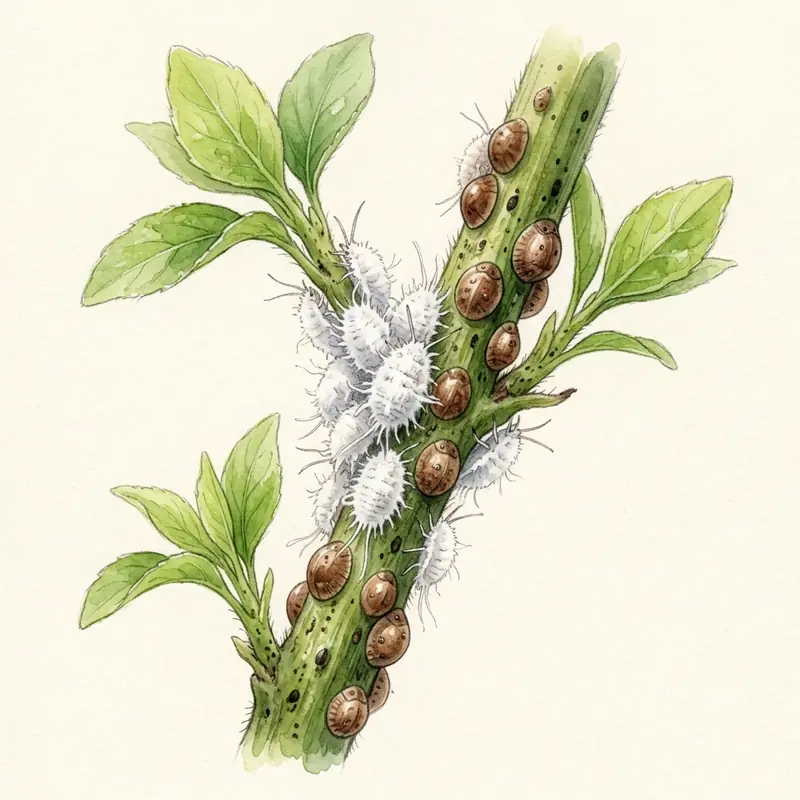
- TipWatch out for mealybugs, aphids and red spider mite, and for grey mould if the leaves stay too damp.
03Propagation
Make new plants
It is propagated mainly from stem cuttings, and also from seed, which is uncommon. Tip cuttings about 10 cm long with several pairs of leaves are taken from spring to summer, the lower leaves removed, and planted in a light, very airy potting mix of peat, perlite or fine bark, under a clear plastic bag or in a mini propagator, at about 20-25 °C; they root in three to four weeks. They also root in water, although they then struggle to adapt to soil. The seed comes in long, slender capsules, and is tiny with a tuft of hairs; it is sown on the surface of moist potting mix, with warmth and high humidity, and the plant takes several years to flower.
Seeds: how to germinate them~21 days
- TipPlant three or four cuttings together in the same pot to get a bushy plant.
04Uses and health
What it is used for, and with what care
There are no reliable data on its toxicity to people, so it should not be eaten. The sources consulted disagree on its toxicity to dogs and cats: most consider it slightly or not at all toxic, and some mildly irritant, so to be safe do not let animals chew it and consult the vet if they swallow a noticeable amount. It can be kept in a home with children and pets if it is hung out of their reach.
- Properties
- It is an ornamental houseplant with very showy, long-lasting flowers. It is not used as a medicinal plant.
- Uses
- It is not edible and is not used in cooking.
For guidance only; this is not medical treatment and does not replace advice from a doctor or vet.
05Companions and related plants
What to plant it with
Compare with similar varieties
| Variety | Sowing | Harvest | Days | Spacing | Difficulty |
|---|---|---|---|---|---|
| Polka dot plant (Hypoestes phyllostachya) | Mar–May | — | — | 25 cm | Easy |
| Curry plant | Feb–Mar | May–Sep | ~120 | 40 cm | Easy |
| Lipstick plant | Feb–Apr | — | — | 30 cm | Moderate |
06Pests and diseases
Critters and ailments to keep an eye on
The most common ones on this plant. Tap one to see how to recognise it and what to do.