Credits and licences
- #1 — vueltaalhuerto illustration
- #2 — vueltaalhuerto illustration
- #3 — vueltaalhuerto illustration
- #4 — vueltaalhuerto illustration
- #5 — vueltaalhuerto illustration
- #6 — vueltaalhuerto illustration
- #7 — vueltaalhuerto illustration
- #8 — vueltaalhuerto illustration
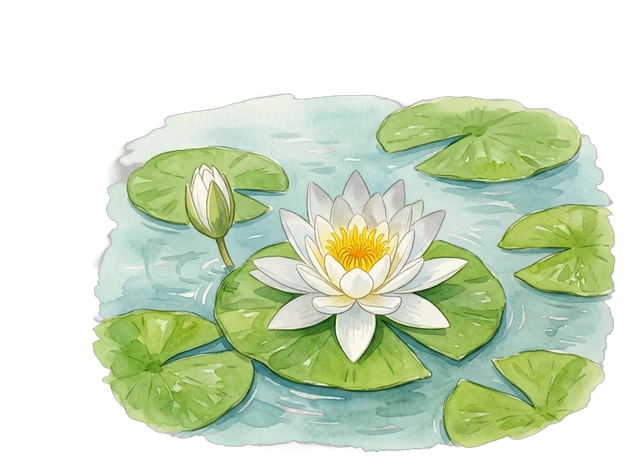
Hybrid water lilies (Nymphaea × hybrida)
and 3 more names
Nymphaea, Marliacea Chromatella, Nymphaea × hybridaHybrid water lilies (Nymphaea × hybrida) is planted from April to June and in September. It flowers from May to September. Grow it in full sun, 100 cm apart, with plenty of watering. Dates are for a mild temperate climate in the northern hemisphere; the calendar below adjusts them to your zone.
Hybrid pond water lilies are garden cultivars, such as 'Marliacea Chromatella' (yellow), 'Alexsea' or 'Bambi', sold in shops as red, pink or yellow water lilies. They are perennial aquatic plants with a thick rhizome buried in the bottom of the pond, from which grow rounded floating leaves with a notch reaching the centre, and star-shaped flowers that float or rise slightly above the water from June to September; they open in the sun and close in the afternoon. Depending on the cultivar, the flowers are white, pink, red, yellow or orange, and the spread of the plant ranges from less than a metre to more than two. "Hardy" hybrids withstand ice as long as the rhizome stays below the frozen layer. They are planted in baskets with heavy soil and gravel, at a shallow depth to begin with, and the surface covered by leaves shades the water and helps to keep algae in check. LEGAL AND SAFETY NOTICE: garden water lilies can be bought and grown, but there are two legal warnings. One concerns the Mexican water lily (Nymphaea mexicana), with yellow flowers, which is listed in the Spanish Catalogue of Invasive Alien Species (Real Decreto 630/2013): keeping, selling and growing it are prohibited in Spain, so check that the yellow plant you buy is a nursery cultivar, such as 'Marliacea Chromatella', and not that species. The other concerns the wild: never release water lilies or pieces of rhizome into rivers, lakes, irrigation channels or other people's ponds, because ornamental aquatic plants naturalise easily, and do not pull up wild water lilies, because the native white water lily (Nymphaea alba) is protected in some Spanish regions. Safety: a pond with more than about 30 cm of water is a drowning risk for young children and it is advisable to fit a grille or a fence; do not eat any part or use it in home-made preparations.
Family and origin: Water lily family (Nymphaeaceae) · native to Garden hybrids bred mainly from European and North American water lilies; the parent species are aquatic plants of still water
01In your area
How will it do in your garden?
Year calendar
| Task | J | F | M | A | M | J | J | A | S | O | N | D |
|---|---|---|---|---|---|---|---|---|---|---|---|---|
| Plant / transplantApr–Jun, Sep | no | no | no | yes | yes | yes | no | no | yes | no | no | no |
| FloweringMay–Sep | no | no | no | no | yes | yes | yes | yes | yes | no | no | no |
| Divide the clumpMay–Jul | no | no | no | no | yes | yes | yes | no | no | no | no | no |
Its life cycle at a glance
Swipe and tap a stage to see its details.
02Planting
Where and how to plant it
Leave 1 m between plants and 1 m between rows.
1 m between plants · 1 m between rows
Seedlings are planted with the root ball level with the soil.
- Transplanting
- Apr–Jun, Sep
- Common mistakeSowing out of season: many need warmth or a cold spell beforehand to sprout.
03Care
Care through the year
Sun and aspectFull sun · 6 h of sun · South or south-west, with nothing casting shade at midday
- Too little sun
- Ideal range
- Plenty of sun
South or south-west, with nothing casting shade at midday
Moderate sun: Copes with full sun, but give it some shade during heatwaves.
Full or nearly full sun; with less than four hours of sun it flowers poorly. In very hot areas, a little shade in the middle of the day keeps the water from overheating.
WateringVery moist, tolerates waterlogging · summer: daily or every 2 days above 30 °C
- Summerdaily or every 2 days above 30 °C2.1 L per plant/week
- Spring / Autumnevery 3-4 days1 L per plant/week
- Winterevery 2 weeks if dry0.2 L per plant/week
Very moist, tolerates waterlogging: Saturated or nearly saturated soil. Still watch out for fungal disease. Mulch: straw or dry plant material cuts watering by 30-50 %.
It always lives submerged, in still, clean water. It is recommended to placing the basket with 15 to 25 cm of water above the crown at first and then lowering it, to up to twice that depth, as the plant establishes; nurseries give final depths of 30 to 90 cm depending on the cultivar. Plant in a basket with heavy garden soil, without peat or fresh manure, and cover the soil with gravel. It does not like moving water.
This is a plant for waterlogged soil or pond margins: the finger test does not help, because the soil must stay wet all the time. Make sure the mud never dries out and, if it grows in a pond, that the water covers the base as the profile says; in summer, top up what evaporates.
Soil and feedingpH 6–7.5 · Loose soil with organic matter and good drainage
Loose soil with organic matter and good drainage.
50 % topsoil · 30 % well-rotted compost · 20 % sand or perlite.
Medium/high.
This plant prefers a pH between 6.0 and 7.5 (slightly acidic to slightly alkaline).
- Overfeeding gives lots of leaf and few flowers.
- Compacted, poorly drained soil rots the roots in winter.
- TipPlant in a pond basket with heavy garden soil and a layer of gravel on top, so that fish do not stir up the bottom and cloud the water.
- TipFeed in spring with slow-release fertiliser tablets for aquatic plants, pushed into the soil in the basket.
- Common mistakeOverfeeding gives lush leaves but few flowers.
Pruning
- TipRemove faded flowers to prolong flowering.
Common mistakes and tips
- TipRemove dead leaves and flowers, and do not cover more than half of the pond's surface.
- TipIf the pond freezes over completely, move the basket to a deeper area.
- TipThe figures for depth, cold and dates are a guide only and vary with the cultivar.
04Propagation
Make new plants
Hybrids are propagated by dividing the rhizome, because seed does not produce plants true to the parent. In summer, lift the basket, clean the rhizome and separate pieces each with a bud or shoot and roots, then plant them in new baskets with heavy soil and gravel, in shallow water until they establish. It is best to divide the clump every two or three years, when it becomes congested and flowers less.
05Uses and health
What it is used for, and with what care
There is no reliable data on its toxicity in people or in dogs and cats, and alkaloids have been reported in some water lilies; as a precaution, do not eat any part or use it in infusions or remedies. The main risk in the garden is the water: a pond more than about 30 cm deep is a drowning risk for young children, so fit a grille or a fence.
- Properties
- An ornamental pond plant, with no proven medicinal uses.
- Uses
- We do not recommend it as a food. In other countries parts of some water lilies have been used, but shop-bought plants may have been treated, and raw parts of pond plants can carry parasites and contaminants. Do not use it in home-made preparations.
For guidance only; this is not medical treatment and does not replace advice from a doctor or vet.
06Companions and related plants