Credits and licences
- #1 — vueltaalhuerto illustration
- #2 — vueltaalhuerto illustration
- #3 — vueltaalhuerto illustration
- #4 — vueltaalhuerto illustration
- #5 — vueltaalhuerto illustration
- #6 — vueltaalhuerto illustration
- #7 — vueltaalhuerto illustration
- #8 — vueltaalhuerto illustration
Whorled water-milfoil (Myriophyllum verticillatum)
and 2 more names
myriophyllum, submerged oxygenating plantWhorled water-milfoil (Myriophyllum verticillatum) is planted from April to June and in September. Grow it in sun or partial shade, 30 cm apart, with plenty of watering. Dates are for a mild temperate climate in the northern hemisphere; the calendar below adjusts them to your zone.
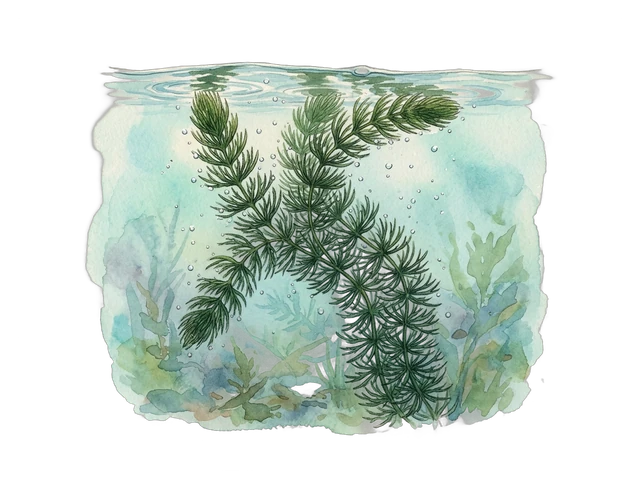
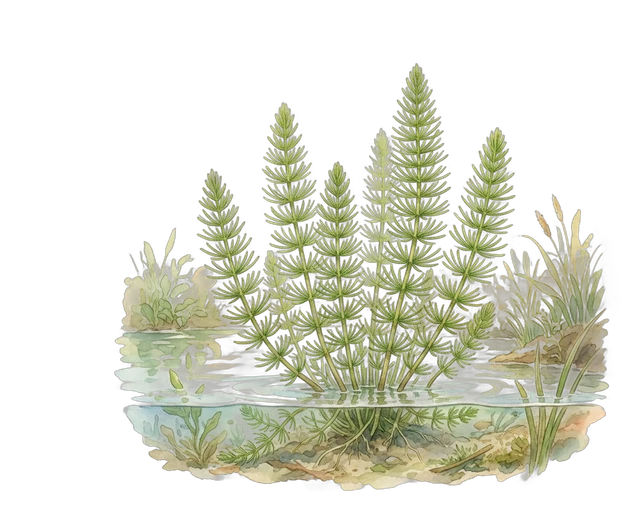
Whorled water-milfoil is a submerged aquatic plant native to Spain, with long, flexible green stems that can reach one to three metres depending on the depth. The olive-green leaves are grouped in whorls of four to five and divided into fine segments like the teeth of a comb. In summer it raises a flower spike above the water with tiny pinkish or yellowish flowers, surrounded by divided bracts that are longer than the flowers. In autumn it forms club-shaped winter buds, called turions, which sink to the bottom and sprout again in spring. It lives in pools, lagoons and canals with still, clean water, and is used as an oxygenating plant in wildlife ponds. It is easily confused with other water milfoils, including invasive species, so it is worth checking the identification carefully. LEGAL AND SAFETY NOTICE: it is a native species and, as far as we have checked, it is not listed under the CITES convention or in the Spanish Catalogue of Invasive Alien Species, but it is scarce in many wetlands and must not be pulled up from the wild: collecting wild plants in protected wetlands may require permission and be subject to penalties, and seeds and fragments of invasive species are carried along with them. Buy only nursery plants that state the species. The water milfoils that are banned in Spain and in the EU (Myriophyllum aquaticum and M. heterophyllum) look like it: if you buy or are given a milfoil without clear identification, do not plant it in an open pond. It is not edible.
Family and origin: Water milfoil family (Haloragaceae) · native to Still fresh waters of Europe, Asia and North America; in Spain it is native, but scarce, on the mainland and in the Balearic Islands · More plants from Temperate Europe
01In your area
How will it do in your garden?
Year calendar
| Task | J | F | M | A | M | J | J | A | S | O | N | D |
|---|---|---|---|---|---|---|---|---|---|---|---|---|
| Plant / transplantApr–Jun, Sep | no | no | no | yes | yes | yes | no | no | yes | no | no | no |
| CuttingsApr–Sep | no | no | no | yes | yes | yes | yes | yes | yes | no | no | no |
Its life cycle at a glance
Swipe and tap a stage to see its details.
02Planting
Where and how to plant it
Leave 30 cm between plants and 30 cm between rows.
30 cm between plants · 30 cm between rows
Seedlings are planted with the root ball level with the soil.
- Transplanting
- Apr–Jun, Sep
- TipAvoid bringing in fragments of other species when you buy it: wash the plants and check them before putting them in the pond.
03Care
Care through the year
Sun and aspectSun and shade · 5 h of sun · East, or south with light shade during the middle of the day
- Too little sun
- Ideal range
- Plenty of sun
East, or south with light shade during the middle of the day
Moderate sun: Copes with full sun, but give it some shade during heatwaves.
Plenty of light, with at least four hours of sun, in water that does not go above about 25 °C; in small, warm ponds it weakens. In winter the stems break down and the plant sees out the cold as turions.
WateringVery moist, tolerates waterlogging · summer: always submerged
- Summeralways submerged1.4 L per plant/week
- Spring / Autumnevery 3-4 days0.6 L per plant/week
- Winterjust keep the water level up0.2 L per plant/week
Very moist, tolerates waterlogging: Saturated or nearly saturated soil. Still watch out for fungal disease.
Set the basket or pot so that it is covered by 30 cm to 1 m of clear, still water. It is sensitive to murky, algae-rich water, which robs it of light, and does not tolerate the pond drying out.
This is a plant for waterlogged soil or pond margins: the finger test does not help, because the soil must stay wet all the time. Make sure the mud never dries out and, if it grows in a pond, that the water covers the base as the profile says; in summer, top up what evaporates.
- TipThin it in summer if it covers too much, and remove loose stems from the water with a rake.
Soil and feedingpH 6.5–8.5 · Free-draining, airy mix
Free-draining, airy mix.
40 % topsoil · 30 % coarse sand or perlite · 30 % well-rotted compost (less compost for Mediterranean herbs).
High: almost all prefer being thirsty to being wet.
This plant prefers a pH between 6.5 and 8.5 (neutral to alkaline).
- Mediterranean herbs in very rich, heavily watered soil: they grow a lot but lose their aroma.
- A pot without a drainage hole: the roots rot within weeks.
Pruning
- TipPinch out the tips often so it branches and does not run to seed so soon.
Common mistakes and tips
- TipThe dates and depths are a rough guide.
- Common mistakeLetting them flower early makes the leaves bitter (in leafy herbs).
04Propagation
Make new plants
It is propagated from stem cuttings about 15 to 20 cm long, which root in the bottom substrate within a few weeks, from April to September. The turions, the club-shaped winter buds, can also be separated; bury them or drop them onto the substrate in autumn and they sprout in spring. Seed is not used.
- TipPlant three or four cuttings together in a basket with heavy soil and a layer of gravel, and lower the basket to a depth of a couple of hand-spans in clean water.
05Uses and health
What it is used for, and with what care
No significant toxins are known, but it is not edible and there are no reliable data for dogs and cats. It is a scarce native species: do not pull it up from natural wetlands. It looks like banned invasive milfoils (Myriophyllum aquaticum and M. heterophyllum): do not release it into watercourses or mix in plants of doubtful origin in an open pond.
- Properties
- A pond plant that oxygenates the water and gives shelter to fish fry and invertebrates; it has no medicinal uses and none are recommended.
- Uses
- It is not edible and is not used in cooking or as a remedy.
For guidance only; this is not medical treatment and does not replace advice from a doctor or vet.
06Companions and related plants