
Credits and licences
- #1 — vueltaalhuerto illustration
- #2 — vueltaalhuerto illustration
- #3 — vueltaalhuerto illustration
- #4 — vueltaalhuerto illustration
- #5 — vueltaalhuerto illustration
- #6 — vueltaalhuerto illustration
- #7 — vueltaalhuerto illustration
- #8 — vueltaalhuerto illustration
- #9 — vueltaalhuerto illustration
Mare's tail
and 1 more names
pond plantMare's tail is planted from April to September. It flowers from June to August. Grow it in full sun, 30 cm apart, with plenty of watering. Dates are for a mild temperate climate in the northern hemisphere; the calendar below adjusts them to your zone.
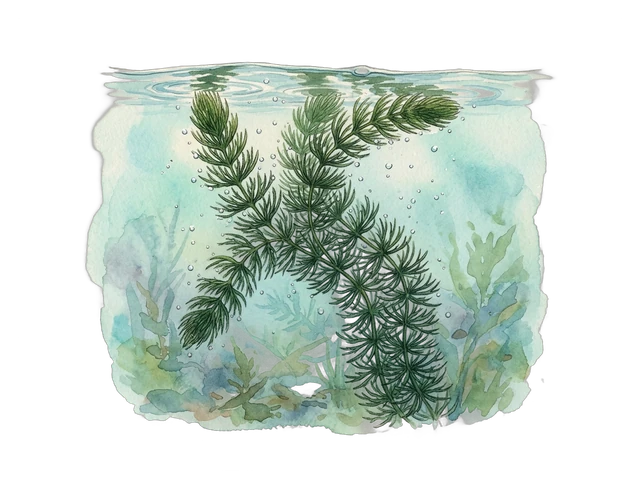
Mare's tail is a perennial pond plant with upright, stiff, unbranched stems that rise 20 to 60 cm, or up to 1 m, out of the water and look like miniature fir trees. The very narrow, linear, bright green leaves are arranged in whorls, that is, in rings of 6 to 12 leaves around the stem; underwater they are softer and longer, and above water shorter and stiffer. The flowers are tiny, without petals, with a single reddish stamen, and are hidden in the axils of the emergent leaves, so they are barely visible; the fruits are small oval nutlets the size of a small grain of rice. It grows in ponds, pools, reservoirs and the margins of shallow, clean, still water, with its roots in the mud and anchored to the bottom. It has nothing to do with land horsetail (Equisetum), a primitive flowerless plant related to ferns, although its whorls of leaves look similar. In Spain it is rare and protected in some regions, so do not pull it up from the wild: buy a nursery-grown plant.
Family and origin: Mare's tail family (Hippuridaceae) · native to Cold and temperate fresh and brackish waters throughout the northern hemisphere and some in the southern; on the Iberian Peninsula it is a rare plant · More plants from Temperate Europe
01In your area
How will it do in your garden?
Year calendar
| Task | J | F | M | A | M | J | J | A | S | O | N | D |
|---|---|---|---|---|---|---|---|---|---|---|---|---|
| Plant / transplantApr–Sep | no | no | no | yes | yes | yes | yes | yes | yes | no | no | no |
| FloweringJun–Aug | no | no | no | no | no | yes | yes | yes | no | no | no | no |
| PruningMay–Aug | no | no | no | no | yes | yes | yes | yes | no | no | no | no |
| CuttingsApr–Aug | no | no | no | yes | yes | yes | yes | yes | no | no | no | no |
| Divide the clumpApr–May, Sep | no | no | no | yes | yes | no | no | no | yes | no | no | no |
Its life cycle at a glance
Swipe and tap a stage to see its details.
02Planting
Where and how to plant it
Leave 30 cm between plants and 30 cm between rows.
30 cm between plants · 30 cm between rows
Seedlings are planted with the root ball level with the soil.
- Transplanting
- Apr–Sep
- TipIt is a good plant for wildlife, as it gives shelter to dragonfly larvae, tadpoles and small fish.
03Care
Care through the year
Sun and aspectFull sun · 8 h of sun · South or south-west, with nothing casting shade at midday
- Too little sun
- Ideal range
- Plenty of sun
South or south-west, with nothing casting shade at midday
Moderate sun: Copes with full sun, but give it some shade during heatwaves.
Plenty of light, with about five hours of sun or more. It is very cold-hardy: in winter it loses its emergent parts and regrows in spring from the submerged rhizome. In water that is too warm, above 30 °C, it suffers and becomes covered in algae.
WateringVery moist, tolerates waterlogging · summer: daily or every 2 days above 30 °C
- Summerdaily or every 2 days above 30 °C1.4 L per plant/week
- Spring / Autumnevery 3-4 days0.6 L per plant/week
- Winterevery 2 weeks if dry0.2 L per plant/week
Very moist, tolerates waterlogging: Saturated or nearly saturated soil. Still watch out for fungal disease. Mulch: straw or dry plant material cuts watering by 30-50 %.
It lives with its roots in the mud and its stems half submerged, in clean, still water 5 to 50 cm deep, without strong currents. Plant it in an aquatic basket or at the edge of the pond, with the crown 10 to 15 cm below the surface. If the pond dries out, the plant withers and dies.
This is a plant for waterlogged soil or pond margins: the finger test does not help, because the soil must stay wet all the time. Make sure the mud never dries out and, if it grows in a pond, that the water covers the base as the profile says; in summer, top up what evaporates.
- TipTrim back stems that invade the pond and remove the surplus pieces with a rake: they form new plants, so do not throw them into watercourses, reservoirs or natural wetlands.
Soil and feedingpH 6.5–8.5 · Free-draining, airy mix
Free-draining, airy mix.
40 % topsoil · 30 % coarse sand or perlite · 30 % well-rotted compost (less compost for Mediterranean herbs).
High: almost all prefer being thirsty to being wet.
This plant prefers a pH between 6.5 and 8.5 (neutral to alkaline).
- Mediterranean herbs in very rich, heavily watered soil: they grow a lot but lose their aroma.
- A pot without a drainage hole: the roots rot within weeks.
- TipPlant in spring, in a basket of heavy soil topped with gravel, at a shallow depth and in plenty of light.
PruningWhen: May–Aug
Pruning time for this plant: May–Aug.
- TipPinch out the tips often so it branches and does not run to seed so soon.
Common mistakes and tips
- TipIt is not edible and is not used in remedies.
- TipTemperature and depth details are a guide only.
- Common mistakeLetting them flower early makes the leaves bitter (in leafy herbs).
04Propagation
Make new plants
Easily propagated from stem cuttings, 10 to 20 cm long with several whorls of leaves, pushed into mud or a heavy aquatic potting mix or left to root in water, and by dividing the rhizome, cut into pieces with roots and buds, in spring. As it breaks easily, every fragment can form a new plant. Seed is produced but rarely used.
Seeds: how to germinate them
05Uses and health
What it is used for, and with what care
No significant toxins are known, but there are no solid data either: do not eat it or use it in herbal teas. It is not land horsetail (Equisetum), which is a different plant and does not serve the same purposes. It is a plant native to the Iberian Peninsula, rare and protected in some Spanish regions: buy nursery-grown plants and do not take them from the wild. Every broken fragment regrows, so do not throw it into watercourses or wetlands, and dispose of the remains on dry land.
- Properties
- A pond plant that gives shelter to dragonfly larvae, tadpoles and small fish, and helps keep the water clean. No medicinal use is recommended.
- Uses
- It is not edible and is not used in cooking or herbal teas, and it should not be confused with land horsetail (Equisetum), which is a different plant.
For guidance only; this is not medical treatment and does not replace advice from a doctor or vet.
06Companions and related plants
What to plant it with
Compare with similar varieties
| Variety | Sowing | Harvest | Days | Spacing | Difficulty |
|---|---|---|---|---|---|
| Field horsetail | Mar–Apr, Oct | May–Aug | — | 40 cm | Easy |
| Mare's tail | Apr–Sep | — | — | 30 cm | Easy |