
Credits and licences
- #1 — vueltaalhuerto illustration
- #2 — vueltaalhuerto illustration
- #3 — vueltaalhuerto illustration
- #4 — vueltaalhuerto illustration
- #5 — vueltaalhuerto illustration
- #6 — vueltaalhuerto illustration
- #7 — vueltaalhuerto illustration
- #8 — vueltaalhuerto illustration
- #9 — vueltaalhuerto illustration
- #10 — vueltaalhuerto illustration
Rabbit-ear iris (Iris laevigata)
and 4 more names
water iris, kakitsubata, pond iris, Iris laevigata 'Variegata'Rabbit-ear iris (Iris laevigata) is sown directly outdoors from October to November. It flowers from May to June. Grow it in full sun, 40 cm apart, with plenty of watering. Dates are for a mild temperate climate in the northern hemisphere; the calendar below adjusts them to your zone.
What else to sow in October and November
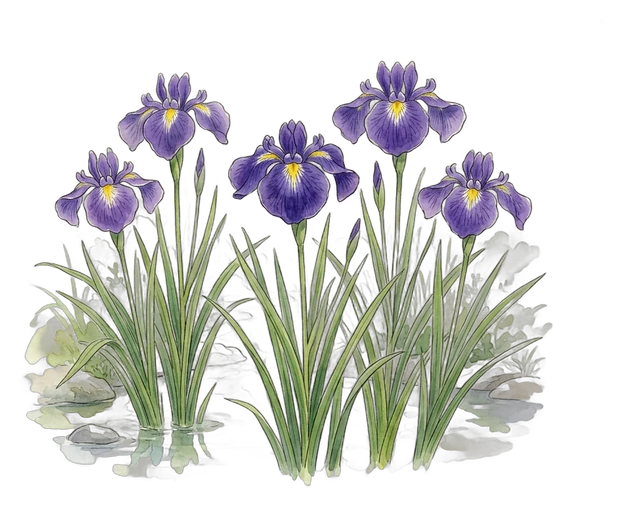
Iris laevigata is an aquatic iris about 50 to 80 cm tall, forming clumps of long, broad, light green, sword-shaped leaves without a prominent midrib, with thick rhizomes that spread slowly. It flowers in late spring and early summer, before the Japanese iris (Iris ensata), with flat, beardless flowers 8 to 10 cm across, violet-blue with a white and yellow central stripe; there are white, pink and variegated-leaved cultivars. It is one of the few iris species that live with the crown submerged: it tolerates about 5 to 15 cm of water above the rhizome, which makes it a plant for pond margins, boggy edges and submerged baskets. It prefers acid or neutral soil and does not cope well with lime. All parts of the plant, and especially the rhizome, are toxic if eaten. It should not be confused with the yellow flag iris (Iris pseudacorus), which has yellow flowers.
Family and origin: Iris family (Iridaceae) · native to East Asia (Japan, Korea, north-eastern China and eastern Siberia), in pools, lake shores and abandoned rice paddies with the crown in shallow water · More plants from Far East
01In your area
How will it do in your garden?
Year calendar
| Task | J | F | M | A | M | J | J | A | S | O | N | D |
|---|---|---|---|---|---|---|---|---|---|---|---|---|
| Direct sowingOct–Nov | no | no | no | no | no | no | no | no | no | yes | yes | no |
| Plant / transplantMar–May, Sep | no | no | yes | yes | yes | no | no | no | yes | no | no | no |
| FloweringMay–Jun | no | no | no | no | yes | yes | no | no | no | no | no | no |
| PruningOct–Nov | no | no | no | no | no | no | no | no | no | yes | yes | no |
| Divide the clumpJun–Sep | no | no | no | no | no | yes | yes | yes | yes | no | no | no |
Its life cycle at a glance
Swipe and tap a stage to see its details.
02Planting
Where and how to plant it
Sow the seed 1 cm deep; leave 40 cm between plants and 40 cm between rows.
40 cm between plants · 40 cm between rows
Seed at a depth of 1 cm; seedlings go in with the root ball level with the soil.
- Transplanting
- Mar–May, Sep
- Direct sowing
- Oct–Nov
- Germination
- ~45 days
- Common mistakeSowing out of season: many need warmth or a cold spell beforehand to sprout.
03Care
Care through the year
Sun and aspectFull sun · 6 h of sun · shade in summer
- Too little sun
- Ideal range
- Plenty of sun
South or south-west, with nothing casting shade at midday
Moderate sun: Copes with full sun, but give it some shade during heatwaves.
It flowers best in full sun, although it tolerates some shade; in hot inland areas and on the coast it benefits from shade at midday. It is very cold-hardy, down to about -20 °C, as it loses its leaves in winter and regrows in spring.
WateringVery moist, tolerates waterlogging · summer: keep the soil soaked or with 5 to 10 cm of water over the crown during growth and flowering
- Summerkeep the soil soaked or with 5 to 10 cm of water over the crown during growth and flowering2.1 L per plant/week
- Spring / Autumnevery 3-4 days1 L per plant/week
- Wintermoist soil; in a pond, a constant water level0.2 L per plant/week
Very moist, tolerates waterlogging: Saturated or nearly saturated soil. Still watch out for fungal disease.
It is a water plant: from spring to autumn it needs soil that is always soaked or the crown covered by a few centimetres of water; it never dries out without suffering. In a pond, plant it in baskets at a shallow depth, with the rhizome 5 to 15 cm below the water. Use rainwater or low-lime water: hard water and lime turn its leaves yellow.
This is a plant for waterlogged soil or pond margins: the finger test does not help, because the soil must stay wet all the time. Make sure the mud never dries out and, if it grows in a pond, that the water covers the base as the profile says; in summer, top up what evaporates.
Soil and feedingpH 5.5–7 · Loose soil with organic matter and good drainage
Loose soil with organic matter and good drainage.
50 % topsoil · 30 % well-rotted compost · 20 % sand or perlite.
Medium/high.
This plant prefers a pH between 5.5 and 7.0 (slightly acidic to neutral).
- Overfeeding gives lots of leaf and few flowers.
- Compacted, poorly drained soil rots the roots in winter.
- TipPlant it on a margin or in a basket of heavy garden soil (without fertiliser), with the rhizome covered and about 5 to 10 cm of water above it during growth; 40 cm between plants.
- TipFeed it only with a slow-release fertiliser for aquatic plants, in baskets, and avoid strong fertilisers.
- TipThe water depth, pH and calendar figures are approximate.
- Common mistakeOverfeeding gives lush leaves but few flowers.
PruningWhen: Oct–Nov
Pruning time for this plant: Oct–Nov.
- TipCut off dry leaves in autumn and flower stems after flowering; if you do not want seeds, remove the faded flowers.
- TipRemove faded flowers to prolong flowering.
Common mistakes and tips
- TipWatch for aphids and slugs.
- TipDo not confuse it with the yellow flag iris (Iris pseudacorus).
04Propagation
Make new plants
It is propagated mainly by dividing the rhizome, from midsummer to early autumn, after flowering, or in spring: dig up the clump and cut it with a clean knife into pieces each with a fan of leaves, a section of rhizome about 10 cm long and roots, and replant them with the leaves trimmed to a third. From seed it gives variable, slow-flowering plants: sow freshly collected seed in autumn, in a tray left outdoors with the potting mix soaked, and it germinates irregularly in one to three months or more; the plants take two or three years to flower. Named cultivars can only be kept true by division.
Seeds: how to germinate them~45 days
- TipDivide the clump every three or four years, or when it flowers less.
05Uses and health
What it is used for, and with what care
Warning: irises contain irritant substances, especially in the rhizome; if eaten they cause nausea, vomiting, diarrhoea and stomach pain, and handling the rhizome can irritate some people's skin. In dogs and cats, eating rhizomes or leaves can cause drooling, vomiting and diarrhoea. Wear gloves when dividing clumps, wash your hands and do not leave pieces of rhizome within reach of children or pets, or near a pond where they drink. If a significant amount has been eaten, in Spain call the Toxicology Information Service (91 562 04 20) or 112, and the vet if it is an animal. It is not regulated as an invasive species in Spain or in the EU.
- Properties
- An ornamental pond plant, valued for its late-spring flowers and for the bees and butterflies that visit them. No home medicinal use is attributed to it.
- Uses
- It is not edible: the rhizome, leaves and seeds must not be eaten or used in infusions.
For guidance only; this is not medical treatment and does not replace advice from a doctor or vet.
06Companions and related plants
What to plant it with
Compare with similar varieties
| Variety | Sowing | Harvest | Days | Spacing | Difficulty |
|---|---|---|---|---|---|
| Dutch iris | Oct–Nov | Apr–Jun | ~180 | 10 cm | Easy |
| Louisiana iris (Iris Louisiana hybrids) | Oct–Nov | — | ~730 | 40 cm | Moderate |
| Rabbit-ear iris (Iris laevigata) | Oct–Nov | — | ~730 | 40 cm | Moderate |
| Bearded iris (German iris) | Jul–Sep | Apr–Jun | — | 40 cm | Easy |
| Japanese iris (Iris ensata) | Oct–Nov | — | — | 40 cm | Moderate |