
Credits and licences
- #1 — vueltaalhuerto illustration
- #2 — vueltaalhuerto illustration
- #3 — vueltaalhuerto illustration
- #4 — vueltaalhuerto illustration
- #5 — vueltaalhuerto illustration
- #6 — vueltaalhuerto illustration
- #7 — vueltaalhuerto illustration
- #8 — vueltaalhuerto illustration
- #9 — vueltaalhuerto illustration
- #10 — vueltaalhuerto illustration
Meadowsweet
and 2 more names
mead wort, bridewortMeadowsweet is sown directly outdoors from February to March and from October to November. It flowers from June to August. Grow it in sun or partial shade, 60 cm apart, with plenty of watering. Dates are for a mild temperate climate in the northern hemisphere; the calendar below adjusts them to your zone.
What else to sow in February, March, October and November
Meadowsweet is a robust herbaceous perennial, 80 cm to 1.5 m tall, which forms clumps of upright reddish stems on damp ground. The leaves are large and pinnate, with a larger terminal leaflet of three to five lobes and other smaller ones, toothed at the edge, dark green above and whitish and downy underneath. From June to August it bears frothy flower heads made up of many small cream flowers with five petals and long stamens, with a sweet, almond-like scent that carries a long way. The fruits are small, greenish-brown and twisted into a spiral like corkscrews. It grows wild in the north of the Iberian Peninsula and is grown in wildlife gardens, at the edges of ponds and in damp borders, where it attracts bees and hoverflies. It is a plant for cool soil: in the dry Mediterranean climate it suffers in summer and only thrives in very damp spots with partial shade. It contains salicylates, relatives of aspirin, and has been used as an infusion since ancient times, so it is wise to take precautions before consuming it.
Family and origin: Rose family (Rosaceae) · native to Europe and temperate Asia; in the Iberian Peninsula, in the north, in damp meadows, riverbanks, tall mountain grassland and peat bogs · More plants from Temperate Europe
01In your area
How will it do in your garden?
Year calendar
| Task | J | F | M | A | M | J | J | A | S | O | N | D |
|---|---|---|---|---|---|---|---|---|---|---|---|---|
| Direct sowingFeb–Mar, Oct–Nov | no | yes | yes | no | no | no | no | no | no | yes | yes | no |
| Plant / transplantMar–Apr, Sep–Oct | no | no | yes | yes | no | no | no | no | yes | yes | no | no |
| HarvestJun–Aug | no | no | no | no | no | yes | yes | yes | no | no | no | no |
| FloweringJun–Aug | no | no | no | no | no | yes | yes | yes | no | no | no | no |
| Divide the clumpMar, Sep–Oct | no | no | yes | no | no | no | no | no | yes | yes | no | no |
Its life cycle at a glance
Swipe and tap a stage to see its details.
02Planting
Where and how to plant it
Sow the seed 3 mm deep; leave 60 cm between plants and 70 cm between rows.
60 cm between plants · 70 cm between rows
Seed at a depth of 3 mm; seedlings go in with the root ball level with the soil.
- Transplanting
- Mar–Apr, Sep–Oct
- Direct sowing
- Feb–Mar, Oct–Nov
- Germination
- ~30 days
- TipThe sowing and hardiness figures are approximate.
03Care
Care through the year
Sun and aspectSun and shade · 5 h of sun · shade in summer
- Too little sun
- Ideal range
- Plenty of sun
East, or south with light shade during the middle of the day
Gentle sun: Morning or afternoon sun. Midday summer sun stresses and scorches it.
It grows in full sun if the soil is always moist, and in partial shade in warm climates; strong sun combined with drought scorches its leaves. It is very cold-hardy, down to about -25 °C (an approximate figure), and suffers more from dry heat than from frost.
WateringVery moist, tolerates waterlogging · summer: daily or every 2 days above 30 °C
- Summerdaily or every 2 days above 30 °C1.4 L per plant/week
- Spring / Autumnevery 3-4 days0.6 L per plant/week
- Winterevery 2 weeks if dry0.2 L per plant/week
Very moist, tolerates waterlogging: Saturated or nearly saturated soil. Still watch out for fungal disease. Mulch: straw or dry plant material cuts watering by 30-50 %.
It needs moist soil rich in humus all year round, like that on the bank of a stream or pond; it does not tolerate drought and its leaves scorch, although it regrows if cut right back. It tolerates heavy clay soils, but not dry or very acid soils.
This is a plant for waterlogged soil or pond margins: the finger test does not help, because the soil must stay wet all the time. Make sure the mud never dries out and, if it grows in a pond, that the water covers the base as the profile says; in summer, top up what evaporates.
Soil and feedingpH 6–8 · Free-draining, airy mix
Free-draining, airy mix.
40 % topsoil · 30 % coarse sand or perlite · 30 % well-rotted compost (less compost for Mediterranean herbs).
High: almost all prefer being thirsty to being wet.
This plant prefers a pH between 6.0 and 8.0 (slightly acidic to alkaline).
- Mediterranean herbs in very rich, heavily watered soil: they grow a lot but lose their aroma.
- A pot without a drainage hole: the roots rot within weeks.
- TipPlant it in a moist, rich soil, at the edge of a pond or in the coolest part of the garden, and mulch to retain moisture.
- TipIt is prone to powdery mildew, especially in drought: water the soil, not the leaves.
Pruning
- TipCut off spent flowers if you do not want it to self-seed, and divide the clump every three or four years to renew it.
- TipPinch out the tips often so it branches and does not run to seed so soon.
Common mistakes and tips
- TipBefore using it in an infusion, bear in mind that it contains salicylates and is not suitable for everyone.
- Common mistakeLetting them flower early makes the leaves bitter (in leafy herbs).
04Harvest
Harvesting and storing
Harvest in Jun–Aug.
- TipThe flowers can be picked in summer for drying.
05Propagation
Make new plants
Meadowsweet is propagated by dividing the clump, in spring or autumn, which is the easiest and most reliable method, and also by seed. The seed is sown in autumn, outdoors or in a cold frame, so that it goes through the winter cold, or it is kept cold for a few weeks before sowing in spring (an approximate method). It can also be propagated by root cuttings in winter. Seed-grown plants take one or two years to flower.
Seeds: how to germinate them~30 days
06Uses and health
What it is used for, and with what care
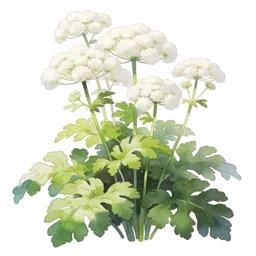
It contains salicylates, compounds related to aspirin. Do not take it if you are allergic to aspirin or salicylates, if you have aspirin-sensitive asthma, a stomach ulcer or clotting problems, if you take anticoagulants, or if you are pregnant or breastfeeding, and do not give it to children. It is not a home remedy for fever or pain, and do not self-medicate with it. It must be identified correctly: in the same damp areas of the north of the Iberian Peninsula there are highly toxic white-flowered plants, such as hemlock water-dropwort (Oenanthe crocata), which can be told apart by their umbels of flowers and very finely divided leaves. There is no solid information on its effect on dogs and cats, and cats tolerate salicylates poorly: do not let them chew it.
- Properties
- It has been used as an infusion since ancient times in traditional European medicine because of its salicylates and other compounds, but there is not enough evidence to recommend any medicinal use. Its flowers provide nectar and pollen for beneficial insects.
- Uses
- The dried flowers have been used in small amounts to flavour infusions, mead, wines and desserts, for their sweet, almond-like aroma. The leaves and flowers can be used in moderation, and only if the plant has been correctly identified.
For guidance only; this is not medical treatment and does not replace advice from a doctor or vet.
07Companions and related plants
What to plant it with
Good companions
Compare with similar varieties
| Variety | Sowing | Harvest | Days | Spacing | Difficulty |
|---|---|---|---|---|---|
| Meadowsweet | Feb–Mar, Oct–Nov | Jun–Aug | — | 60 cm | Moderate |
| China aster | Mar–May | Jul–Oct | ~110 | 25 cm | Moderate |