Credits and licences
- #1 — vueltaalhuerto illustration
- #2 — vueltaalhuerto illustration
- #3 — vueltaalhuerto illustration
- #4 — vueltaalhuerto illustration
- #5 — vueltaalhuerto illustration
- #6 — vueltaalhuerto illustration
- #7 — vueltaalhuerto illustration
- #8 — vueltaalhuerto illustration
- #9 — vueltaalhuerto illustration
Creeping Jenny (Lysimachia nummularia)
and 2 more names
golden creeping Jenny, herb twopenceCreeping Jenny (Lysimachia nummularia) is planted from March to May and from September to October. It flowers from June to July. Grow it in sun or partial shade, 30 cm apart, with plenty of watering. Dates are for a mild temperate climate in the northern hemisphere; the calendar below adjusts them to your zone.
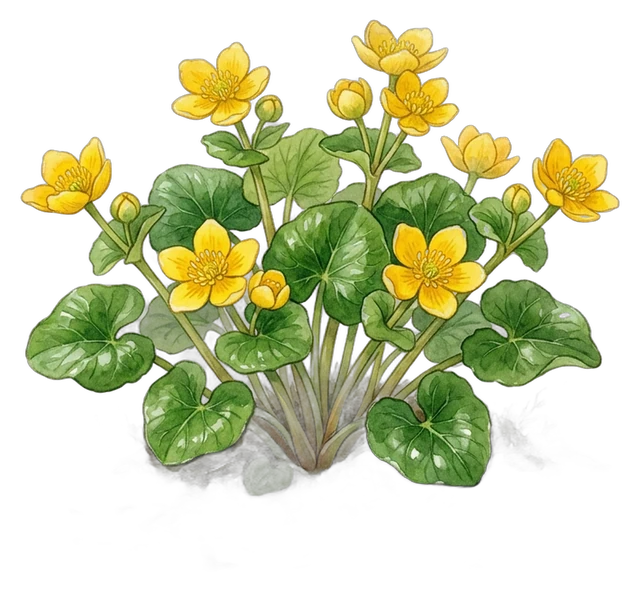
A perennial ground-cover plant with creeping stems 30 to 60 cm long, which reach only 5 to 10 cm in height and root at every node, so that they quickly form a green carpet. The leaves are round, small and opposite, which explains its coin-related names; the widely sold cultivar 'Aurea' has golden-yellow leaves. From May to August, cup-shaped yellow flowers about 2 cm across, with small reddish dots, appear in the leaf axils. It likes moisture and partial shade, and withstands hard frosts. It is used along pond edges, in hanging pots and as ground cover in damp areas. It grows very vigorously: in an open stream or pond it can spread beyond its spot and smother other plants, and in North America it behaves as an invasive species, although in Spain it is native and not regulated. It is not edible.
Family and origin: Primrose family (Primulaceae) · native to Europe and western Asia (including the northern half of Spain), on stream banks, in damp meadows and at woodland edges · More plants from Temperate Europe
01In your area
How will it do in your garden?
Year calendar
| Task | J | F | M | A | M | J | J | A | S | O | N | D |
|---|---|---|---|---|---|---|---|---|---|---|---|---|
| Plant / transplantMar–May, Sep–Oct | no | no | yes | yes | yes | no | no | no | yes | yes | no | no |
| FloweringJun–Jul | no | no | no | no | no | yes | yes | no | no | no | no | no |
| CuttingsApr–Sep | no | no | no | yes | yes | yes | yes | yes | yes | no | no | no |
| Divide the clumpMar–Apr, Sep–Oct | no | no | yes | yes | no | no | no | no | yes | yes | no | no |
Its life cycle at a glance
Swipe and tap a stage to see its details.
02Planting
Where and how to plant it
Leave 30 cm between plants and 30 cm between rows.
30 cm between plants · 30 cm between rows
Seedlings are planted with the root ball level with the soil.
- Transplanting
- Mar–May, Sep–Oct
- TipPlant in a grid or at wide spacing: they will fill in on their own with runners.
03Care
Care through the year
Sun and aspectSun and shade · 4 h of sun · shade in summer
- Too little sun
- Ideal range
- Plenty of sun
East-facing, or south-facing with light shade in the middle of the day
Moderate sun: Copes with full sun, but give it some shade during heatwaves.
Partial shade or morning sun. In full sun in a hot summer the leaves scorch and the edges dry out, especially in the golden variety. In too much shade it loses colour and flowers less. It withstands hard frosts down to about -25 °C, losing some of its leaves in winter and then regrowing.
WateringConstantly moist · summer: generous watering every 1 to 3 days, or soil kept constantly moist by the water
- Summergenerous watering every 1 to 3 days, or soil kept constantly moist by the water1.4 L per plant/week
- Spring / Autumnevery 3-4 days0.6 L per plant/week
- Winteronly if the soil dries out; the rest of the winter, rain is enough0.2 L per plant/week
Constantly moist: The soil should always feel cool and damp. Ideal with mulch and drip irrigation. Mulch: straw or dry plant material cuts watering by 30-50 %.
It needs soil that is always moist: it is a waterside plant. If you grow it in a pot, use a saucer of water in summer; next to a pond, plant it a hand's breadth from the edge, with its roots in waterlogged soil. In the dryness of a Mediterranean summer it shows straight away: limp leaves and dry edges.
When to water? Push your finger 2 cm into the soil next to the base of the plant:
- Damp: soil sticks to your finger. Do not water, although for this plant it is just right — check again tomorrow.
- Cool but clean, no mud. Water today: it likes to stay constantly moist.
- Dry and dusty. Water urgently and add mulch to hold in moisture.
- TipTo keep it in check in a pond, plant it in a plastic basket or cut back the stems that reach the water every year.
- TipDo not let it escape into natural watercourses or wild wetlands, where it could crowd out the local flora.
- TipRegular watering at the start helps them carpet the ground sooner.
Soil and feedingpH 5.5–7.5 · Airy soil with some organic matter
Airy soil with some organic matter.
Medium.
This plant prefers a pH between 5.5 and 7.5 (slightly acidic to slightly alkaline).
- Regular watering at the start speeds up coverage by runners.
- Edging to contain it if the species tends to spread.
- Very compacted soil holds back its spread and leaves bare patches.
- Without proper spacing they do not cover well and weeds appear in between.
- TipPlant it in moist garden soil, about 30 cm apart, and in a pot with multipurpose potting mix that does not dry out.
- TipFeed it lightly in spring.
- Common mistakeCompacted soil holds back their spread.
Common mistakes and tips
- TipCut back stems that spread too far and trim it to the ground after flowering if it looks untidy.
- TipThe figures in this profile are only a guide.
- Common mistakeLeft unchecked, some become invasive: contain them with edging.
04Propagation
Make new plants
It is very easily propagated from stem cuttings and by division. When a stem rests on moist soil, it roots at every node within a few days, so you only need to cut a rooted piece about 10 to 15 cm long and plant it. This can be done from spring to autumn. Division is done in spring or autumn, separating pieces with roots. Seed yields little, because in cultivation it hardly sets any, and it is not needed.
05Uses and health
What it is used for, and with what care
There are no reliable data on its toxicity; do not use it as food or as a remedy. Since the genus Lysimachia can contain saponins, treat the plant as an irritant if eaten in quantity: if a child or a pet has eaten a significant amount, consult a doctor or a vet. The sap can irritate sensitive skin.
- Properties
- An ornamental ground-cover plant. In European folk tradition it has been used as an astringent, but there is no modern basis for recommending it as a home remedy.
- Uses
- It is not grown to be eaten. Eating it or making infusions from it is not recommended.
For guidance only; this is not medical treatment and does not replace advice from a doctor or vet.
06Companions and related plants
What to plant it with
Compare with similar varieties
| Variety | Sowing | Harvest | Days | Spacing | Difficulty |
|---|---|---|---|---|---|
| Ice plant (crystalline ice plant) | Feb–May, Sep–Oct | May–Sep | ~75 | 30 cm | Easy |
| Creeping Jenny (Lysimachia nummularia) | Mar–May, Sep–Oct | — | — | 30 cm | Easy |
| Toothache plant (Acmella) | Mar–May | Jul–Oct | ~90 | 30 cm | Easy |
| East Indian lemongrass | Feb–Apr | Jul–Oct | ~120 | 30 cm | Easy |
07Pests and diseases
Critters and ailments to keep an eye on
The most common ones on this plant. Tap one to see how to recognise it and what to do.