
Wireworms
Also known as: wireworms, wireworm, click beetle larvae, Agriotes
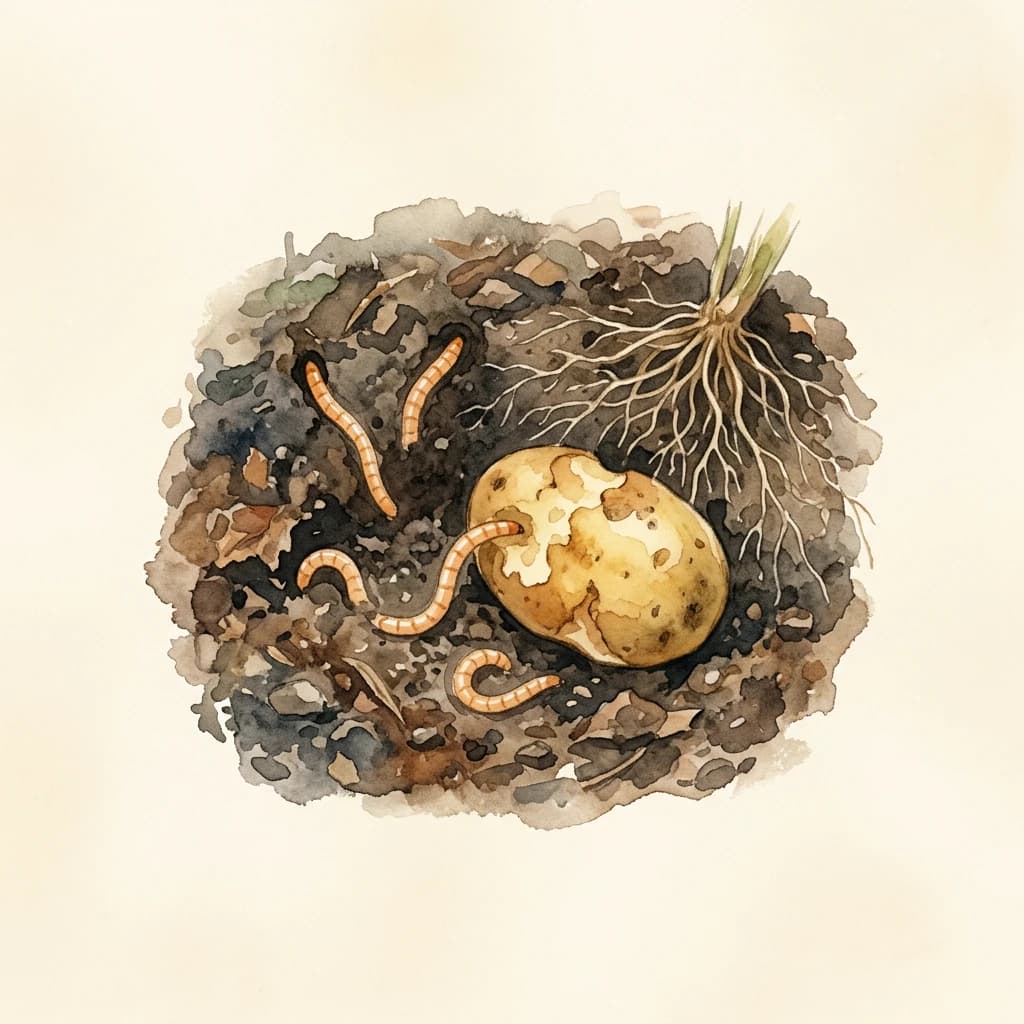
Hard, elongated, amber-coloured larvae (the larvae of click beetles) that live in the soil and gnaw roots, tubers and the base of stems. The first step is to set potato bait traps to find out how many there are.

How to recognise it at every stage
Shares your gardenIt likes your potatoes, carrots and freshly sown seeds.
Life cycle: Complete but slow metamorphosis: the larva lives 2 to 5 years in the soil before pupating in summer. The adult is a harmless 'click beetle'. That is why they are common in new gardens dug out of grassland.
Tap a stage to see it full size. The photos are AI reference images checked against real photographs; stages without a reliable photo are shown as text only.
Life-stage calendar
| Jan | Feb | Mar | Apr | May | Jun | Jul | Aug | Sep | Oct | Nov | Dec | |
|---|---|---|---|---|---|---|---|---|---|---|---|---|
| Eggs | ||||||||||||
| Larva (wireworm) | ||||||||||||
| Pupa | ||||||||||||
| Click beetle |
Approximate months for mainland Spain; in cold areas they start later and in warm areas they last longer. Garden creatures this month
No reliable photo yet
1Keep an eye on itEggs
· 0.5 mmTiny white spheres, not visible to the naked eye.
- Where to find it
- In the soil, under grass and meadows.
- When: May–Jul
- What to do
- Nothing to do; avoid leaving tall grass in spring where you will plant potatoes.
- 2Protect your plants
Larva (wireworm)
· 2-3 cmCylindrical, hard and shiny, amber-orange, with three pairs of tiny legs behind the head.
- Where to find it
- In the soil; it bores narrow round holes in potatoes and carrots.
- When: Mar–Jun, Sep–Nov
- What to do
- Bury pieces of potato or carrot on a stick, check them every 2-3 days and take the larvae well away from the garden.
- Often confused with
- Centipede. Lots of legs, one pair per segment, and very fast. It is an ally: leave it. See profile
- Millipede. Two pairs of legs per segment, grey or black, coils up in a spiral. It eats plant debris.
- 3Keep an eye on it
Pupa
· 1-1.5 cmWhite and soft, in a little soil cell.
- Where to find it
- 10-20 cm deep.
- When: Jul–Aug
- What to do
- Not visible; it lasts two or three weeks.
- 4Keep an eye on it
Click beetle
· 7-12 mmA brown, long, narrow beetle. If it lands on its back, it jumps up with a 'click'.
- Where to find it
- On grasses and flowers in spring.
- When: Apr–Jul
- What to do
- Leave it be: the adult does not harm crops.
Often confused with
- Centipede. Lots of legs, one pair per segment, and very fast. It is an ally: leave it. See profile
- Millipede. Two pairs of legs per segment, grey or black, coils up in a spiral. It eats plant debris.
How to recognise it (symptoms)
- Tunnels and holes in potatoes, carrots and roots
- Seedlings that wilt and die when the base of the stem is gnawed
- Hard, thin, yellowish larvae when you turn the soil
- Patchy germination and gaps in the row
Crops affected
 PotatoThe 'Kennebec' potato is versatile in the kitchen, with pale skin.
 CarrotThe Nantes carrot, cylindrical and sweet.
 SweetcornMaize with tender, sugary kernels for eating on the cob.
 OnionThe Figueres onion is a sweet onion with purplish skin, typical of Catalonia in Spain.
 LettuceCos lettuce, with a long, crisp heart.
 StrawberryA strawberry with large, firm, deep red fruit, very productive and early.
What favours it
- Moist soils rich in undecomposed organic matter
- Plots newly dug from grassland or lawn, where the larvae were already living among the grass roots
- Uncomposted plant debris dug into the soil, which provides them with food and shelter
Prevention
- Dig and aerate the soil in summer to expose the larvae to birds and the sun
- Rotate crops and avoid planting tubers straight after lawn or grassland
- Do not dig in uncomposted green waste
- Encourage insect-eating birds, which eat the larvae brought up by digging
Organic treatment
Always start here: these remedies are kind to the garden, the soil and pollinators.
- First: bury pieces of potato or carrot (5-10 cm deep) as bait, check them every 3-4 days and remove any larvae that have burrowed in
- Dig the soil in summer, when it is dry, to expose the larvae and dry them out
- There are insect-killing nematodes (Heterorhabditis) that are applied in the irrigation water; their effectiveness against wireworms varies and it is worth trying them on a small area first
- Vary the rotation with less attractive crops and avoid leaving the soil under grass just before sowing root crops
Chemical treatment (with caution)
Soil insecticides are heavily restricted. In a home garden, bait traps and rotation work better.
Don't confuse it with…
With other soil larvae (chafer grubs, cutworms). The wireworm is hard, thin and amber-coloured, like a piece of wire.
In-depth guide — wireworms
These are the hard, yellowish larvae of click beetles (Elateridae), which attack roots and tubers (potato, carrot) and live for several years in the soil.
Detection
Plants that wilt for no visible reason above ground, and tunnels in the tubers.
- Traps: pieces of potato buried 5-10 cm deep; check them after 3-4 days.
- They are more common after grassland or a grassy fallow.
Strategy
Rotation, cultivation and avoiding too much raw organic matter just before sowing root crops.
- Alternate with crops that are less attractive to them and dig the soil when it is dry.
- Water regularly: drought stress makes the damage worse.
Use plant protection products responsibly, even organic ones. Always read and follow the label, the doses and the harvest interval, and never treat plants in flower or while bees are flying, in order to protect pollinators. If in doubt, put prevention and organic methods first.

In the plant catalogue you'll see what to plant, how and when: a well-tended plant resists pests much better.