
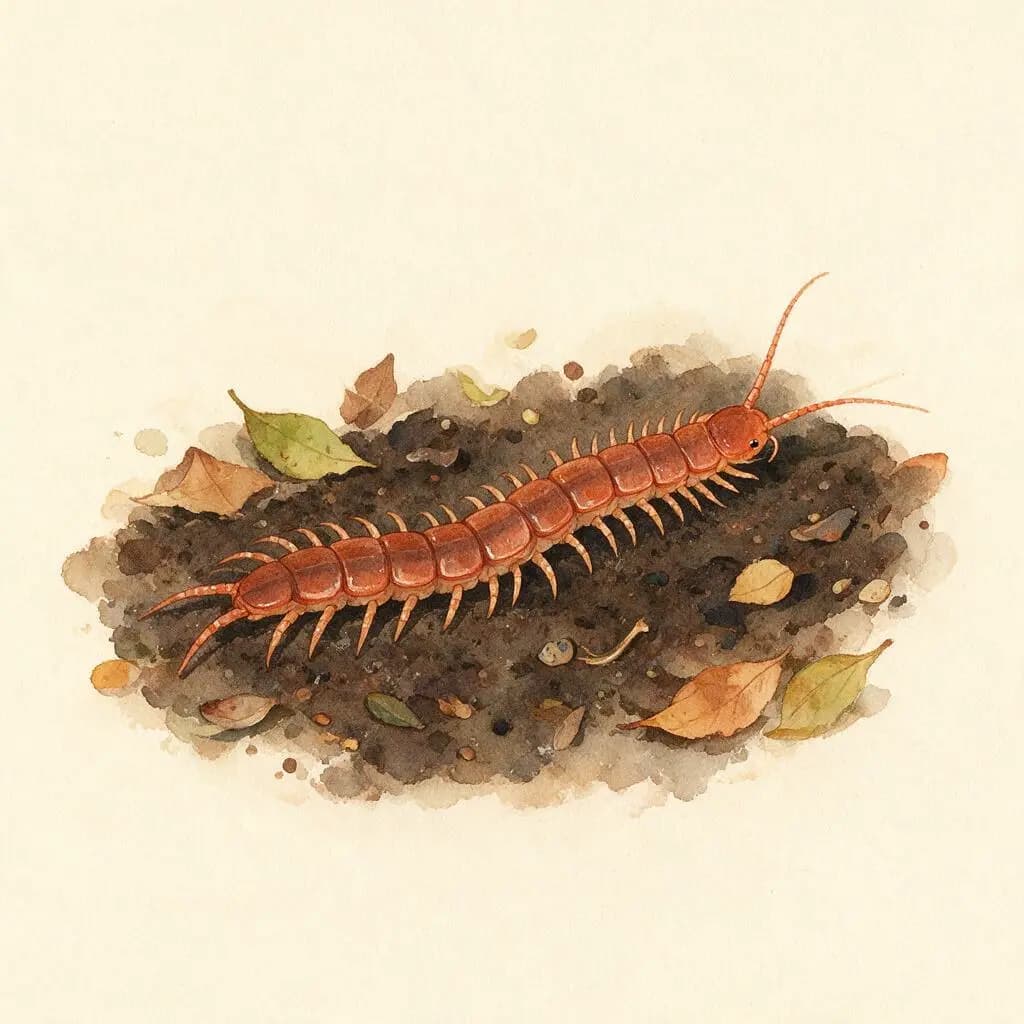
Centipede
Chilopoda
Also called: scolopendra, Lithobius, Scolopendra, house centipede
A night-time ground predator that hunts insects, spiders, larvae and young slugs. Not to be confused with the millipede (a plant-eating decomposer with short legs). The centipede is fast, flattened and long-legged.

How to recognise it at every stage
Garden allyGarden ally: it hunts larvae, small slugs and soil insects.
Life cycle: No metamorphosis: a small centipede comes out of the egg. In the lithobiids, the young are born with fewer legs and gain more with each moult; the scolopendra looks after its eggs, curled around them. They live several years.
Tap a stage to see it full size. The photos are AI reference images checked against real photographs; stages without a reliable photo are shown as text only.
Life-stage calendar
| Jan | Feb | Mar | Apr | May | Jun | Jul | Aug | Sep | Oct | Nov | Dec | |
|---|---|---|---|---|---|---|---|---|---|---|---|---|
| Eggs | ||||||||||||
| Young | ||||||||||||
| Adult |
Approximate months for mainland Spain; in cold areas they start later and in warm areas they last longer. Garden creatures this month
- 1Protect it
Eggs
· 1-2 mmLoose eggs covered in earth (lithobiids) or a cluster guarded by the mother curled around it (scolopendra).
- Where to find it
- Under stones, logs and in damp soil.
- When: Apr–Jul
- What to do
- If you lift a stone and see a mother with eggs, put it back carefully.
- 2Protect it
Young
· 3-10 mmSmall, pale centipedes, with fewer pairs of legs than the adults.
- Where to find it
- Under leaf litter and mulch.
- When: May–Sep
- What to do
- Leave them: mulch and pruning remains give them shelter.
- 3Protect it
Adult
· 2-3 cm (scolopendra, up to 10 cm)Flattened body, reddish brown, with one pair of legs per segment and very fast. The scolopendra is yellowish with dark bands.
- Where to find it
- Under stones, pots and boards; it comes out at night.
- When: all year
- What to do
- Protect it. Wear gloves when moving stones: the scolopendra can give a painful nip, although it is not dangerous.
- Often confused with
- Millipede. Cylindrical, slow, with two pairs of legs per segment, and it curls into a spiral. It eats plant remains.
- Wireworm. Only six legs next to the head, hard and yellow-orange. See profile
Often confused with
- Millipede. Cylindrical, slow, with two pairs of legs per segment, and it curls into a spiral. It eats plant remains.
- Wireworm. Only six legs next to the head, hard and yellow-orange. See profile
Sources
What it eats
- Cutworm and beetle larvae
- Young slugs and snails
- Spiders and other arthropods
- Woodlice
How it helps in the garden
How to attract this ally to your garden
- Stones, boards and leaf litter in cool, shady parts of the garden.
- Soil with organic matter and some moisture all year round: that is where the larvae they hunt live, and centipedes dry out quickly on bare soil.
What to avoid so you do not harm it by accident
- Soil insecticides: they kill centipedes and other useful predators that live in the ground.
- Killing them out of disgust: they are useful predators of larvae and other soil creatures.
How to recognise it
Flattened, elongated body, a single pair of legs per segment (the millipede has two per segment and is cylindrical). Very fast.
Risk to people: The big centipedes (Scolopendra cingulata, in the south of the peninsula) can give a painful bite, similar to a wasp sting: do not pick them up with your hand; if one bites you, wash the wound and see a doctor if there is a lot of swelling or malaise. The small garden centipedes can hardly bite people.
Many allies are protected by Spanish law: do not capture or keep in captivity toads, hedgehogs, bats or native reptiles. Attract them, watch them and thank them from a distance. Rules in other countries differ: check your local regulations.

Allies do better if the garden is varied. Learn to identify each visitor and to prevent problems with good habits.