
Credits and licences
- #1 — vueltaalhuerto illustration
- #2 — vueltaalhuerto illustration
- #3 — vueltaalhuerto illustration
- #4 — vueltaalhuerto illustration
- #5 — vueltaalhuerto illustration
- #6 — vueltaalhuerto illustration
- #7 — vueltaalhuerto illustration
- #8 — vueltaalhuerto illustration
- #9 — vueltaalhuerto illustration
- #10 — vueltaalhuerto illustration
Umbrella tree (Schefflera actinophylla)
and 3 more names
Schefflera actinophylla, Heptapleurum actinophyllum, Brassaia actinophyllaUmbrella tree (Schefflera actinophylla) is sown in seed trays from March to May, and planted out from March to May. Grow it in sun or partial shade, 60 cm apart, with moderate watering. Dates are for a mild temperate climate in the northern hemisphere; the calendar below adjusts them to your zone.
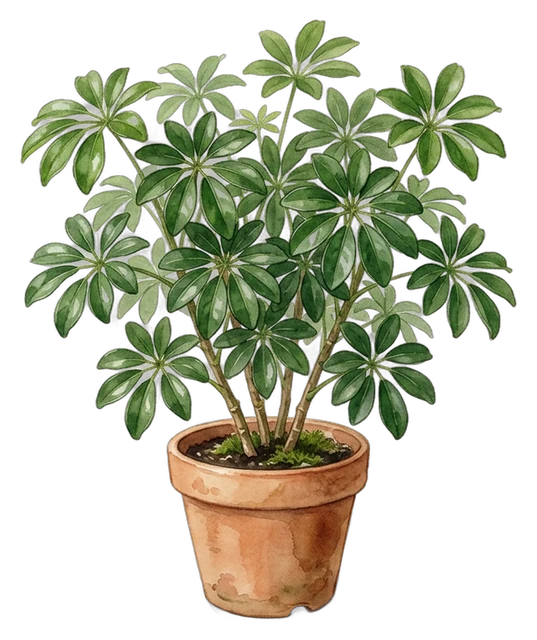
An indoor tree with an upright, sparsely branched trunk that reaches 1.5 to 3 m indoors and more than 10 m in its native land. The leaves are large, glossy and dark green, made up of 7 to 16 oval leaflets that radiate like the ribs of an umbrella from the end of a long leaf stalk, which gives it its name. In the wild, and rarely in indoor pots, it produces long, horizontal, burgundy-red spikes, like tentacles, which fill with tiny flowers and then dark red berries. It grows fast and is easy to look after, although it cannot bear cold or waterlogging. Botanical note: the name accepted by Kew (POWO) is now Heptapleurum actinophyllum, and Schefflera actinophylla (or Brassaia actinophylla) is kept as a synonym, which is how it is sold. In warm, frost-free areas it can become invasive (for example in Florida and Hawaii); in Spain it is not on the catalogue of invasive alien species, but it is best not to plant it outdoors in very warm areas or let it naturalise. Warning: the leaves and sap are irritating if swallowed and are toxic to dogs and cats.
Family and origin: Ivy family (Araliaceae) · native to Northern Australia and southern New Guinea, in tropical rainforest and open woodland · More plants from Oceania
01In your area
How will it do in your home?
Year calendar
| Task | J | F | M | A | M | J | J | A | S | O | N | D |
|---|---|---|---|---|---|---|---|---|---|---|---|---|
| Seed trayMar–May | no | no | yes | yes | yes | no | no | no | no | no | no | no |
| Plant / transplantMar–May | no | no | yes | yes | yes | no | no | no | no | no | no | no |
| PruningMar–May | no | no | yes | yes | yes | no | no | no | no | no | no | no |
| CuttingsApr–Aug | no | no | no | yes | yes | yes | yes | yes | no | no | no | no |
Its life cycle at a glance
Swipe and tap a stage to see its details.
02Planting
Planting and transplanting
- TipRepot every two years in spring, into a slightly larger pot.
03Care
Care through the year
Sun and aspectSun and shade · 4 h of sun · shade in summer
- Too little sun
- Ideal range
- Plenty of sun
East, or south with light shade in the middle of the day
Moderate sun: Copes with full sun, but give it some shade during heatwaves.
Plenty of light, with some gentle morning or afternoon sun, near a window. In low light it becomes leggy and loses leaves; in strong direct sun the leaves scorch. Indoors keep it above 10 °C and never below about 5 °C, away from cold draughts and radiators.
- TipTurn the pot every week so it grows evenly towards the light.
WateringLet it dry out between waterings · summer: every 5 to 7 days, when the top 3 to 4 cm are dry
- Summerevery 5 to 7 days, when the top 3 to 4 cm are dry0.6 L per plant/week
- Spring / Autumnevery 4-5 days0.3 L per plant/week
- Winterevery 10 to 14 days, and less if it is cool0.1 L per plant/week
Let it dry out between waterings: A Mediterranean favourite: better thirsty than overwatered.
Water thoroughly when the top of the potting mix dries out and let the saucer drain well: too much water rots the roots and is the most common cause of yellow leaves that drop. In winter, with less light and lower temperatures, water less often. Raise the humidity by misting the leaves or with a tray of wet pebbles.
When to water? Push your finger 3 cm into the soil next to the base of the plant:
- Damp: soil sticks to your finger. Do not water yet. It has more than enough; wait for it to dry out more.
- Cool but clean, no mud. Wait another 1-2 days before watering.
- Dry and dusty. Water now, but moderately. Do not overdo it: it prefers thirst to excess.
- TipAdjust watering to the light and the season: in winter almost all of them need much less water.
- Common mistakeOverwatering is the number one killer: let it dry out as the species requires.
Potting mix and feedingpH 5.5–7 · Multi-purpose compost lightened with perlite
Multi-purpose compost lightened with perlite.
70 % multi-purpose compost · 20 % perlite · 10 % coir.
High: always a pot with a drainage hole and a shallow saucer.
This plant prefers a pH between 5.5 and 7.0 (slightly acidic to neutral).
- Repot every 2-3 years into a pot a finger's width wider, not much more.
- A handful of worm castings a year keeps the potting mix alive.
- Reusing old potting mix without refreshing it compacts and rots the roots.
- No drainage in the pot = waterlogged roots = dead plant.
- TipUse a multi-purpose potting mix with perlite or coir so that it drains well, and a pot with holes.
- TipFeed every two weeks from spring to summer with a liquid fertiliser for foliage plants, at half strength.
- Common mistakePots without drainage waterlog the roots and rot the plant.
PruningWhen: Mar–May
Pruning time for this plant: Mar–May.
Common mistakes and tips
- TipWipe the leaves with a damp cloth.
- TipIf it grows too tall, tip the trunk in spring: it will resprout lower down.
- TipWatch for mealybugs and scale insects, red spider mite and aphids.
- TipDo not place it where pets can nibble it.
- TipThe figures in this profile are approximate.
04Propagation
Make new plants
It is propagated mainly by semi-ripe stem cuttings, and also by seed. Cuttings 15 to 20 cm long with two or three nodes and one or two leaves are taken in spring and summer, inserted in light, moist potting mix and kept at 22-25 °C with plenty of light and humidity; they root in four to eight weeks. Air layering on a thick stem is also possible. The berries give small, flat seeds that are sown freshly collected in spring, without burying them deeply, with constant warmth, and they take two to six weeks to germinate.
Seeds: how to germinate them~21 days
05Uses and health
What it is used for, and with what care
WARNING: the plant contains calcium oxalate crystals and other irritant compounds. Chewing the leaves or eating the berries can cause itching and burning in the mouth and lips, salivation, vomiting and difficulty swallowing. It is considered toxic to dogs and cats, with mainly digestive and oral effects. Keep it out of reach of children and pets. If it is swallowed, rinse the mouth with water and consult a doctor, a vet or a poisons information service. The sap can irritate sensitive skin.
- Properties
- A decorative houseplant; it helps bring greenery into the home, but it has no home medicinal uses.
- Uses
- It is not edible. The leaves, sap and berries must not be eaten.
For guidance only; this is not medical treatment and does not replace advice from a doctor or vet.
06Companions and related plants
What to plant it with
Compare with similar varieties
| Variety | Sowing | Harvest | Days | Spacing | Difficulty |
|---|---|---|---|---|---|
| Umbrella tree (Schefflera actinophylla) | Mar–May | — | — | 60 cm | Easy |
| Dwarf umbrella tree (Schefflera arboricola) | Mar–May | — | — | 60 cm | Easy |