Credits and licences
- #1 — vueltaalhuerto illustration
- #2 — vueltaalhuerto illustration
- #3 — vueltaalhuerto illustration
- #4 — vueltaalhuerto illustration
- #5 — vueltaalhuerto illustration
- #6 — vueltaalhuerto illustration
- #7 — vueltaalhuerto illustration
- #8 — vueltaalhuerto illustration
- #9 — vueltaalhuerto illustration
- #10 — vueltaalhuerto illustration
Tobacco (ornamental plant)
and 3 more names
Virginia tobacco, Nicotiana tabacum, nicotianaTobacco (ornamental plant) is sown in seed trays from February to April, and planted out from May to June. It flowers from July to September. Grow it in full sun, 70 cm apart, with moderate watering. Dates are for a mild temperate climate in the northern hemisphere; the calendar below adjusts them to your zone.
What else to sow in February, March and April
A tall, robust plant, 1.2 to 2 m, with a thick stem and very large, broad, soft and somewhat sticky light green leaves, and from summer to autumn a terminal cluster of pink to reddish tubular flowers with star-shaped mouths, followed by capsules holding thousands of minute seeds. It is grown as an annual. This profile treats the plant as an ornamental for the back of a border: it does not cover curing, processing or use for smoking, and commercial tobacco production is a regulated activity in Spain and the EU. The whole plant is toxic because it contains nicotine: it must not be eaten, chewed or used for infusions. It is not woodland tobacco (Nicotiana sylvestris), which has white, drooping flowers, nor the ornamental plant Nicotiana alata. Nor is it tree tobacco (Nicotiana glauca), an invasive species included in the Spanish Catalogue of Invasive Alien Species for the Canary Islands, where keeping and trading it are prohibited.
Family and origin: Nightshade family (Solanaceae) · native to Andes of Bolivia and northern Argentina; cultivated in the Americas for thousands of years · More plants from Andes
01In your area
How will it do in your garden?
Year calendar
| Task | J | F | M | A | M | J | J | A | S | O | N | D |
|---|---|---|---|---|---|---|---|---|---|---|---|---|
| Seed trayFeb–Apr | no | yes | yes | yes | no | no | no | no | no | no | no | no |
| Plant / transplantMay–Jun | no | no | no | no | yes | yes | no | no | no | no | no | no |
| FloweringJul–Sep | no | no | no | no | no | no | yes | yes | yes | no | no | no |
Its life cycle at a glance
Swipe and tap a stage to see its details.
02Planting
Where and how to plant it
Leave 70 cm between plants and 90 cm between rows; give it a stake from the start.
70 cm between plants · 90 cm between rows
Seedlings are planted with the root ball level with the soil.
- Transplanting
- May–Jun
- Seed tray
- Feb–Apr
- Germination
- ~10 days
- Support
- Needs a stake
- TipPlace it at the back of a border or in a large pot, about 70 cm from other plants, staked if it is windy.
- TipSAFETY WARNING: the whole plant contains nicotine and other alkaloids and is toxic if swallowed; wet leaves can irritate the skin and cause dizziness and nausea if handled without gloves, so wash your hands.
- Common mistakeSowing out of season: many need warmth or a cold spell beforehand to sprout.
03Care
Care through the year
Sun and aspectFull sun · 8 h of sun · South or south-west, with nothing casting shade at midday
- Too little sun
- Ideal range
- Plenty of sun
South or south-west, with nothing casting shade at midday
Strong sun: Loves full midday sun and high temperatures.
Full sun and shelter from wind, which tears the large leaves. It cannot withstand frost, so it is planted out after the last frost, when the soil has warmed up.
- TipIt belongs to the nightshade family: it shares pests and viruses with tomato, potato and pepper, so do not plant it next to them, and watch out for aphids, whitefly and caterpillars.
WateringMoist but never waterlogged · summer: every 2-3 days
- Summerevery 2-3 days1.2 L per plant/week
- Spring / Autumnevery 4-5 days0.6 L per plant/week
- Winterevery 2-3 weeks0.2 L per plant/week
Moist but never waterlogged: Water before the surface is completely dry. Never puddles. Mulch: straw or dry plant material cuts watering by 30-50 %.
Regular watering, without waterlogging, and more generous in hot weather, because the large leaves lose a lot of water. A mulch helps retain moisture. It prefers fertile, well-drained soil rich in organic matter.
When to water? Push your finger 3 cm into the soil next to the base of the plant:
- Damp: soil sticks to your finger. Do not water today. The moisture is fine.
- Cool but clean, no mud. Water early tomorrow if it stays like this, or this evening.
- Dry and dusty. Water now, and deeply. This is not where it likes to be.
Soil and feedingpH 5.5–7.5 · Loose soil with organic matter and good drainage
Loose soil with organic matter and good drainage.
50 % topsoil · 30 % well-rotted compost · 20 % sand or perlite.
Medium/high.
This plant prefers a pH between 5.5 and 7.5 (slightly acidic to slightly alkaline).
- Overfeeding gives lots of leaf and few flowers.
- Compacted, poorly drained soil rots the roots in winter.
- TipFeed it with organic fertiliser and water regularly.
- Common mistakeOverfeeding gives lush leaves but few flowers.
Pruning
- TipRemove faded flowers to prolong flowering.
Common mistakes and tips
- TipDo not smoke it, chew it or use it for infusions or to make home-made insecticides.
- TipKeep the seed capsules out of reach of children and pets.
- TipThe height and flowering dates are approximate.
04Propagation
Make new plants
It is propagated from seed, as fine as dust, which needs light to germinate: sow it on the surface, uncovered, in a seed tray under cover from the end of winter, at about 20 to 28 °C with the potting mix always moist. It comes up in one to two weeks; prick out the seedlings when they have two or three true leaves and plant them out in their final position once the last frosts are over, in May. In a garden it may self-seed.
Seeds: how to germinate them~10 days
05Uses and health
What it is used for, and with what care
SAFETY WARNING: the whole plant (leaves, stems, flowers, capsules and seeds) contains nicotine and other alkaloids and is toxic if swallowed; in small children and pets a small amount can cause nausea, vomiting, salivation, tremors and heart and breathing problems. Place it out of their reach and keep an eye on the seed capsules. Wet leaves can be absorbed through the skin and cause dizziness and nausea (green tobacco sickness): wear gloves and wash your hands. Do not smoke it, chew it or use it for infusions, extracts or home-made insecticides. This profile is for ornamental use only: commercial tobacco production is a regulated activity. Do not confuse it with tree tobacco (Nicotiana glauca), a listed invasive species in the Canary Islands. If you suspect it has been swallowed, in Spain call the Toxicology Information Service (91 562 04 20), or call the vet.
- Properties
- An ornamental plant with no safe food or medicinal use.
- Uses
- It is not edible: no part of the plant should be eaten, chewed or taken as an infusion.
For guidance only; this is not medical treatment and does not replace advice from a doctor or vet.
06Companions and related plants
What to plant it with
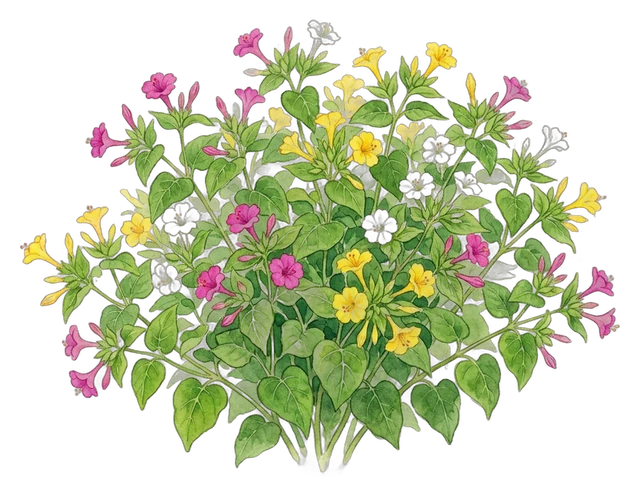
Good companions

Compare with similar varieties
| Variety | Sowing | Harvest | Days | Spacing | Difficulty |
|---|---|---|---|---|---|
| Tobacco (ornamental plant) | Feb–Apr | — | — | 70 cm | Easy |
| Woodland tobacco | Feb–May | Jul–Oct | — | 50 cm | Easy |
| Aztec tobacco (wild tobacco) | Feb–Apr | — | — | 50 cm | Easy |
07Pests and diseases
Critters and ailments to keep an eye on
The most common ones on this plant. Tap one to see how to recognise it and what to do.