
Credits and licences
- #1 — vueltaalhuerto illustration
- #2 — vueltaalhuerto illustration
- #3 — vueltaalhuerto illustration
- #4 — vueltaalhuerto illustration
- #5 — vueltaalhuerto illustration
- #6 — vueltaalhuerto illustration
- #7 — vueltaalhuerto illustration
- #8 — vueltaalhuerto illustration
- #9 — vueltaalhuerto illustration
- #10 — vueltaalhuerto illustration
Tillandsia tectorum (snowball air plant)
and 3 more names
air plant, tillandsia, tectorumTillandsia tectorum (snowball air plant) is planted from April to June. Grow it in sun or partial shade, 15 cm apart, with little watering. Dates are for a mild temperate climate in the northern hemisphere; the calendar below adjusts them to your zone.
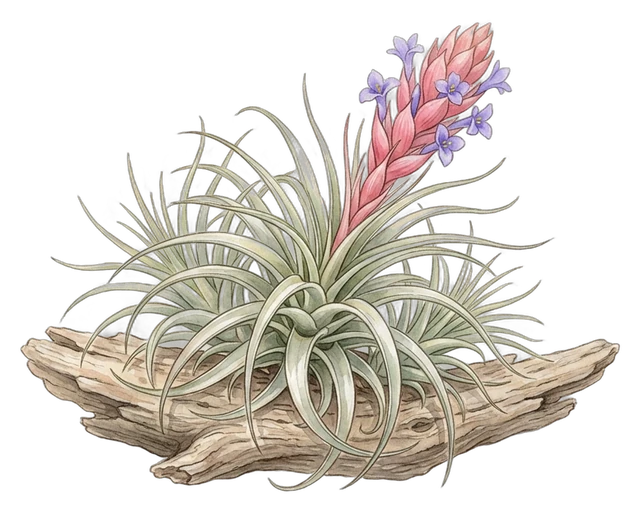
An air plant with an almost spherical rosette, about 15 to 25 cm across, that lives on rocks and shrubs without any need for soil: the roots only serve to cling on, and it absorbs water and nutrients through its leaves. Its most striking feature is its look of a white, woolly ball, because the fine, pointed leaves are covered in a dense layer of white hairs (trichomes) that protect it from the strong sun and dryness of its native habitat. When it flowers, a short spike of pink bracts with violet flowers rises from the centre. Each rosette flowers once and then produces offsets, with which it forms a clump. It is one of the tillandsias that best tolerates drought and sun, but not frost. It is not edible and not toxic.
Family and origin: Bromeliad family (Bromeliaceae) · native to The dry Andes of southern Ecuador and northern Peru, on rocks and shrubs on misty slopes · More plants from Andes
01In your area
How will it do in your home?
Year calendar
| Task | J | F | M | A | M | J | J | A | S | O | N | D |
|---|---|---|---|---|---|---|---|---|---|---|---|---|
| Plant / transplantApr–Jun | no | no | no | yes | yes | yes | no | no | no | no | no | no |
| Divide the clumpApr–Sep | no | no | no | yes | yes | yes | yes | yes | yes | no | no | no |
Its life cycle at a glance
Swipe and tap a stage to see its details.
02Care
Care through the year
Sun and aspectSun and shade · 5 h of sun · shade in summer
- Too little sun
- Ideal range
- Plenty of sun
East, or south with light shade in the middle of the day
Moderate sun: Copes with full sun, but give it some shade during heatwaves.
Very bright light and a few hours of gentle morning or afternoon sun; it is one of the most sun-tolerant, because its white fuzz reflects the light. In low light it loses its shape and does not flower. Indoors, next to a bright window; outdoors only in frost-free areas and sheltered from constant rain. It should not drop below about 5 °C.
- TipTurn the pot every week so it grows evenly towards the light.
WateringLet it dry out between waterings · summer: soak for 10 minutes every 7 to 10 days, or mist a couple of times a week
- Summersoak for 10 minutes every 7 to 10 days, or mist a couple of times a week0.3 L per plant/week
- Spring / Autumnevery 10-14 days0.1 L per plant/week
- Winterevery 2 weeks or less often0 L per plant/week
Let it dry out between waterings: A Mediterranean favourite: better thirsty than overwatered.
It copes well with drought, and its fuzz holds water longer than that of other tillandsias, so water it cautiously. Soak the whole plant for 10 minutes in rainwater or low-lime water once a week or every ten days, without rubbing it so as not to damage the hairs, then shake it and leave it upside down until it dries in under four hours, with good airflow: if water stays between the leaves, it rots. In winter and in low light, water less.
When to water? Push your finger 0 cm into the soil next to the base of the plant:
- Damp: soil sticks to your finger. Do not water yet. It has more than enough; wait for it to dry out more.
- Cool but clean, no mud. Wait another 1-2 days before watering.
- Dry and dusty. Water now, but moderately. Do not overdo it: it prefers thirst to excess.
- TipIf the leaves wrinkle and roll up, it needs more water; if the base goes soft and black, it is getting too much or has been left wet.
- TipWatering frequencies and temperatures are only a guide.
- TipAdjust watering to the light and the season: in winter almost all of them need much less water.
- Common mistakeOverwatering is the number one killer: let it dry out as the species requires.
Potting mix and feedingMulti-purpose compost lightened with perlite
Multi-purpose compost lightened with perlite.
70 % multi-purpose compost · 20 % perlite · 10 % coir.
High: always a pot with a drainage hole and a shallow saucer.
This plant prefers a pH between 5.5 and 6.5 (slightly acidic to neutral).
- Repot every 2-3 years into a pot a finger's width wider, not much more.
- A handful of worm castings a year keeps the potting mix alive.
- Reusing old potting mix without refreshing it compacts and rots the roots.
- No drainage in the pot = waterlogged roots = dead plant.
Common mistakes and tips
- TipFix it with a little non-toxic glue, or tie it loosely, to a piece of cork-oak bark, a branch or a stone, or rest it on an airy surface; do not bury it.
- TipIt needs moving air.
- TipHandle the leaves no more than necessary: the white hairs rub off and do not grow back.
- TipA rosette that has flowered will not flower again, but its offsets will.
03Propagation
Make new plants
It is propagated mainly from offsets: after flowering, the mother rosette produces one to several pups at the base. When an offset is a third to a half of the size of the mother plant, separate it carefully with your fingers or a clean blade and let the wound dry for a few hours. It can also be left on the clump, which grows ever larger. From seed it is much slower: the seeds, which have a tuft of white hairs, are stuck onto damp bark or fibre and take several years to produce flowering plants.
Seeds: how to germinate them~14 days
04Uses and health
What it is used for, and with what care
- Properties
- A decorative, low-maintenance air plant. It has no home medicinal uses.
- Uses
- It is not edible. There are no culinary uses.
For guidance only; this is not medical treatment and does not replace advice from a doctor or vet.
05Companions and related plants
What to plant it with
Compare with similar varieties
| Variety | Sowing | Harvest | Days | Spacing | Difficulty |
|---|---|---|---|---|---|
| Tillandsia ionantha (sky plant) | — | — | — | 10 cm | Easy |
| Tillandsia aeranthos (air plant) | Apr–Jun | — | — | 15 cm | Easy |
| Tillandsia brachycaulos (air plant) | Apr–Jun | — | — | 15 cm | Easy |
| Tillandsia bulbosa | Apr–Jun | — | — | 15 cm | Easy |
| Tillandsia butzii | Apr–Jun | — | — | 15 cm | Moderate |
| Tillandsia capillaris | Apr–Jun | — | — | 10 cm | Easy |
| Tillandsia capitata | Apr–Jun | — | — | 20 cm | Easy |
| Tillandsia caput-medusae (Medusa's head) | Apr–Jun | — | — | 20 cm | Easy |
| Tillandsia duratii (air plant) | Apr–Jun | — | — | 15 cm | Easy |
| Tillandsia flabellata (air plant) | Apr–Jun | — | — | 15 cm | Easy |
| Tillandsia fuchsii (air plant) | Apr–Jun | — | — | 15 cm | Easy |
| Tillandsia funckiana (trailing air plant) | Apr–Jun | — | — | 15 cm | Moderate |
| Tillandsia juncea (rush-like air plant) | Apr–Jun | — | — | 15 cm | Easy |
| Tillandsia latifolia (air plant) | Apr–Jun | — | — | 15 cm | Easy |
| Tillandsia magnusiana | Apr–Jun | — | — | 15 cm | Easy |
| Tillandsia paleacea | Apr–Jun | — | — | 15 cm | Easy |
No known toxicity to people or pets
Bromeliads and tillandsias are listed as non-toxic to dogs and cats, and there are no known risks to people. A pet that chews a lot of the plant may have mild digestive upset.