Credits and licences
- #1 — vueltaalhuerto illustration
- #2 — vueltaalhuerto illustration
- #3 — vueltaalhuerto illustration
- #4 — vueltaalhuerto illustration
- #5 — vueltaalhuerto illustration
- #6 — vueltaalhuerto illustration
- #7 — vueltaalhuerto illustration
- #8 — vueltaalhuerto illustration
- #9 — vueltaalhuerto illustration
- #10 — vueltaalhuerto illustration
Guzmania
and 1 more names
Guzmania lingulataGuzmania is sown in seed trays from March to April, and planted out from April to June. It flowers from June to August. Grow it in sun or partial shade, 35 cm apart, with moderate watering. Dates are for a mild temperate climate in the northern hemisphere; the calendar below adjusts them to your zone.
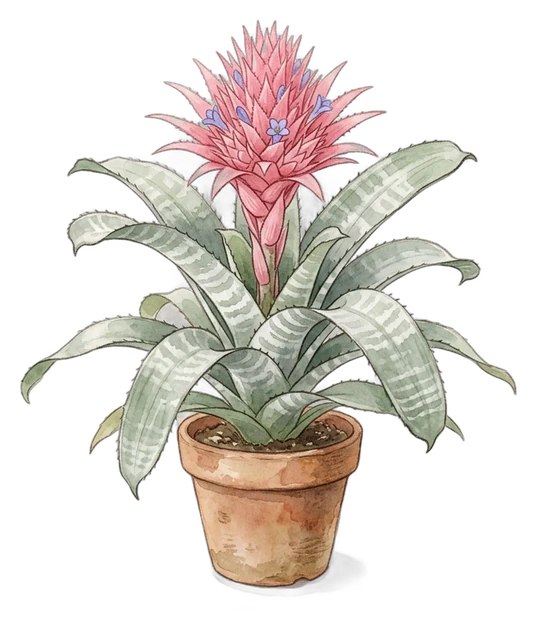
An epiphytic bromeliad with a compact rosette, 30 to 60 cm, formed of long, smooth, spineless, glossy green leaves that leave a kind of cup in the centre that can hold water. From it rises an upright, star-shaped inflorescence of red, orange, pink or yellow bracts depending on the cultivar (the best-selling one, ‘Candy’, has bright colours), with small, short-lived white flowers in the centre; the bracts, on the other hand, keep their colour for several months. It is monocarpic: each rosette flowers only once, slowly dies back and leaves offsets at the base, which are the usual way to renew it. It is a plant for indoors or a sheltered terrace, because it cannot stand cold. It is not edible. Do not confuse it with aechmea, which has spiny leaves with silvery bands.
Family and origin: Bromeliad family (Bromeliaceae) · native to Central America, the Caribbean and northern South America (understorey and tree trunks of humid tropical forests) · More plants from South America
01In your area
How will it do in your home?
Year calendar
| Task | J | F | M | A | M | J | J | A | S | O | N | D |
|---|---|---|---|---|---|---|---|---|---|---|---|---|
| Seed trayMar–Apr | no | no | yes | yes | no | no | no | no | no | no | no | no |
| Plant / transplantApr–Jun | no | no | no | yes | yes | yes | no | no | no | no | no | no |
| FloweringJun–Aug | no | no | no | no | no | yes | yes | yes | no | no | no | no |
| Divide the clumpApr–Jul | no | no | no | yes | yes | yes | yes | no | no | no | no | no |
Its life cycle at a glance
Swipe and tap a stage to see its details.
02Planting
Planting and transplanting
- TipIf you are not going to throw the plant away after flowering, cut the dry inflorescence off at the base and keep the rosette until the offsets are well developed.
- TipIf a mature plant does not flower, you can trigger flowering by putting a ripe apple inside a clear bag with it for a couple of weeks (the ethylene from the fruit helps), with mixed results.
03Care
Care through the year
Sun and aspectSun and shade · 3 h of sun · shade in summer
- Too little sun
- Ideal range
- Plenty of sun
East, or south with light shade during the middle of the day
Gentle sun: Morning or afternoon sun. Midday summer sun stresses and scorches it.
Bright, indirect light, for example by an east- or west-facing window, without direct summer sun, which scorches the leaves. In low light it survives, but grows less and the bracts lose colour. It likes warmth: 18 to 25 °C, and it should not drop below about 12 to 16 °C.
- TipTurn the pot every week so it grows evenly towards the light.
WateringLet it dry out between waterings · summer: always a little water in the cup; the potting mix every 7 days
- Summeralways a little water in the cup; the potting mix every 7 days0.6 L per plant/week
- Spring / Autumnevery 4-5 days0.3 L per plant/week
- Winterthe potting mix every 10 to 15 days0.1 L per plant/week
Let it dry out between waterings: A Mediterranean favourite: better thirsty than overwatered.
It is watered mainly through the central cup, which is kept topped up with a couple of centimetres of rainwater or filtered water, and emptied and refilled every one or two weeks so that it does not go stale. The potting mix only needs to be slightly moist, because the roots are small and rot if overwatered. With central heating it appreciates humid air.
When to water? Push your finger 3 cm into the soil next to the base of the plant:
- Damp: soil sticks to your finger. Do not water yet. It has more than enough; wait for it to dry out more.
- Cool but clean, no mud. Wait another 1-2 days before watering.
- Dry and dusty. Water now, but moderately. Do not overdo it: it prefers thirst to excess.
- TipAdjust watering to the light and the season: in winter almost all of them need much less water.
- Common mistakeOverwatering is the number one killer: let it dry out as the species requires.
Potting mix and feedingpH 5–6.5 · Multi-purpose compost lightened with perlite
Multi-purpose compost lightened with perlite.
70 % multi-purpose compost · 20 % perlite · 10 % coir.
High: always a pot with a drainage hole and a shallow saucer.
This plant prefers a pH between 5.0 and 6.5 (acidic to neutral).
- Repot every 2-3 years into a pot a finger's width wider, not much more.
- A handful of worm castings a year keeps the potting mix alive.
- Reusing old potting mix without refreshing it compacts and rots the roots.
- No drainage in the pot = waterlogged roots = dead plant.
- TipPut guzmania in a small, heavy pot with orchid compost or peat and perlite, very open and free-draining.
- TipFeed it sparingly: a very dilute liquid fertiliser, on the potting mix or in the cup, once a month from spring to summer.
- Common mistakePots without drainage waterlog the roots and rot the plant.
Common mistakes and tips
- TipWatch out for mealybugs.
- TipTemperatures and germination and flowering times are approximate.
04Propagation
Make new plants
It is propagated mainly by offsets, and also by seed, which is very slow. After flowering, the mother rosette slowly dies back and produces offsets at the base: when they are at least a third of the size of the mother, or about 8 to 10 cm, separate them with a clean knife, with some root, and plant them in a small pot with a very open potting mix. The tiny seeds, with a tuft of hairs, come from the dry capsules and are sown on the surface of tree-fern fibre or moist peat at about 22 to 28 °C; the plants take five or six years to flower, compared with about three from offsets.
Seeds: how to germinate them~30 days
05Uses and health
What it is used for, and with what care
Guzmania varieties (Guzmania lingulata ‘Minor’ and G. musaica) are among plants that are non-toxic to dogs, cats and horses. Even so, if an animal eats a large amount it may vomit or have diarrhoea, so it is best to stop pets nibbling it. For people there is no reliable data: do not eat it. The leaves have no spines, but the sap or the leaf edges may irritate sensitive skin; wash your hands after handling it.
- Properties
- A long-lasting ornamental plant, one of the showiest for indoors. It has no home medicinal uses.
- Uses
- It is not edible. Do not confuse it with pineapple, which is another bromeliad, or with other edible plants.
For guidance only; this is not medical treatment and does not replace advice from a doctor or vet.
06Companions and related plants