Credits and licences
- #1 — vueltaalhuerto illustration
- #2 — vueltaalhuerto illustration
- #3 — vueltaalhuerto illustration
- #4 — vueltaalhuerto illustration
- #5 — vueltaalhuerto illustration
- #6 — vueltaalhuerto illustration
- #7 — vueltaalhuerto illustration
- #8 — vueltaalhuerto illustration
- #9 — vueltaalhuerto illustration
- #10 — vueltaalhuerto illustration
Urn plant (Aechmea fasciata)
and 3 more names
aechmea, bromeliad, Billbergia rhodocyaneaUrn plant (Aechmea fasciata) is sown in seed trays from March to April, and planted out from April to June. It flowers from June to August. Grow it in sun or partial shade, 40 cm apart, with moderate watering. Dates are for a mild temperate climate in the northern hemisphere; the calendar below adjusts them to your zone.
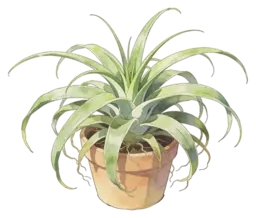
An epiphytic indoor bromeliad, very popular for its rosette of arching, silvery-green leaves crossed by white bands, which forms a kind of urn or vase in the centre that can hold water. It reaches 40 to 60 cm tall and as much across, and its leaves have small spines along the edge that prick when you handle it. When the plant is mature, a cone-shaped inflorescence of stiff, spiny pink bracts rises from the urn, with small violet-blue flowers peeping out between them that last only a few days; the bracts, however, keep their colour for several months. It is monocarpic: each rosette flowers only once, takes several years to do so and afterwards slowly dies back while producing one to four offsets at the base, which are the usual way to renew it. It is a plant for indoors or a sheltered balcony, because it does not tolerate cold below about 10 °C, and in very mild climates, such as the Canary Islands coast or the Spanish Mediterranean coast, it can be kept outdoors in light shade. It is not edible. Do not confuse it with the pineapple or with other indoor bromeliads, such as tillandsias or guzmanias, which have smooth green leaves.
Family and origin: Bromeliad family (Bromeliaceae) · native to Brazil (Atlantic Forest, in the states of Rio de Janeiro and Espirito Santo) · More plants from South America
01In your area
How will it do in your home?
Year calendar
| Task | J | F | M | A | M | J | J | A | S | O | N | D |
|---|---|---|---|---|---|---|---|---|---|---|---|---|
| Seed trayMar–Apr | no | no | yes | yes | no | no | no | no | no | no | no | no |
| Plant / transplantApr–Jun | no | no | no | yes | yes | yes | no | no | no | no | no | no |
| FloweringJun–Aug | no | no | no | no | no | yes | yes | yes | no | no | no | no |
| Divide the clumpApr–Jul | no | no | no | yes | yes | yes | yes | no | no | no | no | no |
Its life cycle at a glance
Swipe and tap a stage to see its details.
02Planting
Planting and transplanting
- TipIf a mature plant will not flower, you can trigger flowering by placing it in a clear plastic bag with a ripe apple for one or two weeks, because the fruit gives off ethylene; it is a common trick among nurseries and hobbyists, and it works erratically.
03Care
Care through the year
Sun and aspectSun and shade · 5 h of sun · shade in summer
- Too little sun
- Ideal range
- Plenty of sun
East, or south with light shade during the middle of the day
Moderate sun: Copes with full sun, but give it some shade during heatwaves.
Bright light without direct sun, for example by an east- or west-facing window: in poor light the leaves lose their silvery markings and it does not flower, and direct midday sun scorches the leaves. It appreciates a warm atmosphere, 18 to 27 °C, and should not drop below about 10 °C.
- TipTurn the pot every week so it grows evenly towards the light.
WateringLet it dry out between waterings · summer: every 2-3 days
- Summerevery 2-3 days0.6 L per plant/week
- Spring / Autumnevery 4-5 days0.3 L per plant/week
- Winterevery 2-3 weeks0.1 L per plant/week
Let it dry out between waterings: A Mediterranean favourite: better thirsty than overwatered. Mulch: straw or dry plant material cuts watering by 30-50 %.
It is watered mainly through the central urn, which is kept filled with a couple of centimetres of rainwater or filtered water, and emptied and refilled every one or two weeks so that it does not stagnate or breed mosquitoes. The potting mix only needs to be slightly moist: let the top dry out between waterings, because its roots are small and rot with excess water. When the heating is on, it appreciates a slightly humid atmosphere.
When to water? Push your finger 3 cm into the soil next to the base of the plant:
- Damp: soil sticks to your finger. Do not water yet. It has more than enough; wait for it to dry out more.
- Cool but clean, no mud. Wait another 1-2 days before watering.
- Dry and dusty. Water now, but moderately. Do not overdo it: it prefers thirst to excess.
- TipAdjust watering to the light and the season: in winter almost all of them need much less water.
- Common mistakeOverwatering is the number one killer: let it dry out as the species requires.
Potting mix and feedingpH 5.5–6.5 · Multi-purpose compost lightened with perlite
Multi-purpose compost lightened with perlite.
70 % multi-purpose compost · 20 % perlite · 10 % coir.
High: always a pot with a drainage hole and a shallow saucer.
This plant prefers a pH between 5.5 and 6.5 (slightly acidic to neutral).
- Repot every 2-3 years into a pot a finger's width wider, not much more.
- A handful of worm castings a year keeps the potting mix alive.
- Reusing old potting mix without refreshing it compacts and rots the roots.
- No drainage in the pot = waterlogged roots = dead plant.
- TipPut the bromeliad in a small, heavy pot with good drainage, because it has few roots and is tall.
- TipFeed sparingly: a very dilute liquid fertiliser, applied to the urn or the potting mix once a month from spring to summer, is enough.
- Common mistakePots without drainage waterlog the roots and rot the plant.
Common mistakes and tips
- TipWhen the inflorescence dries, cut it off at the base, but keep the rosette until the offsets have developed.
- TipWatch out for mealybugs and scale insects, which hide between the leaves.
04Propagation
Make new plants
It is propagated mainly by offsets, and also by seed, which is slow. After flowering, the mother rosette slowly dies back and produces one to four offsets at the base: when they are at least a third the size of the mother, or about 15 cm, separate them with a clean knife, with some root, and plant them in a small pot with a very open bromeliad mix or with bark and perlite, burying them only shallowly so the leaves do not rot. The seeds come from the small berries left by the inflorescence: clean off the pulp, sow them on the surface of moist peat and sand at 22-28 °C, and they germinate in about four weeks, although the plant takes three to five years to flower.
Seeds: how to germinate them~30 days
05Uses and health
What it is used for, and with what care
There is no reliable data on its toxicity to people, so it should not be eaten. The sources consulted consider it of little or no toxicity to dogs and cats, but the leaves have spines along the edge that can injure the mouth and eyes of a curious animal, and if chewed they may cause mild digestive upset. Handle it with care, preferably with gloves, and keep the water in the urn fresh so that it does not breed mosquitoes.
- Properties
- It is an ornamental houseplant and no medicinal properties are attributed to it. Its pink inflorescence lasts several months and is a long-lasting decoration in the home; in addition, the central urn holds water and adds humidity around it.
- Uses
- It is not edible. Do not confuse it with the pineapple or use any part of it in the kitchen.
For guidance only; this is not medical treatment and does not replace advice from a doctor or vet.
06Companions and related plants