Credits and licences
- #1 — vueltaalhuerto illustration
- #2 — vueltaalhuerto illustration
- #3 — vueltaalhuerto illustration
- #4 — vueltaalhuerto illustration
- #5 — vueltaalhuerto illustration
- #6 — vueltaalhuerto illustration
- #7 — vueltaalhuerto illustration
- #8 — vueltaalhuerto illustration
Blushing bromeliad (Neoregelia carolinae)
and 2 more names
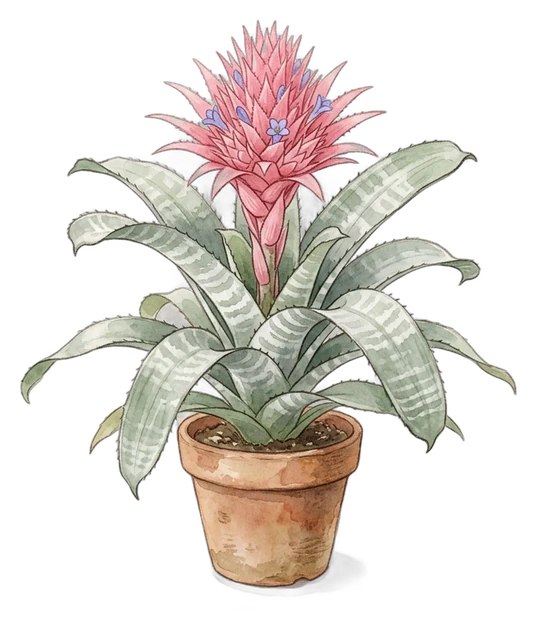
Neoregelia Fireball, heart of flameBlushing bromeliad (Neoregelia carolinae) is planted from April to June. Grow it in sun or partial shade, 40 cm apart, with moderate watering. Dates are for a mild temperate climate in the northern hemisphere; the calendar below adjusts them to your zone.
A rosette-forming indoor bromeliad, 30 to 50 cm across, made up of long, strap-like, glossy, deep green leaves with small spines along the edges, which form a cup in the centre that can hold water. As the plant approaches flowering, the centre of the rosette turns an intense red, hence the name blushing bromeliad; the small violet-blue flowers sit almost submerged in the water in the cup and last only a few days, but the colour in the centre lasts for several months. It is monocarpic: each rosette flowers only once and then slowly dies back, leaving one or several offsets at the base, which are the way to renew it. There are many cultivars and hybrids, such as Fireball, with reddish leaves and green edges, or Mephisto and Guacamole, with striped or blotched leaves. It is not edible. It is a plant for indoors or a sheltered terrace, because it does not tolerate cold below about 10 °C.
Family and origin: Bromeliad family (Bromeliaceae) · native to Atlantic Forest of Brazil (the states of Espírito Santo and Rio de Janeiro, among others) · More plants from South America
01In your area
How will it do in your home?
Year calendar
| Task | J | F | M | A | M | J | J | A | S | O | N | D |
|---|---|---|---|---|---|---|---|---|---|---|---|---|
| Plant / transplantApr–Jun | no | no | no | yes | yes | yes | no | no | no | no | no | no |
| Divide the clumpApr–Jul | no | no | no | yes | yes | yes | yes | no | no | no | no | no |
Its life cycle at a glance
Swipe and tap a stage to see its details.
02Care
Care through the year
Sun and aspectSun and shade · 5 h of sun · shade in summer
- Too little sun
- Ideal range
- Plenty of sun
East, or south with light shade in the middle of the day
Gentle sun: Morning or afternoon sun. Midday summer sun stresses and scorches it.
Bright light without direct midday sun, for example by an east- or west-facing window. With more light the red colour in the centre is more vivid; in poor light the leaves darken and become elongated. It appreciates warmth, 18 to 27 °C, and should not drop below about 10 °C.
- TipIf it does not flower, light and age are usually the cause.
- TipTurn the pot every week so it grows evenly towards the light.
WateringLet it dry out between waterings · summer: every 2-3 days
- Summerevery 2-3 days0.6 L per plant/week
- Spring / Autumnevery 4-5 days0.3 L per plant/week
- Winterevery 2-3 weeks0.1 L per plant/week
Let it dry out between waterings: A Mediterranean favourite: better thirsty than overwatered. Mulch: straw or dry plant material cuts watering by 30-50 %.
It is watered mainly through the central cup, which is kept topped up with a couple of centimetres of rainwater, filtered water or soft water, and emptied and refilled every one or two weeks so it does not stagnate or breed mosquitoes. The potting mix only needs to be slightly moist: let the top dry out between waterings, because the roots are small and rot if overwatered. With central heating it appreciates some humidity.
When to water? Push your finger 3 cm into the soil next to the base of the plant:
- Damp: soil sticks to your finger. Do not water yet. It has more than enough; wait for it to dry out more.
- Cool but clean, no mud. Wait another 1-2 days before watering.
- Dry and dusty. Water now, but moderately. Do not overdo it: it prefers thirst to excess.
- TipWear gloves when handling the leaves, which prick, and keep the water in the cup fresh.
- TipAdjust watering to the light and the season: in winter almost all of them need much less water.
- Common mistakeOverwatering is the number one killer: let it dry out as the species requires.
Potting mix and feedingpH 5.5–6.5 · Multi-purpose compost lightened with perlite
Multi-purpose compost lightened with perlite.
70 % multi-purpose compost · 20 % perlite · 10 % coir.
High: always a pot with a drainage hole and a shallow saucer.
This plant prefers a pH between 5.5 and 6.5 (slightly acidic to neutral).
- Repot every 2-3 years into a pot a finger's width wider, not much more.
- A handful of worm castings a year keeps the potting mix alive.
- Reusing old potting mix without refreshing it compacts and rots the roots.
- No drainage in the pot = waterlogged roots = dead plant.
- TipGrow the bromeliad in a small, heavy pot with good drainage, because it has few roots and a wide habit.
- TipFeed very little: a very dilute liquid fertiliser, applied to the cup or the potting mix once a month between spring and summer, is enough.
- Common mistakePots without drainage waterlog the roots and rot the plant.
Common mistakes and tips
- TipWhen the flower head dies, cut it off, but keep the rosette until the offsets have developed.
- TipWatch out for mealybugs, which hide between the leaves.
- TipTemperatures, timings and dates are a guide only.
03Propagation
Make new plants
It is propagated mainly from offsets. After flowering, the mother rosette slowly dies back and produces one or more offsets at the base: when they are at least a third of the size of the mother, or about 10 to 15 cm, and have small roots, separate them with a clean knife and plant them in a small pot with a very open bromeliad mix, or bark and perlite, burying them only shallowly so the leaves do not rot. Seed, which comes from small berries, is used by hobby growers and nurseries, but it is very slow, and cultivars and hybrids do not come true.
04Uses and health
What it is used for, and with what care
There is no reliable data on its toxicity to people, so it should not be eaten. The sources consulted consider it non-toxic to dogs and cats, but the leaves have small spines along the edges that can injure the mouth and eyes, and chewing them can cause mild digestive upset. Handle it with gloves and refresh the water in the cup so it does not breed mosquitoes.
- Properties
- It is an ornamental houseplant and no medicinal properties are attributed to it. The red-centred rosette lasts for months, and the water-filled cup keeps a little humidity around it.
- Uses
- It is not edible. Do not confuse it with the pineapple or use any part of it in cooking.
For guidance only; this is not medical treatment and does not replace advice from a doctor or vet.
05Companions and related plants