
Credits and licences
- #1 — vueltaalhuerto illustration
- #2 — vueltaalhuerto illustration
- #3 — vueltaalhuerto illustration
- #4 — vueltaalhuerto illustration
- #5 — vueltaalhuerto illustration
- #6 — vueltaalhuerto illustration
- #7 — vueltaalhuerto illustration
- #8 — vueltaalhuerto illustration
- #9 — vueltaalhuerto illustration
- #10 — vueltaalhuerto illustration
Tillandsia juncea (rush-like air plant)
and 2 more names
tillandsia, junceaTillandsia juncea (rush-like air plant) is planted from April to June. Grow it in sun or partial shade, 15 cm apart, with little watering. Dates are for a mild temperate climate in the northern hemisphere; the calendar below adjusts them to your zone.
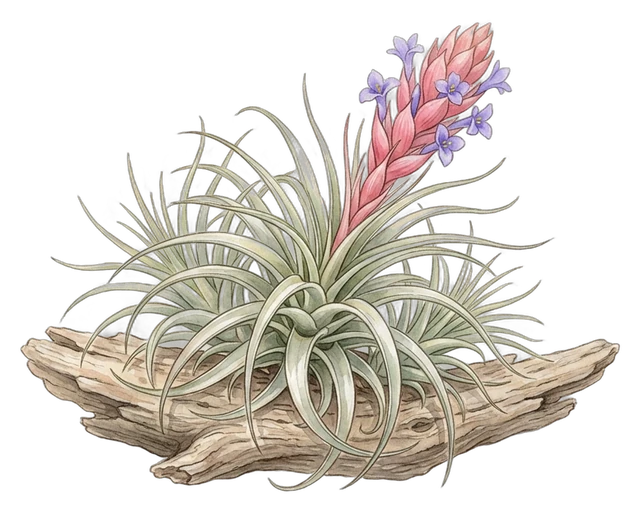
An air plant that looks like a grassy tuft, about 20 to 40 cm tall, living on tree trunks and rocks without any need for soil: the roots only serve to cling on, and it absorbs water and nutrients through its leaves. It forms a tight rosette of very fine, arching, pointed leaves, greyish green from the scales that cover them, which give it a rush-like look. When it flowers, a narrow spike of reddish bracts rises from the centre, from which violet flowers emerge with yellow stamens protruding from their centre; they last several weeks. It is one of the easy tillandsias to grow. Each rosette flowers once and then produces offsets, with which it forms a clump. It is not edible and not toxic.
Family and origin: Bromeliad family (Bromeliaceae) · native to Tropical and subtropical America, from Mexico and the Caribbean to northern Argentina, on tree trunks and rocks · More plants from South America
01In your area
How will it do in your home?
Year calendar
| Task | J | F | M | A | M | J | J | A | S | O | N | D |
|---|---|---|---|---|---|---|---|---|---|---|---|---|
| Plant / transplantApr–Jun | no | no | no | yes | yes | yes | no | no | no | no | no | no |
| Divide the clumpApr–Sep | no | no | no | yes | yes | yes | yes | yes | yes | no | no | no |
Its life cycle at a glance
Swipe and tap a stage to see its details.
02Care
Care through the year
Sun and aspectSun and shade · 4 h of sun · shade in summer
- Too little sun
- Ideal range
- Plenty of sun
East, or south with light shade in the middle of the day
Gentle sun: Morning or afternoon sun. Midday summer sun stresses and scorches it.
Very bright light, with a few hours of gentle morning or afternoon sun; it copes with sun better than green-leaved tillandsias. In low light it becomes leggy and does not flower. Indoors, next to a bright window; outdoors in frost-free areas, sheltered from constant rain. It tolerates about 5 °C, but below 8 to 10 °C it is best protected.
- TipTurn the pot every week so it grows evenly towards the light.
WateringLet it dry out between waterings · summer: soak for 15 to 20 minutes once a week, or mist 2 or 3 times a week
- Summersoak for 15 to 20 minutes once a week, or mist 2 or 3 times a week0.3 L per plant/week
- Spring / Autumnevery 10-14 days0.1 L per plant/week
- Winterevery 10 to 14 days0 L per plant/week
Let it dry out between waterings: A Mediterranean favourite: better thirsty than overwatered.
Soak the whole plant in rainwater or low-lime water for 15 to 20 minutes once a week, or mist it often, then shake it and leave it upside down until it dries in under four hours: if water stays between the leaves, it rots. In winter and in low light, water less.
When to water? Push your finger 0 cm into the soil next to the base of the plant:
- Damp: soil sticks to your finger. Do not water yet. It has more than enough; wait for it to dry out more.
- Cool but clean, no mud. Wait another 1-2 days before watering.
- Dry and dusty. Water now, but moderately. Do not overdo it: it prefers thirst to excess.
- TipIf the tips dry out and turn brown, it needs more water; if the base goes soft and black, it is getting too much.
- TipWatering frequencies and temperatures are only a guide.
- TipAdjust watering to the light and the season: in winter almost all of them need much less water.
- Common mistakeOverwatering is the number one killer: let it dry out as the species requires.
Potting mix and feedingMulti-purpose compost lightened with perlite
Multi-purpose compost lightened with perlite.
70 % multi-purpose compost · 20 % perlite · 10 % coir.
High: always a pot with a drainage hole and a shallow saucer.
This plant prefers a pH between 5.5 and 6.5 (slightly acidic to neutral).
- Repot every 2-3 years into a pot a finger's width wider, not much more.
- A handful of worm castings a year keeps the potting mix alive.
- Reusing old potting mix without refreshing it compacts and rots the roots.
- No drainage in the pot = waterlogged roots = dead plant.
03Propagation
Make new plants
It is propagated mainly from offsets: after flowering, the mother rosette produces one to several pups at the base. When an offset is a third to a half of the size of the mother plant, separate it carefully with your fingers or a clean blade and let the wound dry for a few hours. It can also be left on the clump, which grows ever larger. From seed it is slower: the seeds, which have a tuft of white hairs, are stuck onto damp bark or fibre and take several years to produce flowering plants.
Seeds: how to germinate them~14 days
04Uses and health
What it is used for, and with what care
- Properties
- Tillandsia juncea is an easy air plant with fine, rush-like leaves that form a tuft, and violet flowers on a reddish spike. It has no home medicinal uses.
- Uses
- It is not edible. There are no culinary uses.
For guidance only; this is not medical treatment and does not replace advice from a doctor or vet.
05Companions and related plants
What to plant it with
Compare with similar varieties
| Variety | Sowing | Harvest | Days | Spacing | Difficulty |
|---|---|---|---|---|---|
| Tillandsia ionantha (sky plant) | — | — | — | 10 cm | Easy |
| Tillandsia aeranthos (air plant) | Apr–Jun | — | — | 15 cm | Easy |
| Tillandsia brachycaulos (air plant) | Apr–Jun | — | — | 15 cm | Easy |
| Tillandsia bulbosa | Apr–Jun | — | — | 15 cm | Easy |
| Tillandsia butzii | Apr–Jun | — | — | 15 cm | Moderate |
| Tillandsia capillaris | Apr–Jun | — | — | 10 cm | Easy |
| Tillandsia capitata | Apr–Jun | — | — | 20 cm | Easy |
| Tillandsia caput-medusae (Medusa's head) | Apr–Jun | — | — | 20 cm | Easy |
| Tillandsia duratii (air plant) | Apr–Jun | — | — | 15 cm | Easy |
| Tillandsia flabellata (air plant) | Apr–Jun | — | — | 15 cm | Easy |
| Tillandsia fuchsii (air plant) | Apr–Jun | — | — | 15 cm | Easy |
| Tillandsia funckiana (trailing air plant) | Apr–Jun | — | — | 15 cm | Moderate |
| Tillandsia juncea (rush-like air plant) | Apr–Jun | — | — | 15 cm | Easy |
| Tillandsia latifolia (air plant) | Apr–Jun | — | — | 15 cm | Easy |
| Tillandsia magnusiana | Apr–Jun | — | — | 15 cm | Easy |
| Tillandsia paleacea | Apr–Jun | — | — | 15 cm | Easy |
No known toxicity to people or pets
Bromeliads and tillandsias are listed as non-toxic to dogs and cats, and there are no known risks to people. A pet that chews a lot of the plant may have mild digestive upset.