
Credits and licences
- #1 — vueltaalhuerto illustration
- #2 — vueltaalhuerto illustration
- #3 — vueltaalhuerto illustration
- #4 — vueltaalhuerto illustration
- #5 — vueltaalhuerto illustration
- #6 — vueltaalhuerto illustration
- #7 — vueltaalhuerto illustration
- #8 — vueltaalhuerto illustration
- #9 — vueltaalhuerto illustration
- #10 — vueltaalhuerto illustration
Star apple (caimito)
and 2 more names
milk fruit, purple star appleStar apple (caimito) is planted from April to June. It is harvested from March to June. Grow it in full sun, 600 cm apart, with moderate watering. Dates are for a mild temperate climate in the northern hemisphere; the calendar below adjusts them to your zone.
An evergreen tropical tree, 8 to 15 m tall in its native lands (much less in a pot or with pruning), with a dense crown and oval leaves that are glossy dark green above and a silky golden copper colour beneath. The tiny, purplish-white flowers are clustered in the leaf axils and are followed by round fruits 5 to 10 cm across, with smooth purple or greenish skin and milky, sweet, jelly-like flesh which, when the fruit is cut across, shows a star pattern formed by the dark seeds. It is a fruit tree for warm, frost-free climates, so in Spain it is only realistic in the Canary Islands and in very sheltered corners of the Mediterranean coast, and it takes several years to fruit. Do not confuse it with abiu (Pouteria caimito), which in some countries is also called caimito but has yellow fruit, nor with carambola, which in English is called ‘star fruit’. It is not on the list of regulated invasive alien species.
Family and origin: Sapodilla family (Sapotaceae) · native to The Caribbean and Central America; grown throughout the tropics · More plants from Mesoamerica
01In your area
How will it do in your garden?
Year calendar
| Task | J | F | M | A | M | J | J | A | S | O | N | D |
|---|---|---|---|---|---|---|---|---|---|---|---|---|
| Plant / transplantApr–Jun | no | no | no | yes | yes | yes | no | no | no | no | no | no |
| HarvestMar–Jun | no | no | yes | yes | yes | yes | no | no | no | no | no | no |
| PruningMar | no | no | yes | no | no | no | no | no | no | no | no | no |
Its life cycle at a glance
Swipe and tap a stage to see its details.
02Planting
Where and how to plant it
Sow the seed 2 cm deep; leave 6 m between plants and 8 m between rows.
6 m between plants · 8 m between rows
Seed at a depth of 2 cm; seedlings go in with the root ball level with the soil.
- In a square-foot bed
- 1 plant every 400 squares30 × 30 cm squares
- Transplanting
- Apr–Jun
- Germination
- ~30 days
03Care
Care through the year
Sun and aspectFull sun · 8 h of sun · South or south-west, with nothing casting shade at midday
- Too little sun
- Ideal range
- Plenty of sun
South or south-west, with nothing casting shade at midday
Strong sun: Loves full midday sun and high temperatures.
Full sun or very bright light; young trees appreciate a little light shade in summer in the hottest areas.
- TipIt is a tree with no real tolerance of cold: young trees suffer at 0 to 2 °C and only mature ones withstand very brief, light dips, so at best it is a tree for the Canary Islands, the Costa Tropical (in Granada, southern Spain) or a heated greenhouse.
WateringMoist but never waterlogged · summer: every 2-3 days
- Summerevery 2-3 days30 L per tree/week
- Spring / Autumnevery 4-5 days15 L per tree/week
- Winterevery 2-3 weeks4.5 L per tree/week
Moist but never waterlogged: Water before the surface is completely dry. Never puddles. Mulch: straw or dry plant material cuts watering by 30-50 %.
Water regularly, especially in summer and while fruiting, without waterlogging. Once established it withstands dry spells, but at the expense of the harvest.
When to water? Push your finger 3 cm into the soil next to the base of the plant:
- Damp: soil sticks to your finger. Do not water today. The moisture is fine.
- Cool but clean, no mud. Water early tomorrow if it stays like this, or this evening.
- Dry and dusty. Water now, and deeply. This is not where it likes to be.
Soil and feedingpH 5.5–7.5 · A deep planting hole and well-drained soil
A deep planting hole and well-drained soil.
The site's own topsoil + 1/3 well-rotted compost + a handful of sand if there is clay.
Good: prolonged waterlogging rots the roots.
This plant prefers a pH between 5.5 and 7.5 (slightly acidic to slightly alkaline).
- Dig a hole at least 60×60×60 cm before planting.
- A thick mulch around the tree (not touching the trunk) reduces water stress.
- Spread compost on the surface every autumn; never bury the graft union.
- A narrow hole in hard ground: the roots end up trapped as if in a pot.
- Burying the graft encourages rot and takes vigour away from the rootstock.
- TipPlant it in spring in deep, fertile, well-drained soil, with a layer of mulch and protection from the wind, and feed it in spring and summer.
- Common mistakeDo not bury the graft union (the bulge on the trunk): if it ends up below ground it rots. Leave it a little above the soil.
PruningWhen: Mar
Pruning time for this plant: Mar.
- TipIn a large pot it can be kept small by pruning and moved into a bright room in winter.
- TipPlant while dormant (autumn to winter) and shape the canopy by pruning in the first few years.
Common mistakes and tips
- TipThe flesh is eaten with a spoon, without the skin or seeds.
04Harvest
Harvesting and storing
Harvest in Mar–Jun.
- TipThe fruit is picked when the skin goes from glossy to dull and the fruit gives slightly to the touch; picked green, it does not ripen well and releases a sticky, astringent latex.
- TipThe figures for cold tolerance, harvest time and years to fruiting are only a guide and vary greatly between sources.
- TipA good mulch and drip irrigation in summer make all the difference to the harvest.
05Propagation
Make new plants
The usual and most reliable approach is to buy a grafted tree from a nursery, because from seed it takes a long time to fruit (between five and ten years, depending on the source) and does not come true. The seed is recalcitrant: sow it fresh, without letting it dry out, in a warm, moist mix, and it comes up in about four weeks or more. Nurseries propagate it by cleft or bud grafting onto seedling rootstocks of the same species, and air layering is also possible.
Seeds: how to germinate them~30 days
06Uses and health
What it is used for, and with what care
The ripe flesh is edible. The skin and unripe fruits release a sticky, astringent latex that irritates the mouth and skin, and the seeds are hard and bitter, so they are not eaten. There are no reliable data on pets: to be on the safe side, do not give them the fruit or seeds.
- Properties
- A sweet, juicy fruit with vitamin C and fibre; as with other tropical fruits, studies on its health effects are still limited.
- Uses
- The jelly-like flesh is eaten fresh with a spoon, on its own or in fruit salads, juices and ice creams. The skin, which is rubbery and bitter, and the seeds are discarded.
For guidance only; this is not medical treatment and does not replace advice from a doctor or vet.
07Companions and related plants
What to plant it with
Good companions
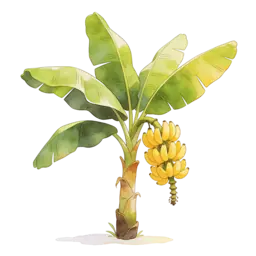
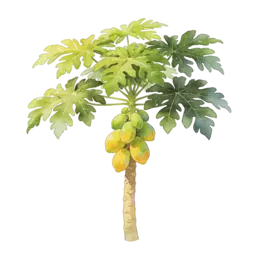
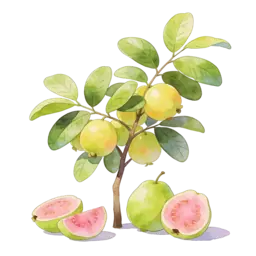
Group it in the same bedPlants with the same watering or the same sun
They are not essential companions, but you will not have to water or position them differently.