Credits and licences
- #1 — vueltaalhuerto illustration
- #2 — vueltaalhuerto illustration
- #3 — vueltaalhuerto illustration
- #4 — vueltaalhuerto illustration
- #5 — vueltaalhuerto illustration
- #6 — vueltaalhuerto illustration
- #7 — vueltaalhuerto illustration
- #8 — vueltaalhuerto illustration
- #9 — vueltaalhuerto illustration
- #10 — vueltaalhuerto illustration
Painted daisy (Tanacetum coccineum)
and 3 more names
Tanacetum coccineum, Chrysanthemum coccineum, Pyrethrum roseumPainted daisy (Tanacetum coccineum) is sown in seed trays from February to April or directly outdoors from April to May, and planted out from April to May and from September to October. It flowers from May to July. Grow it in full sun, 40 cm apart, with moderate watering. Dates are for a mild temperate climate in the northern hemisphere; the calendar below adjusts them to your zone.
What else to sow in February, March, April and May
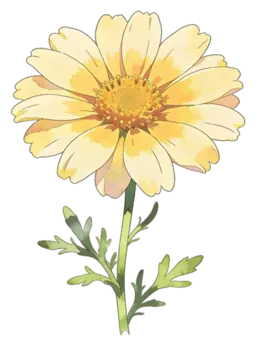
A clump-forming perennial, 50 to 80 cm tall, with finely divided, feathery, slightly greyish-green leaves and upright, unbranched stems that each end in a large daisy-like flower with pink, red or white petals and a yellow centre. It flowers from May to July, and if cut back after flowering it usually produces a second flush in late summer. It is a very long-lasting cut flower, attracts bees and hoverflies, and suits sunny borders and cottage-style beds. Shop seeds, known as Robinson's hybrid pyrethrum, give plants in a mix of pink and red shades. It is not the pyrethrum grown to obtain natural insecticide, which is another species (Tanacetum cinerariifolium, with white flowers): the garden pyrethrum contains very few pyrethrins and is no use for making home-made insecticide. It is not grown for food.
Family and origin: Daisy family (Asteraceae) · native to Caucasus and Iran; widely grown as an ornamental in temperate-climate gardens · More plants from Fertile Crescent
01In your area
How will it do in your garden?
Year calendar
| Task | J | F | M | A | M | J | J | A | S | O | N | D |
|---|---|---|---|---|---|---|---|---|---|---|---|---|
| Seed trayFeb–Apr | no | yes | yes | yes | no | no | no | no | no | no | no | no |
| Direct sowingApr–May | no | no | no | yes | yes | no | no | no | no | no | no | no |
| Plant / transplantApr–May, Sep–Oct | no | no | no | yes | yes | no | no | no | yes | yes | no | no |
| HarvestMay–Jul | no | no | no | no | yes | yes | yes | no | no | no | no | no |
| FloweringMay–Jul | no | no | no | no | yes | yes | yes | no | no | no | no | no |
| PruningJul, Nov | no | no | no | no | no | no | yes | no | no | no | yes | no |
| Divide the clumpMar–Apr, Sep | no | no | yes | yes | no | no | no | no | yes | no | no | no |
Its life cycle at a glance
Swipe and tap a stage to see its details.
02Planting
Where and how to plant it
Sow the seed 2 mm deep; leave 40 cm between plants and 50 cm between rows; give it a stake from the start.
40 cm between plants · 50 cm between rows
Seed at a depth of 2 mm; seedlings go in with the root ball level with the soil.
- Transplanting
- Apr–May, Sep–Oct
- Seed tray
- Feb–Apr
- Direct sowing
- Apr–May
- Germination
- ~14 days
- Common mistakeSowing out of season: many need warmth or a cold spell beforehand to sprout.
03Care
Care through the year
Sun and aspectFull sun · 8 h of sun · South or south-west, with nothing casting shade at midday
- Too little sun
- Ideal range
- Plenty of sun
South or south-west, with nothing casting shade at midday
Strong sun: Loves full midday sun and high temperatures.
Full sun, six hours or more, so the stems are sturdy and produce plenty of flowers. In very hot areas, such as inland southern Spain, it appreciates some midday shade; in dense shade it flops and flowers poorly.
WateringMoist but never waterlogged · summer: every 2-3 days
- Summerevery 2-3 days1.2 L per plant/week
- Spring / Autumnevery 4-5 days0.6 L per plant/week
- Winterevery 2-3 weeks0.2 L per plant/week
Moist but never waterlogged: Water before the surface is completely dry. Never puddles. Mulch: straw or dry plant material cuts watering by 30-50 %.
Water regularly in spring and during flowering, without waterlogging, and let the surface dry a little between waterings. Once established it withstands short dry spells, but a very dry summer shortens flowering. Excess water in winter rots the crown.
When to water? Push your finger 3 cm into the soil next to the base of the plant:
- Damp: soil sticks to your finger. Do not water today. The moisture is fine.
- Cool but clean, no mud. Water early tomorrow if it stays like this, or this evening.
- Dry and dusty. Water now, and deeply. This is not where it likes to be.
Soil and feedingpH 6–7.5 · Loose soil with organic matter and good drainage
Loose soil with organic matter and good drainage.
50 % topsoil · 30 % well-rotted compost · 20 % sand or perlite.
Medium/high.
This plant prefers a pH between 6.0 and 7.5 (slightly acidic to slightly alkaline).
- Overfeeding gives lots of leaf and few flowers.
- Compacted, poorly drained soil rots the roots in winter.
- TipPlant it in full sun, in light soil with good drainage, and give it an unobtrusive stake if the site is windy.
- Common mistakeOverfeeding gives lush leaves but few flowers.
PruningWhen: Jul, Nov
Pruning time for this plant: Jul, Nov.
- TipDeadhead it so it keeps flowering and, when the first flush is over, cut the stems back almost to ground level, which usually triggers a second flowering in late summer.
- TipRemove faded flowers to prolong flowering.
Common mistakes and tips
- TipWatch out for aphids, leaf miners and thrips.
04Harvest
Harvesting and storing
Harvest in May–Jul.
05Propagation
Make new plants
The most reliable method is to divide the clump at the start of spring or in early autumn, every two or three years: lift the plant, separate pieces with roots and shoots and replant them straight away. It can also be propagated from seed, sown on the surface or barely covered, because it needs light to germinate, in a tray at about 15 to 21 °C; it comes up in two to three weeks and the plants flower from the second year. Seeds from hybrid varieties do not produce flowers identical to the parent plant: to keep a particular colour you have to divide.
Seeds: how to germinate them~14 days
- TipDivide it every two or three years, because the clump dies out in the centre.
06Uses and health
What it is used for, and with what care
WARNING: the flowers and leaves contain pyrethrins and sesquiterpene lactones that can irritate the skin and cause contact dermatitis or allergy in people sensitive to daisies and other members of the daisy family; wear gloves if this happens to you when pruning or dividing. If eaten, they cause digestive upset. It is toxic to dogs and, above all, to cats, which are especially sensitive to pyrethrins: if there is drooling, vomiting, trembling or lack of coordination, go to the vet. Do not use the plant or its flowers to make home-made insecticides.
- Properties
- It is a very long-lasting and showy cut flower that attracts bees and hoverflies, and suits sunny borders and low-maintenance dry gardens.
- Uses
- It is not grown for food, nor taken in infusions or home remedies. Nor is it any use for making home-made insecticide: garden flowers contain very few pyrethrins, and insecticidal pyrethrum comes from another species.
For guidance only; this is not medical treatment and does not replace advice from a doctor or vet.
07Companions and related plants