Credits and licences
- #1 — vueltaalhuerto illustration
- #2 — vueltaalhuerto illustration
- #3 — vueltaalhuerto illustration
- #4 — vueltaalhuerto illustration
- #5 — vueltaalhuerto illustration
- #6 — vueltaalhuerto illustration
- #7 — vueltaalhuerto illustration
- #8 — vueltaalhuerto illustration
- #9 — vueltaalhuerto illustration
- #10 — vueltaalhuerto illustration
Mexican grass tree (Dasylirion longissimum)
and 3 more names
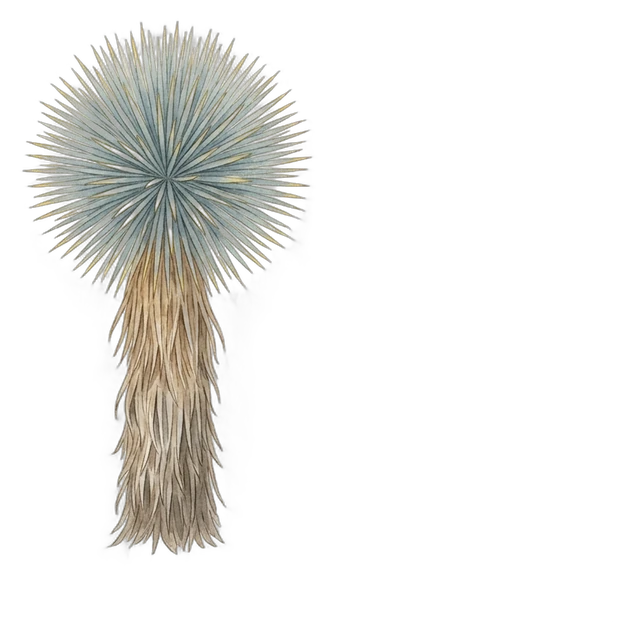
Dasylirion quadrangulatum, dasylirion, grass treeMexican grass tree (Dasylirion longissimum) is sown in seed trays from March to April or directly outdoors from April to May, and planted out from April to May and from September to October. Grow it in full sun, 150 cm apart, with little watering. Dates are for a mild temperate climate in the northern hemisphere; the calendar below adjusts them to your zone.
What else to sow in March, April and May
A sculptural, slow-growing plant that forms a huge spherical rosette of hundreds of very fine, stiff, linear leaves, bluish green or olive green, 1 to 1.5 m long and almost square in cross-section, with almost toothless edges, and a texture reminiscent of a giant pompom of grass. Over the years it develops a short trunk, 1 to 2 m tall, covered in the bases of old leaves. Mature plants, more than ten or fifteen years old, produce a flower spike 3 to 4 m tall with many small cream flowers that open in summer, on separate male and female plants. It is very tolerant of drought and heat, and withstands frosts of about -8 to -10 °C if the soil is dry, although it is safer in mild-climate areas. It is very popular in dry gardens and in large pots. It is not edible. Do not confuse it with the jonquil (Narcissus jonquilla), a toxic yellow-flowered bulb whose Spanish name is also ‘junquillo’, or with rushes (Juncus).
Family and origin: Asparagus family (Asparagaceae) · native to Deserts and dry hills of north-central Mexico (Querétaro, San Luis Potosí and Hidalgo); some botanists consider it a synonym of Dasylirion quadrangulatum · More plants from Mesoamerica
01In your area
How will it do in your garden?
Year calendar
| Task | J | F | M | A | M | J | J | A | S | O | N | D |
|---|---|---|---|---|---|---|---|---|---|---|---|---|
| Seed trayMar–Apr | no | no | yes | yes | no | no | no | no | no | no | no | no |
| Direct sowingApr–May | no | no | no | yes | yes | no | no | no | no | no | no | no |
| Plant / transplantApr–May, Sep–Oct | no | no | no | yes | yes | no | no | no | yes | yes | no | no |
Its life cycle at a glance
Swipe and tap a stage to see its details.
02Planting
Planting and transplanting
- TipIt is a slow and expensive plant: protect it from hard frosts when in small pots and avoid winter damp, which is what damages it most.
03Care
Care through the year
Sun and aspectFull sun · 8 h of sun · South or south-west, with nothing casting shade at midday
- Too little sun
- Ideal range
- Plenty of sun
South or south-west, with nothing casting shade at midday
Strong sun: Loves full midday sun and high temperatures.
Full sun and heat; in partial shade it stretches and loses its compact pompom shape. It copes well with summer heat and with hard frosts down to about -8 to -10 °C, provided the soil is very dry; winter damp is far more dangerous than cold.
- Common mistakeLack of light makes them stretch and go soft (etiolation).
WateringLet it dry out between waterings · summer: every 5-7 days
- Summerevery 5-7 days0.2 L per plant/week
- Spring / Autumnevery 10-14 days0.1 L per plant/week
- Winteronly in extreme drought (once a month)0 L per plant/week
Let it dry out between waterings: A Mediterranean favourite: better thirsty than overwatered.
Water sparingly: once established, it manages on rainfall along most of the coast and inland areas of the Iberian Peninsula. For the first two summers, give a deep watering every two to three weeks. Never water into the centre of the rosette, because it rots, and do not plant it in heavy soil or soil that waterlogs: it needs excellent drainage.
When to water? Push your finger 8 cm into the soil next to the base of the plant:
- Damp: soil sticks to your finger. Do not water yet. It has more than enough; wait for it to dry out more.
- Cool but clean, no mud. Wait another 1-2 days before watering.
- Dry and dusty. Water now, but moderately. Do not overdo it: it prefers thirst to excess.
- TipOnce established it needs almost no care: just remove very dry leaves, wearing gloves, because the edges are rough and the tips are sharp, and do not water in winter.
- TipWater thoroughly and leave long gaps: better thirsty than overwatered.
- Common mistakeWatering often rots the crown and the roots.
Soil and feedingpH 6–8 · Very gritty, free-draining mix
Very gritty, free-draining mix.
30 % multi-purpose compost · 40 % coarse sand · 30 % perlite or pumice.
Very high: standing moisture rots them.
This plant prefers a pH between 6.0 and 8.0 (slightly acidic to alkaline).
- Multi-purpose compost on its own with no drainage: rot sets in quickly.
- Watering the rosette or the leaves marks them and causes rot.
- TipPlant it in spring or autumn, in full sun, in sandy or stony, very free-draining soil, and leave room, because it reaches 1.5 m across.
- TipIn a pot, use a large, very free-draining container with cactus compost.
- TipVery free-draining mix (with sand/perlite) and pots with a drainage hole.
04Propagation
Make new plants
It is propagated almost only from seed, because the plant has a single trunk and rarely produces offsets. The seeds are taken from the flower spikes of pollinated female plants and sown in spring, shallowly, in a sandy, free-draining potting mix at about 18 to 25 °C; they come up in one to two months, often irregularly. Seedlings are very slow: they can take more than ten years to form a trunk and flower. The usual and easiest option is to buy a well-grown plant from a nursery.
Seeds: how to germinate them~30 days
05Uses and health
What it is used for, and with what care
WARNING: there are no reliable data on the toxicity of this species to people, dogs and cats, so to be safe do not eat it, and stop children and pets from chewing the leaves, stems or flowers. The leaves are stiff, with rough edges and very sharp tips, which can scratch, prick and injure the eyes: wear gloves and goggles when handling it and do not plant it next to paths, doors or play areas. Do not confuse it with the jonquil (Narcissus jonquilla), whose bulb is toxic.
- Properties
- It gives a strong presence with very little water and almost no care, withstands heat and drought and is very decorative all year round, even in large pots on sunny terraces.
- Uses
- It is not grown for eating and is not used in cooking or home remedies. Do not confuse it with other plants called junquillo in Spanish, and do not use its leaves or trunk as food. Some species of the same genus are used in Mexico to make the spirit sotol, a traditional, regulated process that is not done at home.
For guidance only; this is not medical treatment and does not replace advice from a doctor or vet.
06Companions and related plants