
Credits and licences
- #1 — vueltaalhuerto illustration
- #2 — vueltaalhuerto illustration
- #3 — vueltaalhuerto illustration
- #4 — vueltaalhuerto illustration
- #5 — vueltaalhuerto illustration
- #6 — vueltaalhuerto illustration
- #7 — vueltaalhuerto illustration
Male fern (Dryopteris filix-mas)
and 1 more names
fernMale fern (Dryopteris filix-mas) is sown in seed trays from March to April and from September to October, and planted out from March to April and from October to November. Grow it in shade, 60 cm apart, with moderate watering. Dates are for a mild temperate climate in the northern hemisphere; the calendar below adjusts them to your zone.
What else to sow in March, April, September and October
A hardy, robust fern, 60 to 120 cm tall, that forms a funnel- or shuttlecock-shaped clump of arching, mid-green, twice-divided fronds growing from a short, thick rhizome covered in brown scales. The young shoots appear in spring tightly coiled, like fiddleheads with golden scales, and the fronds stay green for most of the winter in mild climates, or die back with hard frosts. On the underside it has sori, rounded clusters of spores with a kidney-shaped cover, in two rows on each side of the midrib. It is a garden and woodland fern, not a houseplant: although it is sometimes sold as an indoor plant, inside the house, with central heating and dry air, it quickly weakens. It withstands severe cold, needs shade and cool, rich soil, and is one of the easiest ferns in humid areas. It is toxic and must not be eaten or used as a remedy. Do not confuse it with the lady fern (Athyrium filix-femina), which is finer and more delicate, or with bracken (Pteridium aquilinum), which is toxic and carcinogenic.
Family and origin: Wood fern family (Dryopteridaceae) · native to Temperate regions of the northern hemisphere; native to Spain, mainly in damp, shady woods in the north and in the mountains · More plants from Temperate Europe
01In your area
How will it do in your garden?
Year calendar
| Task | J | F | M | A | M | J | J | A | S | O | N | D |
|---|---|---|---|---|---|---|---|---|---|---|---|---|
| Seed trayMar–Apr, Sep–Oct | no | no | yes | yes | no | no | no | no | yes | yes | no | no |
| Plant / transplantMar–Apr, Oct–Nov | no | no | yes | yes | no | no | no | no | no | yes | yes | no |
| PruningFeb–Mar | no | yes | yes | no | no | no | no | no | no | no | no | no |
| Divide the clumpMar–Apr, Sep–Oct | no | no | yes | yes | no | no | no | no | yes | yes | no | no |
Its life cycle at a glance
Swipe and tap a stage to see its details.
02Care
Care through the year
Sun and aspectShade · 2 h of sun · shade in summer
- Too little sun
- Ideal range
- Plenty of sun
A cool north-facing spot or under the canopy of a deciduous tree
Gentle sun: Morning or afternoon sun. Midday summer sun stresses and scorches it.
Shade or partial shade; it tolerates some gentle early-morning sun if the soil is kept moist. Direct sun and drying wind scorch the fronds and turn them brown. It is an outdoor fern: in a pot, keep it in a shady patio or terrace, and do not keep it indoors all year round.
- TipIn the very hot, dry summers of inland and southern Spain it suffers and thins out: it needs a cool spot with plenty of shade.
- TipHumidity and shade: ideal indoors in bright spots without direct sun.
- Common mistakeDry air and direct sun scorch the fronds.
WateringMoist but never waterlogged · summer: 2 or 3 waterings a week in a pot; in the ground, when the surface dries
- Summer2 or 3 waterings a week in a pot; in the ground, when the surface dries1.2 L per plant/week
- Spring / Autumnevery 4-5 days0.6 L per plant/week
- Winteronly if it does not rain; in a pot, just enough to keep it from drying out0.2 L per plant/week
Moist but never waterlogged: Water before the surface is completely dry. Never puddles. Mulch: straw or dry plant material cuts watering by 30-50 %.
Keep the soil cool and moist, never waterlogged, with a mulch of leaf litter, compost or bark to retain moisture. In garden soil, once established, it can cope with short dry spells; in a pot it dries out sooner and the frond tips quickly turn brown.
When to water? Push your finger 3 cm into the soil next to the base of the plant:
- Damp: soil sticks to your finger. Do not water today. The moisture is fine.
- Cool but clean, no mud. Water early tomorrow if it stays like this, or this evening.
- Dry and dusty. Water now, and deeply. This is not where it likes to be.
- TipCut back old fronds in late winter, before the new fiddleheads appear, and top up the mulch every year.
- TipIf the fronds turn brown at the edges, it is almost always lack of moisture or too much sun and wind, not a disease.
Soil and feedingpH 5.5–7.5 · Acidic, spongy, moist mix
Acidic, spongy, moist mix.
50 % multi-purpose compost · 30 % coir · 20 % perlite.
Medium: constantly moist but airy.
This plant prefers a pH between 5.5 and 7.5 (slightly acidic to slightly alkaline).
- Mist the foliage several times a week in dry climates.
- A little worm castings every spring is enough.
- TipPlant it in loose, cool soil rich in organic matter, from neutral to slightly acidic, in the shade of trees or a wall, leaving about 60 cm between clumps.
- TipIn a pot, use a large container and a humus-rich potting mix, and do not let it dry out.
- TipKeep the potting mix always moist, never waterlogged.
PruningWhen: Feb–Mar
Pruning time for this plant: Feb–Mar.
03Propagation
Make new plants
The easiest and most reliable method is to divide the clump in spring or early autumn: split the thick rhizome into two or three pieces with a clean knife or spade, each with roots and at least one bud or frond, and replant them straight away. It can also be propagated from spores, collected from the underside of the fronds in late summer; this is a slow method, taking three to six months or more before plantlets appear, and it requires constant cleanliness and moisture. Do not dig up plants from the wild: buy it from a nursery or divide a clump from your own garden.
Seeds: how to germinate them~60 days
04Uses and health
What it is used for, and with what care
WARNING: the whole plant, especially the rhizome and the shoots, contains phloroglucinols such as filicin, and it is documented that eating it can cause nausea, vomiting, headache, visual disturbances and, in large amounts, severe poisoning. The rhizome extract was once used against tapeworm, a use abandoned because of its toxic effects: do not use it in home remedies. Keep children and pets away from the plant; in dogs, cats and livestock it can cause vomiting and digestive upset. If swallowed, call the doctor, the vet or the poison information service. Wash your hands after handling it. Do not confuse it with bracken (Pteridium aquilinum), which is toxic and carcinogenic.
- Properties
- It is a decorative, hardy fern, ideal for shady corners and cool soils, adding volume and texture to the garden and giving shelter to insects and small animals. It has no advisable home uses.
- Uses
- It is not edible: do not eat the fronds, the fiddleheads or the rhizome.
For guidance only; this is not medical treatment and does not replace advice from a doctor or vet.
05Companions and related plants
What to plant it with
Compare with similar varieties
| Variety | Sowing | Harvest | Days | Spacing | Difficulty |
|---|---|---|---|---|---|
| Blechnum (dwarf tree fern) | — | — | — | 40 cm | Moderate |
| Korean rock fern (Polystichum tsus-simense) | Mar–Apr, Sep–Oct | — | — | 30 cm | Easy |
| Staghorn fern | — | — | — | 40 cm | Moderate |
| Boston fern | — | — | — | 40 cm | Moderate |
| Java fern (Microsorum pteropus) | Mar–Jun, Sep | — | — | 15 cm | Easy |
| Male fern (Dryopteris filix-mas) | Mar–Apr, Sep–Oct | — | — | 60 cm | Easy |
| Bird's nest fern | — | — | — | 40 cm | Moderate |
| Rabbit's foot fern (Davallia) | Mar–Jun | — | — | 40 cm | Moderate |
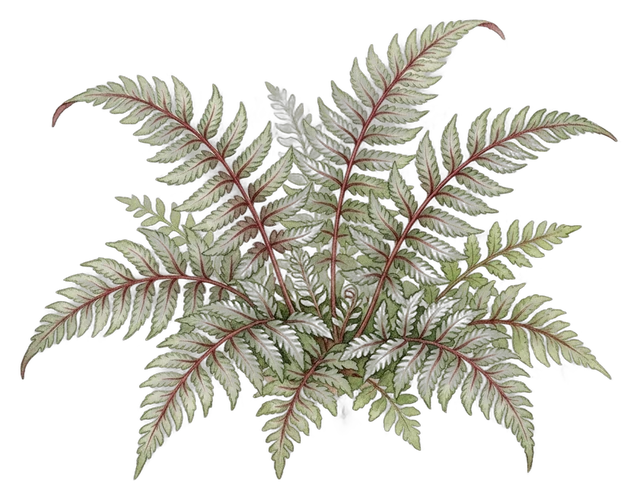
| Japanese painted fern (Athyrium) | Mar–Apr, Oct–Nov | — | — | 40 cm | Moderate |