
Credits and licences
- #1 — vueltaalhuerto illustration
- #2 — vueltaalhuerto illustration
- #3 — vueltaalhuerto illustration
- #4 — vueltaalhuerto illustration
- #5 — vueltaalhuerto illustration
- #6 — vueltaalhuerto illustration
- #7 — vueltaalhuerto illustration
Java fern (Microsorum pteropus)
and 3 more names
narrow leaf Java fern, aquarium fern, microsorumJava fern (Microsorum pteropus) is planted from March to June and in September. Grow it in shade, 15 cm apart, with plenty of watering. Dates are for a mild temperate climate in the northern hemisphere; the calendar below adjusts them to your zone.
Java fern is a fern with a creeping rhizome that lives attached to rocks and logs, in the water or just above it, and is one of the toughest and easiest aquarium plants. It forms clumps of entire, lance-shaped, leathery, dark green fronds between 10 and 30 cm long depending on the variety: the one sold as ‘Narrow’ has narrower fronds. It has no flowers or seeds; it is propagated by dividing the rhizome, from plantlets that sprout on old fronds and from spores, which show as brown dots on the underside. Kew (POWO) now accepts Leptochilus pteropus as the scientific name, although in the trade it is still sold as Microsorum or Microsorium. It is tied or glued to a stone or a piece of wood, without burying the rhizome, and also works in humid terrariums and paludariums. LEGAL AND SAFETY NOTICE: it is not on the Spanish Catalogue of Invasive Alien Species or on the European Union list, but it is a tropical aquarium plant that can take hold in warm waters, and fragments float and sprout: do not empty aquariums or throw plant waste into rivers, ponds, drains or irrigation ditches; put the pieces in the rubbish bin or the compost. There are no reliable data on its toxicity: do not eat it and wash your hands after handling it. Avoid buying loose plants of doubtful origin and do not collect wild plants.
Family and origin: Polypody family (Polypodiaceae) · native to South-East Asia (from southern China and India to Malaysia and Indonesia, including the island of Java), in streams and on damp, shady banks, attached to rocks and logs · More plants from Southeast Asia
01In your area
How will it do in your home?
Year calendar
| Task | J | F | M | A | M | J | J | A | S | O | N | D |
|---|---|---|---|---|---|---|---|---|---|---|---|---|
| Plant / transplantMar–Jun, Sep | no | no | yes | yes | yes | yes | no | no | yes | no | no | no |
| Divide the clumpMar–Sep | no | no | yes | yes | yes | yes | yes | yes | yes | no | no | no |
Its life cycle at a glance
Swipe and tap a stage to see its details.
02Care
Care through the year
Sun and aspectShade · 2 h of sun · A cool north-facing spot or under the canopy of a deciduous tree
- Too little sun
- Ideal range
- Plenty of sun
A cool north-facing spot or under the canopy of a deciduous tree
Gentle sun: Morning or afternoon sun. Midday summer sun stresses and scorches it.
Low to medium light, in shade. In an aquarium, gentle lighting is enough; with strong light, algae appear on the fronds.
- TipTurn the pot every week so it grows evenly towards the light.
WateringVery moist, tolerates waterlogging · summer: daily or every 2 days above 30 °C
- Summerdaily or every 2 days above 30 °C1.1 L per plant/week
- Spring / Autumnevery 3-4 days0.5 L per plant/week
- Winterevery 2 weeks if dry0.1 L per plant/week
Very moist, tolerates waterlogging: Saturated or nearly saturated soil. Still watch out for fungal disease. Mulch: straw or dry plant material cuts watering by 30-50 %.
It lives in water, with the rhizome above the substrate and fixed to rock or wood. Clean water at about 21-28 °C (below 20 °C it slows down), with a pH of 6 to 7.5. It also works in a very humid terrarium. Do not let the clump dry out.
This is a plant for waterlogged soil or pond margins: the finger test does not help, because the soil must stay wet all the time. Make sure the mud never dries out and, if it grows in a pond, that the water covers the base as the profile says; in summer, top up what evaporates.
- TipWith too much light or too many nutrients in the water it becomes covered in algae; reduce the light or clean it with a soft brush.
- TipAdjust watering to the light and the season: in winter almost all of them need much less water.
Potting mix and feedingpH 6–7.5 · Multi-purpose compost lightened with perlite
Multi-purpose compost lightened with perlite.
70 % multi-purpose compost · 20 % perlite · 10 % coir.
High: always a pot with a drainage hole and a shallow saucer.
This plant prefers a pH between 6.0 and 7.5 (slightly acidic to slightly alkaline).
- Repot every 2-3 years into a pot a finger's width wider, not much more.
- A handful of worm castings a year keeps the potting mix alive.
- Reusing old potting mix without refreshing it compacts and rots the roots.
- No drainage in the pot = waterlogged roots = dead plant.
- Common mistakePots without drainage waterlog the roots and rot the plant.
Common mistakes and tips
- TipNever bury the rhizome: it rots.
- TipTie it to the wood or a stone and leave it exposed.
- TipIf black patches or wilted fronds appear, remove those fronds.
- TipIn an aquarium it is tough and herbivorous fish do not usually eat it.
- TipThe temperature figures and dates are only a guide.
03Propagation
Make new plants
It is propagated by dividing the rhizome at any time of year: cut it with a clean knife into pieces with several fronds and fix them with thread or cyanoacrylate gel to a stone or a piece of wood, without burying them. Plantlets also sprout on the old fronds and are separated once they have roots; it can also be grown from spores, which is very slow.
Seeds: how to germinate them~60 days
04Uses and health
What it is used for, and with what care
There are no reliable data on its toxicity: do not eat it and do not let children or pets chew the fronds. LEGAL AND SAFETY NOTICE: it is not listed as invasive, but aquarium plants must not be released into rivers, ponds or drains: put plant waste in the rubbish bin or the compost.
- Properties
- An aquarium plant that gives shelter to fry and shrimps and absorbs nutrients from the water; herbivorous fish do not usually eat the fronds.
- Uses
- It is not grown to be eaten. It has no culinary uses.
For guidance only; this is not medical treatment and does not replace advice from a doctor or vet.
05Companions and related plants
What to plant it with
Good companions
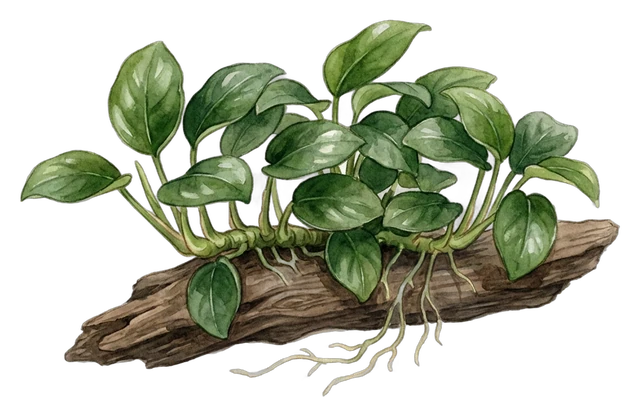
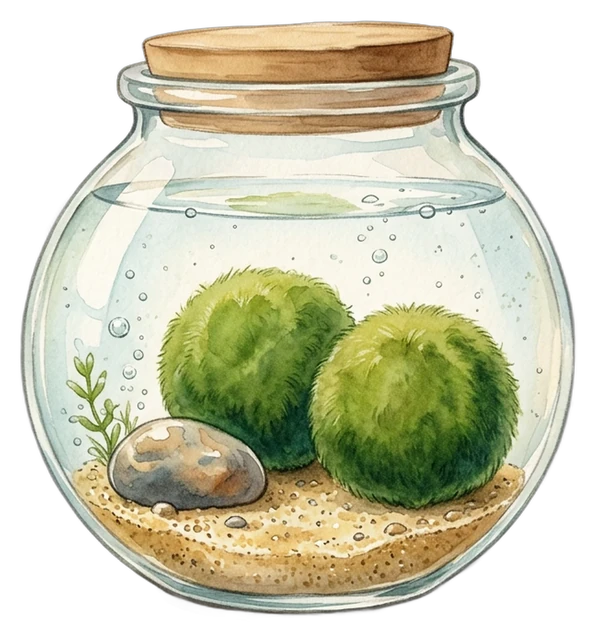
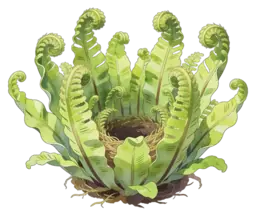
Compare with similar varieties
| Variety | Sowing | Harvest | Days | Spacing | Difficulty |
|---|---|---|---|---|---|
| Blechnum (dwarf tree fern) | — | — | — | 40 cm | Moderate |
| Korean rock fern (Polystichum tsus-simense) | Mar–Apr, Sep–Oct | — | — | 30 cm | Easy |
| Staghorn fern | — | — | — | 40 cm | Moderate |
| Boston fern | — | — | — | 40 cm | Moderate |
| Java fern (Microsorum pteropus) | Mar–Jun, Sep | — | — | 15 cm | Easy |
| Male fern (Dryopteris filix-mas) | Mar–Apr, Sep–Oct | — | — | 60 cm | Easy |
| Bird's nest fern | — | — | — | 40 cm | Moderate |
| Rabbit's foot fern (Davallia) | Mar–Jun | — | — | 40 cm | Moderate |
| Japanese painted fern (Athyrium) | Mar–Apr, Oct–Nov | — | — | 40 cm | Moderate |